If a comet void of all motion was let fall from the height SN, or S𝜇+^(2/3)I𝜇, towards the sun, and was still impelled to the sun by the same force uniformly continued by which it was impelled at first, the same, in one half of that time in which it might describe the arc AC in its own orbit, would, in descending describe a space equal to the length I𝜇.
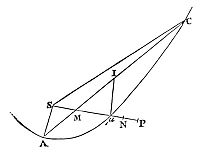
For in the same time that the comet would require to describe the parabolic arc AC, it would (by the last Lemma), with that velocity which it hath in the height SP, describe the chord AC: and, therefore (by Cor. 7, Prop. XVI, Book I), if it was in the same time supposed to revolve by the force of its own gravity in a circle whose semi-diameter was SP, it would describe an arc of that circle, the length of which would be to the chord of the parabolic arc AC in the subduplicate proportion of 1 to 2. Wherefore if with that weight, which in the height SP it hath towards the sun, it should fall from that height towards the sun, it would (by Cor. 9, Prop. XVI, Book I) in half the said time describe a space equal to the square of half the said chord applied to quadruple the height SP, that is, it would describe the space AI²/4SP. But since the weight of the comet towards the sun in the height SN is to the weight of the same towards the sun in the height SP as SP to S𝜇, the comet, by the weight which it hath in the height SN, in falling from that height towards the sun, would in the same time describe the space AI²/4S𝜇; that is, a space equal to the length I𝜇 or 𝜇M. Q.E.D.