“THERE are some, king Gelon, who think that the number of the sand is infinite in multitude; and I mean by the sand not only that which exists about Syracuse and the rest of Sicily but also that which is found in every region whether inhabited or uninhabited. Again there are some who, without regarding it as infinite, yet think that no number has been named which is great enough to exceed its multitude. And it is clear that they who hold this view, if they imagined a mass made up of sand in other respects as large as the mass of the earth, including in it all the seas and the hollows of the earth filled up to a height equal to that of the highest of the mountains, would be many times further still from recognising that any number could be expressed which exceeded the multitude of the sand so taken. But I will try to show you by means of geometrical proofs, which you will be able to follow, that, of the numbers named by me and given in the work which I sent to Zeuxippus, some exceed not only the number of the mass of sand equal in magnitude to the earth filled up in the way described, but also that of a mass equal in magnitude to the universe. Now you are aware that ‘universe’ is the name given by most astronomers to the sphere whose centre is the centre of the earth and whose radius is equal to the straight line between the centre of the sun and the centre of the earth. This is the common account , as you have heard from astronomers. But Aristarchus of Samos brought out a book consisting of some hypotheses, in which the premisses lead to the result that the universe is many times greater than that now so called. His hypotheses are that the fixed stars and the sun remain unmoved, that the earth revolves about the sun in the circumference of a circle, the sun lying in the middle of the orbit, and that the sphere of the fixed stars, situated about the same centre as the sun, is so great that the circle in which he supposes the earth to revolve bears such a proportion to the distance of the fixed stars as the centre of the sphere bears to its surface. Now it is easy to see that this is impossible; for, since the centre of the sphere has no magnitude, we cannot conceive it to bear any ratio whatever to the surface of the sphere. We must however take Aristarchus to mean this: since we conceive the earth to be, as it were, the centre of the universe, the ratio which the earth bears to what we describe as the ‘universe’ is the same as the ratio which the sphere containing the circle in which he supposes the earth to revolve bears to the sphere of the fixed stars. For he adapts the proofs of his results to a hypothesis of this kind, and in particular he appears to suppose the magnitude of the sphere in which he represents the earth as moving to be equal to what we call the ‘ universe.’
I say then that, even if a sphere were made up of the sand, as great as Aristarchus supposes the sphere of the fixed stars to be, I shall still prove that, of the numbers named in the Principles*, some exceed in multitude the number of the sand which is equal in magnitude to the sphere referred to, provided that the following assumptions be made.
1. The perimeter of the earth is about 3,000,000 stadia and not greater.
It is true that some have tried, as you are of course aware, to prove that the said perimeter is about 300,000 stadia. But I go further and, putting the magnitude of the earth at ten times the size that my predecessors thought it, I suppose its perimeter to be about 3,000,000 stadia and not greater.
2. The diameter of the earth is greater than the diameter of the moon, and the diameter of the sun is greater than the diameter of the earth.
In this assumption I follow most of the earlier astronomers.
It is true that, of the earlier astronomers, Eudoxus declared it to be about nine times as great, and Pheidias my father* twelve times, while Aristarchus tried to prove that the diameter of the sun is greater than 18 times but less than 20 times the diameter of the moon. But I go even further than Aristarchus, in order that the truth of my proposition may be established beyond dispute, and I suppose the diameter of the sun to be about 30 times that of the moon and not greater.
4. The diameter of the sun is greater than the side of the chiliagon inscribed in the greatest circle in the (sphere of the)
I make this assumption because Aristarchus discovered that the sun appeared to be about 1/720th part of the circle of the zodiac, and I myself tried, by a method which I will now describe, to find experimentally the angle subtended by the sun and having its vertex at the eye .”
[The rest of the work is here reproduced somewhat more freely. Archimedes next describes how he arrived at an upper and a lower limit for the angle subtended by the sun.]
He took a long rod , fastened a small cylinder to its end, and pointed the rod at the sun just after its rising, when it was possible to look directly at it. He then moved the cylinder to the distance at which it just concealed, and just failed to conceal, the sun, and measured the angles subtended by the cylinder. He also made a correction for the fact that “the eye does not see from a single point but from a certain area” .
The result of the experiment was to show that the angle subtended by the diameter of the sun was less than 1/164th, and greater than 1/200th, of a right angle.
To prove that (on this assumption) the diameter of the sun is greater than the side of a chiliagon, a figure of 1000 equal sides, inscribed in a great circle of the universe:
Suppose the plane of the paper passes through the centre of the sun, the centre of the earth, and the eye, at the moment when the sun has just risen. Let this plane cut the earth in the circle EHL and the sun in the circle FKG, the centres being C and O respectively, with E the position of the eye; and let it cut the sphere of the universe (centre C, radius CO) in the great circle AOB.
Draw from E two tangents to the circle FKG, touching it at P and Q, and from C two tangents touching it at F and G. Let CO meet the sections of the earth and sun in H and K; let CF, CG produced meet the great circle in A and B; and join EO, OF, OG, OP, OQ, and AB, with AB meeting CO in M.
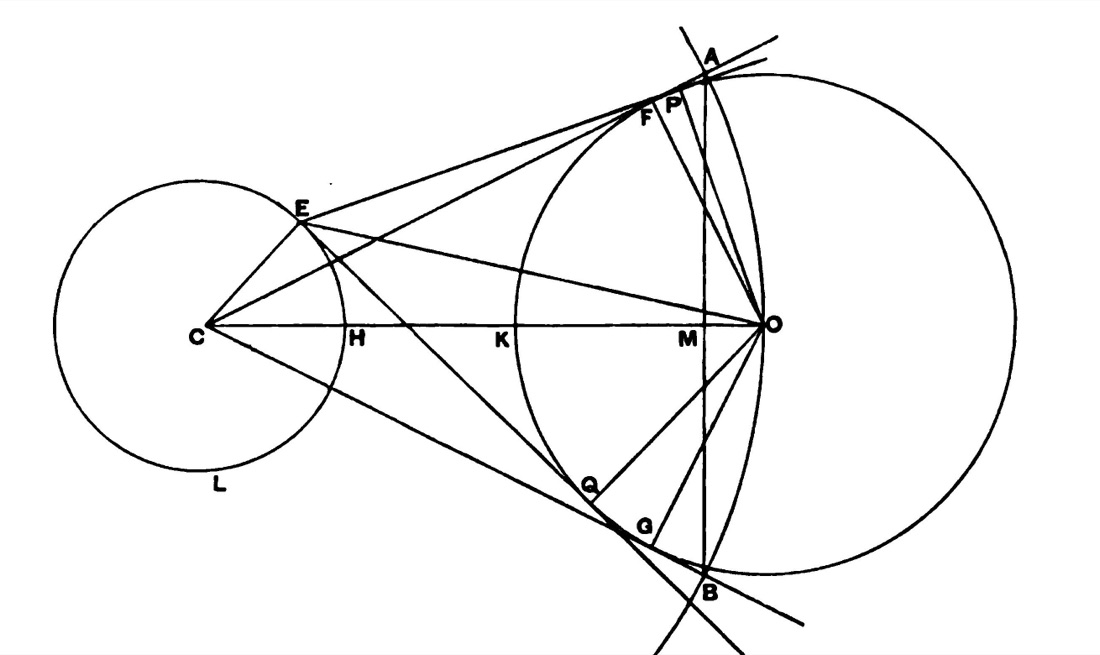
Now CO > EO, since the sun is just above the horizon; and R denotes a right angle.
The chord AB therefore subtends an arc less than 1/656 of the great circle, so AB is less than the side of a 656-sided polygon inscribed in it. Since the perimeter of any inscribed polygon is less than 44/7 of CO (by Measurement of a Circle, Proposition 3):
Since CA = CO, with AM perpendicular to CO and OF perpendicular to CA, AM = OF; hence AB = 2 AM = the diameter of the sun. Therefore:
For the lower limit, using a standard inequality relating angles to their tangents and sines[1], the same figure gives:
It follows that the arc AB is greater than 1/812 of the great circle, so AB is greater than the side of a chiliagon inscribed in it — which establishes the assumption. Archimedes then derives the size of the universe:
Assumption 5.
Suppose a quantity of sand taken not greater than a poppy-seed, and suppose that it contains not more than 10,000 grains. Next suppose the diameter of the poppy-seed to be not less than 1/40th of a finger-breadth.
Orders and periods of numbers.
I. We have traditional names for numbers up to a myriad (10,000); we can therefore express numbers up to a myriad myriads (100,000,000). Let these be called numbers of the first order. Take the 100,000,000 to be the unit of the second order, which then runs from that unit up to (100,000,000)². Let this in turn be the unit of the third order, ending with (100,000,000)³; and so on, until we reach the 100,000,000th order, ending with 100,000,000 raised to the 100,000,000th power, which we will call P.
The scheme is clearer expressed by indices. In the first period the orders run:
II. Let the numbers from 1 to P just described form the first period. Take P as the unit of the first order of the second period, running from P up to 100,000,000 P; the second order of that period ends with (100,000,000)² P; and so on, until the 100,000,000th order of the second period ends with P². III. Taking P² as the unit of the first order of the third period, we proceed in the same way until we reach P³. IV. Continuing thus, period after period, we arrive at last at the 100,000,000th order of the 100,000,000th period, ending with P raised to the 100,000,000th power.
This last number Archimedes names “a myriad-myriad units of the myriad-myriad-th order of the myriad-myriad-th period” , which is easily seen to be P raised to the 100,000,000th power. The extent of the scheme is prodigious: the last number of the first period alone would be written as 1 followed by 800,000,000 ciphers.
Octads.
Consider the terms in continued proportion 1, 10, 10², 10³, … — the powers of ten. The first octad of these terms (1, 10, …, 10⁷) falls under the first order of the first period; the second octad (10⁸, …, 10¹⁵) under the second order of the first period; and so on, the first term of each octad being the unit of the corresponding order. In the same way any number of octads can be placed.
Theorem.
If there be any number of terms of a series in continued proportion — say A₁, A₂, A₃, … with A₁ = 1 and A₂ = 10, so that the series is the geometrical progression 1, 10, 10², … — and if any two terms Aₘ, Aₙ be taken and multiplied, the product Aₘ·Aₙ will be a term in the same series, distant from Aₙ by as many terms as Aₘ is distant from A₁, and distant from A₁ by a number of terms less by one than the sum of the numbers of terms by which Aₘ and Aₙ are distant from A₁. In modern notation this is the law of exponents:
The proof: terms equally distant from other terms in a continued proportion are proportional, so
Application to the number of the sand.
By Assumption 5 the diameter of a poppy-seed is not less than 1/40th of a finger-breadth; and since spheres are to one another in the triplicate ratio of their diameters, a sphere one finger-breadth in diameter contains not more than 40³ = 64,000 poppy-seeds. Hence:
We now increase the diameter of the sphere, multiplying it by 100 each time. Since the volume is thereby multiplied by 100³ = 1,000,000, the number of grains contained in a sphere of each successive diameter is bounded as follows:
But the diameter of the ‘universe’ was shown to be less than 10,000,000,000 stadia. Hence the number of grains of sand that would fill a sphere the size of our ‘universe’ is less than 1,000 units of the seventh order of numbers — that is,
From this we can prove further that a sphere of the size Aristarchus attributed to the sphere of the fixed stars would contain a bounded number of grains as well. For by his hypothesis, as the earth is to the ‘universe,’ so is the ‘universe’ to the sphere of the fixed stars; and since the diameter of the ‘universe’ is less than 10,000 times that of the earth, the diameter of the sphere of the fixed stars is less than 10,000 times that of the ‘universe.’ Therefore that sphere is less than (10,000)³ times the ‘universe,’ and the grains of sand it could contain number less than 10,000,000 units of the eighth order — that is,
Conclusion.
“I conceive that these things, king Gelon, will appear incredible to the great majority of people who have not studied mathematics, but that to those who are conversant therewith and have given thought to the question of the distances and sizes of the earth the sun and moon and the whole universe the proof will carry conviction. And it was for this reason that I thought the subject would be not inappropriate for your consideration.”