Produce S𝜇 to N and P, so as 𝜇N may be one third of 𝜇I, and SP may be to SN as SN to S𝜇; and in the time that a comet would describe the arc A𝜇C, if it was supposed to move always forwards with the velocity which it hath in a height equal to SP, it would describe a length equal to the chord AC.
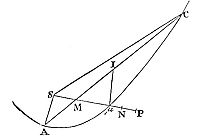
For if the comet with the velocity which it hath in 𝜇 was in the said time supposed to move uniformly forward in the right line which touches the parabola in 𝜇, the area which it would describe by a radius drawn to the point S would be equal to the parabolic area ASC𝜇A; and therefore the space contained under the length described in the tangent and the length S𝜇 would be to the space contained under the lengths AC and SM as the area ASC𝜇A to the triangle ASC, that is, as SN to SM. Wherefore AC is to the length described in the tangent as S𝜇 to SN. But since the velocity of the comet in the height SP (by Cor. 6, Prop. XVI., Book I) is to the velocity of the same in the height S𝜇 in the reciprocal subduplicate proportion of SP to S𝜇, that is, in the proportion of S𝜇 to SN, the length described with this velocity will be to the length in the same time described in the tangent as S𝜇 to SN. Wherefore since AC, and the length described with this new velocity, are in the same proportion to the length described in the tangent, they must be equal betwixt themselves. Q.E.D.
COR. Therefore a comet, with that velocity which it hath in the height S𝜇 +^(2/3)I𝜇, would in the same time describe the chord AC nearly.