From three observations given to determine the orbit of a comet moving in a parabola.
This being a Problem of very great difficulty, I tried many methods of resolving it; and several of these Problems, the composition whereof I have given in the first Book, tended to this purpose. But afterwards I contrived the following solution, which is something more simple.
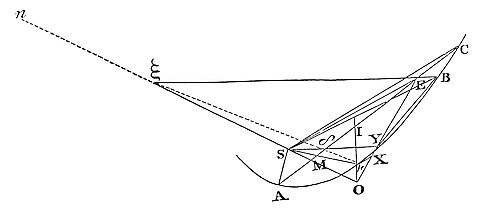
Select three observations distant one from another by intervals of time nearly equal; but let that interval of time in which the comet moves more slowly be somewhat greater than the other; so, to wit, that the difference of the times may be to the sum of the times as the sum of the times to about 600 days; or that the point E may fall upon M nearly, and may err therefrom rather towards I than towards A. If such direct observations are not at hand, a new place of the comet must be found, by Lem. VI.
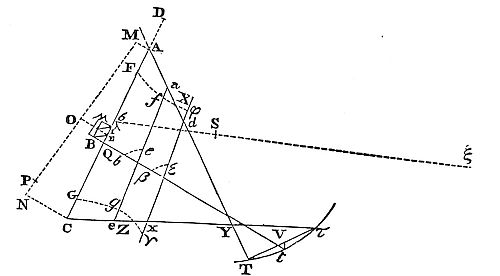
Let S represent the sun; T, t, 𝜏, three places of the earth in the orbis magnus; TA, tB, 𝜏C, three observed longitudes of the comet; V the time between the first observation and the second; W the time between the second and the third; X the length which in the whole time V + W the comet might describe with that velocity which it hath in the mean distance of the earth from the sun, which length is to be found by Cor. 3, Prop. XL, Book III; and tV a perpendicular upon the chord T𝜏. In the mean observed longitude tB take at pleasure the point B, for the place of the comet in the plane of the ecliptic; and from thence, towards the sun S, draw the line BE, which may be to the perpendicular tV as the content under SB and St2 to the cube of the hypothenuse of the right angled triangle, whose sides are SB, and the tangent of the latitude of the comet in the second observation to the radius tB. And through the point E (by Lemma VII) draw the right line AEC, whose parts AE and EC, terminating in the right lines TA and 𝜏C, may be one to the other as the times V and W: then A and C will be nearly the places of the comet in the plane of the ecliptic in the first and third observations, if B was its place rightly assumed in the second.
Upon AC, bisected in I, erect the perpendicular Ii. Through B draw the obscure line Bi parallel to AC. Join the obscure line Si, cutting AC in 𝜆, and complete the parallelogram iI 𝜆𝜇. Take I𝜎 equal to 3I𝜆; and through the sun S draw the obscure line 𝜎𝜉 equal to 3S𝜎+3i𝜆. Then, cancelling the letters A, E, C, I, from the point B towards the point 𝜉, draw the new obscure line BE, which may be to the former BE in the duplicate proportion of the distance BS to the quantity S𝜇+^(1/3)i𝜆. And through the point E draw again the right line AEC by the same rule as before; that is, so as its parts AE and EC may be one to the other as the times V and W between the observations. Thus A and C will be the places of the comet more accurately.
Upon AC, bisected in I, erect the perpendiculars AM, CN, IO, of which AM and CN may be the tangents of the latitudes in the first and third observations, to the radii TA and 𝜏C. Join MN, cutting IO in O. Draw the rectangular parallelogram iI𝜆𝜇, as before. In IA produced take ID equal to S𝜇+^(2/3)i𝜆. Then in MN, towards N, take MP, which may be to the above found length X in the subduplicate proportion of the mean distance of the earth from the sun (or of the semi-diameter of the orbis magnus) to the distance OD. If the point P fall upon the point N; A, B, and C, will be three places of the comet, through which its orbit is to be described in the plane of the ecliptic. But if the point P falls not upon the point N, in the right line AC take CG equal to NP, so as the points G and P may lie on the same side of the line NC.
By the same method as the points E, A, C, G, were found from the assumed point B, from other points b and 𝛽 assumed at pleasure, find out the new points e, a, c, g; and 𝜖, 𝛼, 𝜅, 𝜆. Then through G, g, and 𝜆, draw the circumference of a circle Gg𝜆, cutting the right line 𝜏C in Z: and Z will be one place of the comet in the plane of the ecliptic. And in AC, ac, 𝛼𝜅, making AF, af, 𝛼𝜙, equal respectively to CG, cg, 𝜅𝜆; through the points F, f, and 𝜙, draw the circumference of a circle Ff𝜙, cutting the right line AT in X; and the point X will be another place of the comet in the plane of the ecliptic. And at the points X and Z, erecting the tangents of the latitudes of the comet to the radii TX and 𝜏Z, two places of the comet in its own orbit will be determined. Lastly, if (by Prop. XIX., Book I) to the focus S a parabola is described passing through those two places, this parabola will be the orbit of the comet. Q.E.I.
The demonstration of this construction follows from the preceding Lemmas, because the right line AC is cut in E in the proportion of the times, by Lem. VII, as it ought to be, by Lem. VIII.; and BE, by Lem. XI., is a portion of the right line BS or B𝜉 in the plane of the ecliptic, intercepted between the arc ABC and the chord AEC; and MP (by Cor. Lem. X.) is the length of the chord of that arc, which the comet should describe in its proper orbit between the first and third observation, and therefore is equal to MN, providing B is a true place of the comet in the plane of the ecliptic.
But it will be convenient to assume the points B, b, 𝛽, not at random, but nearly true. If the angle AQt, at which the projection of the orbit in the plane of the ecliptic cuts the right line tB, is rudely known, at that angle with Bt draw the obscure line AC, which may be to ^(4/3)T𝜏 in the subduplicate proportion of SQ to St; and, drawing the right line SEB so as its part EB may be equal to the length Vt, the point B will be determined, which we are to use for the first time. Then, cancelling the right line AC, and drawing anew AC according to the preceding construction, and, moreover, finding the length MP, in tB take the point b, by this rule, that, if TA and 𝜏C intersect each other in Y, the distance Yb may be to the distance YB in a proportion compounded of the proportion of MP to MN, and the subduplicate proportion of SB to Sb. And by the same method you may find the third point 𝛽, if you please to repeat the operation the third time; but if this method is followed, two operations generally will be sufficient; for if the distance Bb happens to be very small, after the points F, f, and G, g, are found, draw the right lines Ff and Gg, and they will cut TA and 𝜏C in the points required, X and Z.
EXAMPLE.
Let the comet of the year 1680 be proposed. The following table shews the motion thereof, as observed by Flamsted, and calculated afterwards by him from his observations, and corrected by Dr. Halley from the same observations.
Time. Sun's
Longitude. Comet's
Appar. True.
Longitude. Lat. N.
h. '' h. ' '' ° ' '' ° ' '' ° ' ''
1680, Dec. 12 4.46 4.46. 0 ♑ 1.51.23 ♑ 6.32.30 8.28. 0
21 6.32^(1/2) 6.36.59 11.06.44 ♒ 5.08.12 21.42.13
24 6.12 6.17.52 14.09.26 18.49.23 25.23. 5
26 5.14 5.20.44 16.09.22 28.24.13 27.00.52
29 7.55 8.03.02 19.19.43 ♓ 13.10.41 28.09.58
30 8.02 8.10.26 20.21.09 17.38.20 28.11.53
1681, Jan. 5 5.51 6.01.38 26.22.18 ♈ 8.48.53 26.15. 7
9 6.49 7.00.53 ♒ 0.29.02 18.44.04 24.11.56
10 5.54 6.06.10 1.27.43 20.40.50 23.43.52
13 6.56 7.08.55 4.33.20 25.59.48 22.17.28
25 7.44 7.58.42 16.45.36 ♉ 9.35. 0 17.56.30
30 8.07 8.21.53 21.49.58 13.19.51 16.42.18
Feb. 2 6.20 6.34.51 24.46.59 15.13.53 16.04. 1
5 6.50 7.04.41 27.49.51 16.59.06 15.27. 3
To these you may add some observations of mine.
Ap.
Time. Comet's
Longitude. Lat. N.
h. ' ° ' '' ° ' ''
1681, Feb. 25 8.30 ♉︎ 26.18.35 12.46.46
27 8.15 27.04.30 12.36.12
Mar. 1 11. 0 27.52.42 12.23.40
2 8. 0 28.12.48 12.19.38
5 11.30 29.18. 0 12.03.16
7 9.30 ♊︎ 0. 4. 0 11.57. 0
9 8.30 0.43. 4 11.45.52
These observations were made by a telescope of 7 feet, with a micrometer and threads placed in the focus of the telescope; by which instruments we determined the positions both of the fixed stars among themselves, and of the comet in respect of the fixed stars. Let A represent the star of the fourth magnitude in the left heel of Perseus (Bayer's ο), B the following star of the third magnitude in the left foot (Bayer's 𝜁 ), C a star of the sixth magnitude (Bayer's 𝜂 ) in the heel of the same foot, and D, E, F, G, H, I, K, L, M, N, O, Z, 𝛼, 𝛽, 𝛾, 𝛿, other smaller stars in the same foot; and let p, P, Q, R, S, T, V, X, represent the places of the comet in the observations above set down; and, reckoning the distance AB of 80^(7/12) parts, AC was 52^(1/4) of those parts; BC, 58^(5/6); AD, 57^(5/12); BD, 82^(6/11); CD, 23^(2/3); AE, 29^(4/7); CE, 57^(1/2); DE, 49^(11/12); AI, 27^(7/12); BI, 52^(1/6); CI, 36^(7/12); DI, 53^(5/11); AK, 38^(2/3); BK, 43; CK, 31^(5/9); FK, 29; FB, 23; FC, 36^(1/4); AH, 18^(6/7); DH, 50^(7/8); BN, 46^(5/12); CN, 31^(1/3); BL, 45^(5/12); NL, 31^(5/7). HO was to HI as 7 to 6, and, produced, did pass between the stars D and E, so as the distance of the star D from this right line was ^(1/6)CD. LM was to LN as 2 to 9, and, produced, did pass through the star H. Thus were the positions of the fixed stars determined in respect of one another.
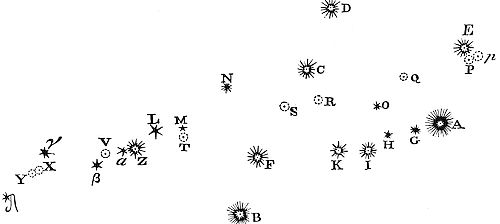
Mr. Pound has since observed a second time the positions of those fixed stars amongst themselves, and collected their longitudes and latitudes according to the following table.
The fixed
stars. Their
Longitudes. Latitute
North. The fixed
stars. Their
Longitudes. Latitute
North.
° ' '' ° ' ''
° ' '' ° ' ''
A ♉︎ 26.41.50 12. 8.36 L ♉︎ 29.33.34 12. 7.48
B 28.40.23 11.17.54 M 9.18.54 2. 7.20
C 27.58.30 12.40.25 N 28.48.29 2.31. 9
E 26.27.17 12.52. 7 Z 29.44.48 11.57.13
F 28.28.37 11.52.22 𝛼 29.52. 3 11.55.48
G 26.56. 8 12. 4.58 𝛽 ♊︎ 0. 8.23 11.48.56
H 27.11.45 12. 2. 1 𝛾 0.40.10 11.55.18
I 27.25. 2 11.53.11 𝛿 1. 3.20 11.30.42
K 27.42. 7 11.53.26
The positions of the comet to these fixed stars were observed to be as follow:
Friday, February 25, O.S. at 8^(1/2)^(ℎ). P.M. the distance of the comet in p from the star E was less than ^(3/13)AE, and greater than ^(1/5)AE, and therefore nearly equal to ^(3/14)AE; and the angle ApE was a little obtuse, but almost right. For from A, letting fall a perpendicular on pE, the distance of the comet from that perpendicular was ^(1/5)pE.
The same night, at 9^(1/2)^(ℎ)., the distance of the comet in P from the star E was greater than 1/(4^(1/2))AE, and less than 1/(5^(1/4))AE, and therefore nearly equal to 1/(4^(7/8)) of AE, or ^(8/39)AE. But the distance of the comet from the perpendicular let fall from the star A upon the right line PE was ^(4/5)PE.
Sunday, February 27, 8^(1/4)^(ℎ). P. M. the distance of the comet in Q, from the star O was equal to the distance of the stars O and H; and the right line QO produced passed between the stars K and B. I could not, by reason of intervening clouds, determine the position of the star to greater accuracy.
Tuesday, March 1, 11h. P. M. the comet in R lay exactly in a line between the stars K and C, so as the part CR of the right line CRK was a little greater than ^(1/3)CK, and a little less than ^(1/3)CK+^(1/8)CR, and therefore = ^(1/3)CK+^(1/16)CR, or ^(16/45)CK.
Wednesday, March 2, 8h. P. M. the distance of the comet in S from the star C was nearly ^(4/9)FC; the distance of the star F from the right line CS produced was ^(1/24)FC; and the distance of the star B from the same right line was five times greater than the distance of the star F; and the right line NS produced passed between the stars H and I five or six times nearer to the star H than to the star I.
Saturday, March 5, 11^(1/2)^(ℎ). P. M. when the comet was in T, the right line MT was equal to ^(1/2)ML, and the right line LT produced passed between B and F four or five times nearer to F than to B, cutting off from BF a fifth or sixth part thereof towards F: and MT produced passed on the outside of the space BF towards the star B four times nearer to the star B than to the star F. M was a very small star, scarcely to be seen by the telescope; but the star L was greater, and of about the eighth magnitude.
Monday, March 7, 9^(1/2)^(ℎ). P. M. the comet being in V, the right line V𝛼 produced did pass between B and F, cutting off, from BF towards F, ^(1/10) of BF, and was to the right line V𝛽 as 5 to 4. And the distance of the comet from the right line 𝛼𝛽 was ^(1/2)V𝛽.
Wednesday, March 9, 8^(1/2)^(ℎ). P. M. the comet being in X, the right line 𝛾X was equal to ^(1/2)𝛾𝛿; and the perpendicular let fall from the star 𝛿 upon the right 𝛾X was ^(2/5) of 𝛾𝛿.
The same night, at 12h. the comet being in Y, the right line 𝛾Y was equal to ^(1/3) of 𝛾𝛿, or a little less, as perhaps ^(5/16) of 𝛾𝛿; and a perpendicular let fall from the star 𝛿 on the right line 𝛾Y was equal to about ^(1/6) or ^(1/3)𝛾𝛿. But the comet being then extremely near the horizon, was scarcely discernible, and therefore its place could not be determined with that certainty as in the foregoing observations.
From these observations, by constructions of figures and calculations, I deduced the longitudes and latitudes of the comet; and Mr. Pound, by correcting the places of the fixed stars, hath determined more correctly the places of the comet, which correct places are set down above. Though my micrometer was none of the best, yet the errors in longitude and latitude (as derived from my observations) scarcely exceed one minute. The comet (according to my observations), about the end of its motion, began to decline sensibly towards the north, from the parallel which it described about the end of February.
Now, in order to determine the orbit of the comet out of the observations above described, I selected those three which Flamsted made, Dec. 21, Jan. 5, and Jan. 25; from which I found St of 9842,1 parts, and Vt of 455, such as the semi-diameter of the orbis magnus contains 10000. Then for the first observation, assuming tB of 5657 of those parts, I found SB 9747, BE for the first time 412, S𝜇 9503, i𝜆 413, BE for the second time 421, OD 10186, X 8528,4, PM 8450, MN 8475, NP 25; from whence, by the second operation, I collected the distance tb 5640; and by this operation I at last deduced the distances TX 4775 and 𝜏Z 11322. From which, limiting the orbit, I found its descending node in ♋, and ascending node in ♑ 1° 53'; the inclination of its plane to the plane of the ecliptic 61° 20 ^(1/3)^(′), the vertex thereof (or the perihelion of the comet) distant from the node 8° 38', and in ♐ 27° 43', with latitude 7° 34' south; its latus rectum 236,8; and the diurnal area described by a radius drawn to the sun 93585, supposing the square of the semi-diameter of the orbis magnus 100000000; that the comet in this orbit moved directly according to the order of the signs, and on Dec. 8d. 00h. 04' P. M. was in the vertex or perihelion of its orbit. All which I determined by scale and compass, and the chords of angles, taken from the table of natural sines, in a pretty large figure, in which, to wit, the radius of the orbis magnus (consisting of 10000 parts) was equal to 16^(1/3) inches of an English foot.
Lastly, in order to discover whether the comet did truly move in the orbit so determined, I investigated its places in this orbit partly by arithmetical operations, and partly by scale and compass, to the times of some of the observations, as may be seen in the following table:—
The Comet's
Dist.
from
sun. Longitude
computed. Latitud.
computed. Longitude
observed. Latitute
observed. Dif.
Lo. Dif.
Lat.
Dec. 12 2792 ♑ 6°.32' 8°.18 ^(1/2) ♑ 6°.31 ^(1/2) 8°.26 +1 - 7 ^(1/2)
29 8403 ♓ 13 .13 ^(2/3) 28. 00 ♓ 13.11 ^(3/4) 28 .10 ^(1/2) +2 -10 ^(1/12)
Feb. 5 16669 ♉ 17 .00 15. 29 ^(2/3) ♉ 16 .59 ^(7/8) 15 .27 ^(2/5) +0 + 2 ^(1/4)
Mar. 5 21737 29 .19 ^(3/4) 12. 4 29 .20 ^(6/7) 12 . 3 ^(1/2) -1 + ^(1/2)
But afterwards Dr. Halley did determine the orbit to a greater accuracy by an arithmetical calculus than could be done by linear descriptions; and, retaining the place of the nodes in ♋ and ♑ 1° 53' and the inclination of the plane of the orbit to the ecliptic 61° 20^(1/3)^(′), as well as the time of the comet's being in perihelion, Dec. 8d. 00h. 04' he found the distance of the perihelion from the ascending node measured in the comet's orbit 9° 20', and the latus rectum of the parabola 2430 parts, supposing the mean distance of the sun from the earth to be 100000 parts; and from these data, by an accurate arithmetical calculus, he computed the places of the comet to the times of the observations as follows:—
The Comet's
True time. Dist. from
the sun. Longitude
computed. Latitude
computed. Errors in
Long.
Lo. Lat.
Lat.
d. h. ' ''
° ' '' ° ' '' ' '' ' ''
Dec. 12. 4.46. 28028 ♑︎ 6.29.25 8.26. 0 bor. -3. 5 -2. 0
21. 6.37. 61076 ♒︎ 5. 6.30 21.43.20 -1.42 +1. 7
24. 6.18. 70008 18.48.20 25.22.40 -1. 3 -0.25
26. 5.20. 75576 28.22.45 27. 1.36 -1.28 +0.44
29. 8. 3. 84021 ♓︎ 13.12.40 28.10.10 +1.59 +0.12
30. 8.10. 86661 17.40. 5 28.11.20 +1.45 -0.33
Jan. 5. 6. 1. ^(1/2) 101440 ♈︎ 8.49.49 26.15.15 +0.56 +0. 8
9. 7. 0. 110959 18.44.36 24.12.54 +0.32 +0.58
10. 6. 6. 113162 20.41. 0 23.44.10 +0.10 +0.18
13. 7. 9. 120000 26. 0.21 22.17.30 +0.33 +0. 2
25. 7.59. 145370 ♉︎ 9.33.40 17.57.55 -1.20 +1.25
30. 8.22. 155303 13.17.41 16.42. 7 -2.10 -0.11
Feb. 2. 6.35. 160951 15.11.11 16. 4.15 -2.42 +0.14
5. 7. 4. ^(1/2) 166686 16.58.55 15.29.13 -0.41 +2. 0
25. 8.41. 202570 26.15.46 12.48. 0 -2.49 +1.10
Mar. 5.11.39. 216205 29.18.35 12. 5.40 +0.35 +2.14
This comet also appeared in the November before, and at Coburg, in Saxony, was observed by Mr. Gottfried Kirch, on the 4th of that month, on the 6th and 11th O. S.; from its positions to the nearest fixed stars observed with sufficient accuracy, sometimes with a two feet, and sometimes with a ten feet telescope; from the difference of longitudes of Coburg and London; 11°; and from the places of the fixed stars observed by Mr. Pound, Dr. Halley has determined the places of the comet as follows:—
Nov. 3, 17h. 2', apparent time at London, the comet was in ♌ 29 deg. 51', with 1 deg. 17' 45'' latitude north.
November 5, 15h. 58' the comet was in ♍ 3° 23', with 1° 6' lat. north.
November 10, 16h. 31', the comet was equally distant from two stars in ♌, which are 𝜎 and 𝜏 in Bayer; but it had not quite touched the right line that joins them, but was very little distant from it. In Flamsted's catalogue this star 𝜎 was then in ♍︎ 14° 15', with 1 deg. 41' lat. north nearly, and 𝜏 in ♍ 17° 3^(1/2)^(′) with 0 deg. 34' lat. south; and the middle point between those stars was ♍ 15° 39^(1/4)^(′), with 0° 33^(1/2)^(′) lat. north. Let the distance of the comet from that right line be about 10' or 12'; and the difference of the longitude of the comet and that middle point will be 7'; and the difference of the latitude nearly 7^(1/2)^(′); and thence it follows that the comet was in ♍ 15° 32', with about 26' lat. north.
The first observation from the position of the comet with respect to certain small fixed stars had all the exactness that could be desired; the second also was accurate enough. In the third observation, which was the least accurate, there might be an error of 6 or 7 minutes, but hardly greater. The longitude of the comet, as found in the first and most accurate observation, being computed in the aforesaid parabolic orbit, comes out ♌ 29° 30' 22'', its latitude north 1° 25' 7'', and its distance from the sun 115546.
Moreover, Dr. Halley, observing that a remarkable comet had appeared four times at equal intervals of 575 years (that is, in the month of September after Julius Cæsar was killed; An. Chr. 531, in the consulate of Lampadius and Orestes; An. Chr. 1106, in the month of February; and at the end of the year 1680; and that with a long and remarkable tail, except when it was seen after Cæsar's death, at which time, by reason of the inconvenient situation of the earth, the tail was not so conspicuous), set himself to find out an elliptic orbit whose greater axis should be 1382957 parts, the mean distance of the earth from the sun containing 10000 such; in which orbit a comet might revolve in 575 years; and, placing the ascending node in ♋ 2° 2', the inclination of the plane of the orbit to the plane of the ecliptic in an angle of 61° 6' 48'', the perihelion of the comet in this plane in ♐ 22° 44' 25'', the equal time of the perihelion December 7d. 23h. 9', the distance of the perihelion from the ascending node in the plane of the ecliptic 9° 17' 35'', and its conjugate axis 18481,2, he computed the motions of the comet in this elliptic orbit. The places of the comet, as deduced from the observations, and as arising from computation made in this orbit, may be seen in the following table.
True time. Longitude
observed. Latit'de
North
obs. Longitude
comp. Latitude
computed. Errors in
Long.
Lo. Lat.
Lat.
d. h. ' '' ° ' '' ° ' '' ° ' '' ' '' ' '' ' ''
Nov. 3.16.47 ♌ 29.51. 0 1.17.45 ♌ 29.51.22 1.17.32 N +0.22 -0.13
5.15.37 ♍ 3.23. 0 1. 6. 0 ♍ 3.24.32 1. 6. 9 +1.32 +0. 9
10.16.18 15.32. 0 0.27. 0 15.33. 2 0.25. 7 +1. 2 -1.53
16.17.00
♎ 8.16.45 0.53. 7 S
18.21.34
18.52.15 1.26.54
20.17. 0
28.10.36 1.53.35
23.17. 5
♏ 13.22.42 2.29. 0
Dec. 12. 4.46 ♑ 6.32.30 8.28. 0 ♑ 6.31.20 8.29. 6 N -1.10 +1. 6
21. 6.37 ♒ 5. 8.12 21.42.13 ♒ 5. 6.14 21.44.42 -1.58 +2.29
24. 6.18 18.49.23 25.23. 5 18.47.30 25.23.35 -1.53 +0.30
26. 5.21 28.24.13 27. 0.52 28.21.42 27. 2. 1 -2.31 +1. 9
29. 8. 3 ♓ 13.10.41 28. 9.58 ♓ 13.11.14 28.10.38 +0.33 +0.40
30. 8.10 17.38. 0 28.11.53 17.38.27 28.11.37 +0. 7 -0.16
Jan. 5. 6. 1 ^(1/2) ♈ 8.48.53 26.15. 7 ♈ 8.48.51 26.14.57 -0. 2 -0.10
9. 7. 1 18.44. 4 24.11.56 18.43.51 24.12.17 -0.13 +0.21
10. 6. 6 20.40.50 23.43.32 20.40.23 23.43.25 -0.27 -0. 7
13. 7. 9 25.59.48 22.17.28 26. 0. 8 22.16.32 +0.20 -0.56
25. 7.59 ♉ 9.35. 0 17.56.30 ♉ 9.34.11 17.56. 6 -0.49 -0.24
30. 8.22 13.19.51 16.42.18 13.18.28 16.40. 5 -1.23 -2.13
Feb. 2. 6.35 15.13.53 16. 4. 1 15.11.59 16. 2.17 -1.54 -1.54
5. 7. 4 ^(1/2) 16.59. 6 15.27. 3 16.59.17 15.27. 0 +0.11 -0. 3
25. 8.41 26.18.35 12.46.46 26.16.59 12.45.22 -1.36 -1.24
Mar. 1.11.10 27.52.42 12.23.40 27.51.47 12.22.28 -0.55 -1.12
5.11.39 29.18. 0 12. 3.16 29.20.11 12. 2.50 +2.11 -0.26
9. 8.38 ♊ 0.43. 4 ♊.45.52 ♊ 0.42.43 11.45.35 -0.21 -0.17
The observations of this comet from the beginning to the end agree as perfectly with the motion of the comet in the orbit just now described as the motions of the planets do with the theories from whence they are calculated; and by this agreement plainly evince that it was one and the same comet that appeared all that time, and also that the orbit of that comet is here rightly defined.
In the foregoing table we have omitted the observations of Nov. 16, 18, 20, and 23, as not sufficiently accurate, for at those times several persons had observed the comet. Nov. 17, O. S. Ponthæus and his companions, at 6h. in the morning at Rome (that is, 5h. 10' at London), by threads directed to the fixed stars, observed the comet in ♎ 8° 30', with latitude 0° 40' south. Their observations may be seen in a treatise which Ponthæus published concerning this comet. Cellius, who was present, and communicated his observations in a letter to Cassini, saw the comet at the same hour in ♎ 8° 30', with latitude 0° 30' south. It was likewise seen by Galletius at the same hour at Avignon (that is, at 5h. 42' morning at London) in ♎ 8° without latitude. But by the theory the comet was at that time in ♎ 8° 16' 45'', and its latitude was 0° 53' 7'' south.
Nov. 18, at 6h. 30' in the morning at Rome (that is, at 5h. 40' at London), Ponthæus observed the comet in ♎ 13° 30', with latitude 1° 20' south; and Cellius in ♎ 13° 30', with latitude 1° 00' south. But at 5h. 30' in the morning at Avignon, Galletius saw it in ♎ 13° 00' with latitude 1° 00' south. In the University of La Fleche, in France, at 5h. in the morning (that is, at 5h. 9' at London), it was seen by P. Ango, in the middle between two small stars, one of which is the middle of the three which lie in a right line in the southern hand of Virgo, Bayers 𝜓; and the other is the outmost of the wing, Bayer's 𝜃. Whence the comet was then in ♎ 12° 46' with latitude 50' south. And I was informed by Dr. Halley, that on the same day at Boston in New England, in the latitude of 42^(1/2) deg. at 5h. in the morning (that is, at 9h. 44' in the morning at London), the comet was seen near ♎ 14°, with latitude 1° 30' south.
Nov. 19, at 4^(1/2)^(ℎ). at Cambridge, the comet (by the observation of a young man) was distant from Spica ♍ about 2° towards the north west. Now the spike was at that time in ♎ 19° 23' 47'', with latitude 2° 1' 59'' south. The same day, at 5h. in the morning, at Boston in New England, the comet was distant from Spica ♍ 1°, with the difference of 40' in latitude. The same day, in the island of Jamaica, it was about 1° distant from Spica ♍. The same day, Mr. Arthur Storer, at the river Patuxent, near Hunting Creek, in Maryland, in the confines of Virginia, in lat. 38^(1/2) °, at 5 in the morning (that is, at 10h. at London), saw the comet above Spica ♍, and very nearly joined with it, the distance between them being about ^(3/4) of one deg. And from these observations compared, I conclude, that at 9h. 44' at London, the comet was in ♎ 18° 50', with about 1° 25' latitude south. Now by the theory the comet was at that time in ♎ 18° 52' 15'', with 1° 26' 54'' lat. south.
Nov. 20, Montenari, professor of astronomy at Padua, at 6h. in the morning at Venice (that is, 5h. 10' at London), saw the comet in ♎ 23°, with latitude 1° 30' south. The same day, at Boston, it was distant from Spica ♍ by about 4° of longitude east, and therefore was in ♎ 23° 24' nearly.
Nov. 21, Ponthæus and his companions, at 7^(1/4)^(ℎ). in the morning, observed the comet in ♎ 27° 50', with latitude 1° 16' south; Cellius, in ♎ 28°; P. Ango at 5h. in the morning, in ♎ 27° 45'; Montenari in ♎ 27° 51'. The same day, in the island of Jamaica, it was seen near the beginning of ♏, and of about the same latitude with Spica ♍, that is, 2° 2'. The same day, at 5h. morning, at Ballasore, in the East Indies (that is, at 11h. 20' of the night preceding at London), the distance of the comet from Spica ♍ was taken 7° 35' to the east. It was in a right line between the spike and the balance, and therefore was then in ♎ 26° 58', with about 1° 11' lat. south; and after 5h. 40' (that is, at 5h. morning at London), it was in ♎ 28° 12', with 1° 16' lat. south. Now by the theory the comet was then in ♎ 28° 10' 36'', with 1° 53' 35'' lat. south.
Nov. 22, the comet was seen by Montenari in ♏ 2° 33'; but at Boston in New England, it was found in about ♏ 3°, and with almost the same latitude as before, that is, 1° 30'. The same day, at 5h. morning at Ballasore, the comet was observed in ♏ 1° 50'; and therefore at 5h. morning at London, the comet was in ♏ 3° 5' nearly. The same day, at 6^(1/2)^(ℎ). in the morning at London, Dr. Hook observed it in about ♏ 3° 30', and that in the right line which passeth through Spica ♍ and Cor Leonis; not, indeed, exactly, but deviating a little from that line towards the north. Montenari likewise observed, that this day, and some days after, a right line drawn from the comet through Spica passed by the south side of Cor Leonis at a very small distance therefrom. The right line through Cor Leonis and Spica ♍ did cut the ecliptic in ♍ 3° 46' at an angle of 2° 51'; and if the comet had been in this line and in ♏ 3°, its latitude would have been 2° 26'; but since Hook and Montenari agree that the comet was at some small distance from this line towards the north, its latitude must have been something less. On the 20th, by the observation of Montenari, its latitude was almost the same with that of Spica ♍, that is, about 1° 30'. But by the agreement of Hook, Montenari, and Ango, the latitude was continually increasing, and therefore must now, on the 22d, be sensibly greater than 1° 30'; and, taking a mean between the extreme limits but now stated, 2° 26' and 1° 30', the latitude will be about 1° 58'. Hook and Montenari agree that the tail of the comet was directed towards Spica ♍, declining a little from that star towards the south according to Hook, but towards the north according to Montenari; and, therefore, that declination was scarcely sensible; and the tail, lying nearly parallel to the equator, deviated a little from the opposition of the sun towards the north.
Nov. 23, O. S. at 5h. morning, at Nuremberg (that is, at 4^(1/2)^(ℎ). at London), Mr. Zimmerman saw the comet in ♏ 8° 8', with 2° 31' south lat. its place being collected by taking its distances from fixed stars.
Nov. 24, before sun-rising, the comet was seen by Montenari in ♏ 12° 52' on the north side of the right line through Cor Leonis and Spica ♍, and therefore its latitude was something less than 2° 38'; and since the latitude, as we said, by the concurring observations of Montenari, Ango, and Hook, was continually increasing, therefore, it was now, on the 24th, something greater than 1° 58'; and, taking the mean quantity, may be reckoned 2° 18', without any considerable error. Ponthæus and Galletius will have it that the latitude was now decreasing; and Cellius, and the observer in New England, that it continued the same, viz., of about 1°, or 1^(1/2) °. The observations of Ponthæus and Cellius are more rude, especially those which were made by taking the azimuths and altitudes; as are also the observations of Galletius. Those are better which were made by taking the position of the comet to the fixed stars by Montenari, Hook, Ango, and the observer in New England, and sometimes by Ponthæus and Cellius. The same day, at 5h. morning, at Ballasore, the comet was observed in ♏ 11° 45'; and, therefore, at 5h. morning at London, was in ♏ 13° nearly. And, by the theory, the comet was at that time in ♏ 13° 22' 42''.
Nov. 25, before sunrise, Montenari observed the comet in ♏ 17^(3/4) ° nearly; and Cellius observed at the same time that the comet was in a right line between the bright star in the right thigh of Virgo and the southern scale of Libra; and this right line cuts the comet's way in ♏ 18° 36'. And, by the theory, the comet was in ♏ 18^(1/3) ° nearly.
From all this it is plain that these observations agree with the theory, so far as they agree with one another; and by this agreement it is made clear that it was one and the same comet that appeared all the time from Nov. 4 to Mar. 9. The path of this comet did twice cut the plane of the ecliptic, and therefore was not a right line. It did cut the ecliptic not in opposite parts of the heavens, but in the end of Virgo and beginning of Capricorn, including an arc of about 98°; and therefore the way of the comet did very much deviate from the path of a great circle; for in the month of Nov. it declined at least 3° from the ecliptic towards the south; and in the month of Dec. following it declined 29° from the ecliptic towards the north; the two parts of the orbit in which the comet descended towards the sun, and ascended again from the sun, declining one from the other by an apparent angle of above 30°, as observed by Montenari. This comet travelled over 9 signs, to wit, from the last deg. of ♌ to the beginning of ♊, beside the sign of ♌, through which it passed before it began to be seen; and there is no other theory by which a comet can go over so great a part of the heavens with a regular motion. The motion of this comet was very unequable; for about the 20th of Nov. it described about 5° a day. Then its motion being retarded between Nov. 26 and Dec. 12, to wit, in the space of 15^(1/2) days, it described only 40°. But the motion thereof being afterwards accelerated, it described near 5° a day, till its motion began to be again retarded. And the theory which justly corresponds with a motion so unequable, and through so great a part of the heavens, which observes the same laws with the theory of the planets, and which accurately agrees with accurate astronomical observations, cannot be otherwise than true.
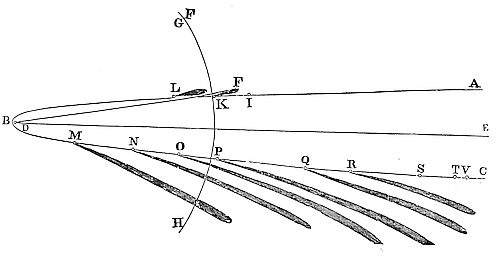
And, thinking it would not be improper, I have given a true representation of the orbit which this comet described, and of the tail which it emitted in several places, in the annexed figure; protracted in the plane of the trajectory. In this scheme ABC represents the trajectory of the comet, D the sun, DE the axis of the trajectory, DF the line of the nodes, GH the intersection of the sphere of the orbis magnus with the plane of the trajectory, I the place of the comet Nov. 4, Ann. 1680; K the place of the same Nov. 11; L the place of the same Nov. 19; M its place Dec. 12; N its place Dec. 21; O its place Dec. 29; P its place Jan. 5 following; Q its place Jan. 25; R its place Feb. 5; S its place Feb. 25; T its place March 5; and V its place March 9. In determining the length of the tail, I made the following observations.
Nov. 4 and 6, the tail did not appear; Nov. 11, the tail just begun to shew itself, but did not appear above ^(1/2) deg. long through a 10 feet telescope; Nov. 17, the tail was seen by Ponthæus more than 15° long; Nov. 18, in New-England, the tail appeared 30° long, and directly opposite to the sun, extending itself to the planet Mars, which was then in ♍, 9° 54'; Nov. 19. in Maryland, the tail was found 15° or 20° long; Dec. 10 (by the observation of Mr. Flamsted), the tail passed through the middle of the distance intercepted between the tail of the Serpent of Ophiuchus and the star 𝛿 in the south wing of Aquila, and did terminate near the stars A, 𝜔, b, in Bayer's tables. Therefore the end of the tail was in ♑ 19^(1/2) °, with latitude about 34^(1/4) ° north; Dec. 11, it ascended to the head of Sagitta (Bayer's 𝛼, 𝛽 ), terminating in ♑ 26° 43' with latitude 38° 34' north; Dec. 12, it passed through the middle of Sagitta, nor did it reach much farther; terminating in ♒ 4°, with latitude 42^(1/2) ° north nearly. But these things are to be understood of the length of the brighter part of the tail; for with a more faint light, observed, too, perhaps, in a serener sky, at Rome, Dec. 12, 5h. 40', by the observation of Ponthæus, the tail arose to 10° above the rump of the Swan, and the side thereof towards the west and towards the north was 45' distant from this star. But about that time the tail was 3° broad towards the upper end; and therefore the middle thereof was 2° 15' distant from that star towards the south, and the upper end was ♓ in 22°, with latitude 61° north; and thence the tail was about 70° long; Dec. 21, it extended almost to Cassiopeia's chair, equally distant from 𝛽 and from Schedir, so as its distance from either of the two was equal to the distance of the one from the other, and therefore did terminate in ♈ 24°, with latitude 47^(1/2) °; Dec. 29, it reached to a contact with Scheat on its left, and exactly filled up the space between the two stars in the northern foot of Andromeda, being 54° in length; and therefore terminated in ♉ 19°, with 35° of latitude;
Jan. 5, it touched the star 𝜋 in the breast of Andromeda on its right side, and the star 𝜇 of the girdle on its left; and, according to our observations, was 40° long; but it was curved, and the convex side thereof lay to the south; and near the head of the comet it made an angle of 4° with the circle which passed through the sun and the comet's head; but towards the other end it was inclined to that circle in an angle of about 10° or 11°; and the chord of the tail contained with that circle an angle of 8°. Jan. 13, the tail terminated between Alamech and Algol, with a light that was sensible enough; but with a faint light it ended over against the star 𝜅 in Perseus's side. The distance of the end of the tail from the circle passing through the sun and the comet was 3° 50'; and the inclination of the chord of the tail to that circle was 8^(1/2) °. Jan. 25 and 26, it shone with a faint light to the length of 6° or 7°; and for a night or two after, when there was a very clear sky, it extended to the length of 12°, or something more, with a light that was very faint and very hardly to be seen; but the axis thereof was exactly directed to the bright star in the eastern shoulder of Auriga, and therefore deviated from the opposition of the sun towards the north by an angle of 10°. Lastly, Feb. 10, with a telescope I observed the tail 2° long; for that fainter light which I spoke of did not appear through the glasses. But Ponthæus writes, that, on Feb. 7, he saw the tail 12° long. Feb. 25, the comet was without a tail, and so continued till it disappeared.
Now if one reflects upon the orbit described, and duly considers the other appearances of this comet, he will be easily satisfied that the bodies of comets are solid, compact, fixed, and durable, like the bodies of the planets; for if they were nothing else but the vapours or exhalations of the earth, of the sun, and other planets, this comet, in its passage by the neighbourhood of the sun, would have been immediately dissipated; for the heat of the sun is as the density of its rays, that is, reciprocally as the square of the distance of the places from the sun. Therefore, since on Dec. 8, when the comet was in its perihelion, the distance thereof from the centre of the sun was to the distance of the earth from the same as about 6 to 1000, the sun's heat on the comet was at that time to the heat of the summer-sun with us as 1000000 to 36, or as 28000 to 1. But the heat of boiling water is about 3 times greater than the heat which dry earth acquires from the summer-sun, as I have tried; and the heat of red-hot iron (if my conjecture is right) is about three or four times greater than the heat of boiling water. And therefore the heat which dry earth on the comet, while in its perihelion, might have conceived from the rays of the sun, was about 2000 times greater than the heat of red-hot iron. But by so fierce a heat, vapours and exhalations, and every volatile matter, must have been immediately consumed and dissipated.
This comet, therefore, must have conceived an immense heat from the sun, and retained that heat for an exceeding long time; for a globe of iron of an inch in diameter, exposed red-hot to the open air, will scarcely lose all its heat in an hour's time; but a greater globe would retain its heat longer in the proportion of its diameter, because the surface (in proportion to which it is cooled by the contact of the ambient air) is in that proportion less in respect of the quantity of the included hot matter; and therefore a globe of red hot iron equal to our earth, that is, about 40000000 feet in diameter, would scarcely cool in an equal number of days, or in above 50000 years. But I suspect that the duration of heat may, on account of some latent causes, increase in a yet less proportion than that of the diameter; and I should be glad that the true proportion was investigated by experiments.
It is farther to be observed, that the comet in the month of December, just after it had been heated by the sun, did emit a much longer tail, and much more splendid, than in the month of November before, when it had not yet arrived at its perihelion; and, universally, the greatest and most fulgent tails always arise from comets immediately after their passing by the neighbourhood of the sun. Therefore the heat received by the comet conduces to the greatness of the tail: from whence, I think I may infer, that the tail is nothing else but a very fine vapour, which the head or nucleus of the comet emits by its heat.
But we have had three several opinions about the tails of comets; for some will have it that they are nothing else but the beams of the sun's light transmitted through the comets' heads, which they suppose to be transparent; others, that they proceed from the refraction which light suffers in passing from the comet's head to the earth; and, lastly, others, that they are a sort of clouds or vapour constantly rising from the comets' heads, and tending towards the parts opposite to the sun. The first is the opinion of such as are yet unacquainted with optics; for the beams of the sun are seen in a darkened room only in consequence of the light that is reflected from them by the little particles of dust and smoke which are always flying about in the air; and, for that reason, in air impregnated with thick smoke, those beams appear with great brightness, and move the sense vigorously; in a yet finer air they appear more faint, and are less easily discerned; but in the heavens, where there is no matter to reflect the light they can never be seen at all. Light is not seen as it is in the beam, but as it is thence reflected to our eyes; for vision can be no otherwise produced than by rays falling upon the eyes; and therefore, there must be some reflecting matter in those parts where the tails of the comets are seen: for otherwise, since all the celestial spaces are equally illuminated by the sun's light, no part of the heavens could appear with more splendor than another. The second opinion is liable to many difficulties. The tails of comets are never seen variegated with those colours which commonly are inseparable from refraction; and the distinct transmission of the light of the fixed stars and planets to us is a demonstration that the æther or celestial medium is not endowed with any refractive power: for as to what is alleged, that the fixed stars have been sometimes seen by the Egyptians environed with a Coma or Capillitium, because that has but rarely happened, it is rather to be ascribed to a casual refraction of clouds; and so the radiation and scintillation of the fixed stars to the refractions both of the eyes and air; for upon laying a telescope to the eye, those radiations and scintillations immediately disappear. By the tremulous agitation of the air and ascending vapours, it happens that the rays of light are alternately turned aside from the narrow space of the pupil of the eye; but no such thing can have place in the much wider aperture of the object-glass of a telescope; and hence it is that a scintillation is occasioned in the former case, which ceases in the latter; and this cessation in the latter case is a demonstration of the regular transmission of light through the heavens, without any sensible refraction.
But, to obviate an objection that may be made from the appearing of no tail in such comets as shine but with a faint light, as if the secondary rays were then too weak to affect the eyes, and for that reason it is that the tails of the fixed stars do not appear, we are to consider, that by the means of telescopes the light of the fixed stars may be augmented above an hundred fold, and yet no tails are seen; that the light of the planets is yet more copious without any tail; but that comets are seen sometimes with huge tails, when the light of their heads is but faint and dull. For so it happened in the comet of the year 1680, when in the month of December it was scarcely equal in light to the stars of the second magnitude, and yet emitted a notable tail, extending to the length of 40°, 50°, 60°, or 70°, and upwards; and afterwards, on the 27th and 28th of January, when the head appeared but as a star of the 7th magnitude, yet the tail (as we said above), with a light that was sensible enough, though faint, was stretched out to 6 or 7 degrees in length, and with a languishing light that was more difficultly seen, even to 12°, and upwards. But on the 9th and 10th of February, when to the naked eye the head appeared no more, through a telescope I viewed the tail of 2° in length. But farther; if the tail was owing to the refraction of the celestial matter, and did deviate from the opposition of the sun, according to the figure of the heavens, that deviation in the same places of the heavens should be always directed towards the same parts. But the comet of the year 1680, December 28d. 8^(1/2)^(ℎ). P. M. at London, was seen in ♓ 8° 41', with latitude north 28° 6'; while the sun was in ♑ 18° 26'. And the comet of the year 1577, December 29d. was in ♓ 8° 41', with latitude north 28° 40', and the sun, as before, in about ♑ 18° 26'. In both cases the situation of the earth was the same, and the comet appeared in the same place of the heavens; yet in the former case the tail of the comet (as well by my observations as by the observations of others) deviated from the opposition of the sun towards the north by an angle of 4^(1/2) degrees; whereas in the latter there was (according to the observations of Tycho) a deviation of 21 degrees towards the south. The refraction, therefore, of the heavens being thus disproved, it remains that the phænomena of the tails of comets must be derived from some reflecting matter.
And that the tails of comets do arise from their heads, and tend towards the parts opposite to the sun, is farther confirmed from the laws which the tails observe. As that, lying in the planes of the comets' orbits which pass through the sun, they constantly deviate from the opposition of the sun towards the parts which the comets' heads in their progress along these orbits have left. That to a spectator, placed in those planes, they appear in the parts directly opposite to the sun; but, as the spectator recedes from those planes, their deviation begins to appear, and daily becomes greater. That the deviation, cæteris paribus, appears less when the tail is more oblique to the orbit of the comet, as well as when the head of the comet approaches nearer to the sun, especially if the angle of deviation is estimated near the head of the comet. That the tails which have no deviation appear straight, but the tails which deviate are likewise bended into a certain curvature. That this curvature is greater when the deviation is greater; and is more sensible when the tail, cæteris paribus is longer; for in the shorter tails the curvature is hardly to be perceived. That the angle of deviation is less near the comet's head, but greater towards the other end of the tail; and that because the convex side of the tail regards the parts from which the deviation is made, and which lie in a right line drawn out infinitely from the sun through the comet's head. And that the tails that are long and broad, and shine with a stronger light, appear more resplendent and more exactly defined on the convex than on the concave side. Upon which accounts it is plain that the phænomena of the tails of comets depend upon the motions of their heads, and by no means upon the places of the heavens in which their heads are seen; and that, therefore, the tails of comets do not proceed from the refraction of the heavens, but from their own heads, which furnish the matter that forms the tail. For, as in our air, the smoke of a heated body ascends either perpendicularly if the body is at rest, or obliquely if the body is moved obliquely, so in the heavens, where all bodies gravitate towards the sun, smoke and vapour must (as we have already said) ascend from the sun, and either rise perpendicularly if the smoking body is at rest, or obliquely if the body, in all the progress of its motion, is always leaving those places from which the upper or higher parts of the vapour had risen before; and that obliquity will be least where the vapour ascends with most velocity, to wit, near the smoking body, when that is near the sun.
But, because the obliquity varies, the column of vapour will be incurvated; and because the vapour in the preceding sides is something more recent, that is, has ascended something more late from the body, it will therefore be something more dense on that side, and must on that account reflect more light, as well as be better defined. I add nothing concerning the sudden uncertain agitation of the tails of comets, and their irregular figures, which authors sometimes describe, because they may arise from the mutations of our air, and the motions of our clouds, in part obscuring those tails; or, perhaps, from parts of the Via Lactea, which might have been confounded with and mistaken for parts of the tails of the comets as they passed by.
But that the atmospheres of comets may furnish a supply of vapour great enough to fill so immense spaces, we may easily understand from the rarity of our own air; for the air near the surface of our earth possesses a space 850 times greater than water of the same weight; and therefore a cylinder of air 850 feet high is of equal weight with a cylinder of water of the same breadth, and but one foot high. But a cylinder of air reaching to the top of the atmosphere is of equal weight with a cylinder of water about 33 feet high: and, therefore, if from the whole cylinder of air the lower part of 850 feet high is taken away, the remaining upper part will be of equal weight with a cylinder of water 32 feet high: and from thence (and by the hypothesis, confirmed by many experiments, that the compression of air is as the weight of the incumbent atmosphere, and that the force of gravity is reciprocally as the square of the distance from the centre of the earth) raising a calculus, by Cor. Prop. XXII, Book II, I found, that, at the height of one semi-diameter of the earth, reckoned from the earth's surface, the air is more rare than with us in a far greater proportion than of the whole space within the orb of Saturn to a spherical space of one inch in diameter; and therefore if a sphere of our air of but one inch in thickness was equally rarefied with the air at the height of one semi-diameter of the earth from the earth's surface, it would fill all the regions of the planets to the orb of Saturn, and far beyond it. Wherefore since the air at greater distances is immensely rarefied, and the coma or atmosphere of comets is ordinarily about ten times higher, reckoning from their centres, than the surface of the nucleus, and the tails rise yet higher, they must therefore be exceedingly rare; and though, on account of the much thicker atmospheres of comets, and the great gravitation of their bodies towards the sun, as well as of the particles of their air and vapours mutually one towards another, it may happen that the air in the celestial spaces and in the tails of comets is not so vastly rarefied, yet from this computation it is plain that a very small quantity of air and vapour is abundantly sufficient to produce all the appearances of the tails of comets: for that they are, indeed, of a very notable rarity appears from the shining of the stars through them.
The atmosphere of the earth, illuminated by the sun's light, though but of a few miles in thickness, quite obscures and extinguishes the light not only of all the stars, but even of the moon itself; whereas the smallest stars are seen to shine through the immense thickness of the tails of comets, likewise illuminated by the sun, without the least diminution of their splendor. Nor is the brightness of the tails of most comets ordinarily greater than that of our air, an inch or two in thickness, reflecting in a darkened room the light of the sun-beams let in by a hole of the window-shutter.
And we may pretty nearly determine the time spent during the ascent of the vapour from the comet's head to the extremity of the tail, by drawing a right line from the extremity of the tail to the sun, and marking the place where that right line intersects the comet's orbit: for the vapour that is now in the extremity of the tail, if it has ascended in a right line from the sun, must have begun to rise from the head at the time when the head was in the point of intersection. It is true, the vapour does not rise in a right line from the sun, but, retaining the motion which it had from the comet before its ascent, and compounding that motion with its motion of ascent, arises obliquely; and, therefore, the solution of the Problem will be more exact, if we draw the line which intersects the orbit parallel to the length of the tail; or rather (because of the curvilinear motion of the comet) diverging a little from the line or length of the tail. And by means of this principle I found that the vapour which, January 25, was in the extremity of the tail, had begun to rise from the head before December 11, and therefore had spent in its whole ascent 45 days; but that the whole tail which appeared on December 10 had finished its ascent in the space of the two days then elapsed from the time of the comet's being in its perihelion. The vapour, therefore, about the beginning and in the neighbourhood of the sun rose with the greatest velocity, and afterwards continued to ascend with a motion constantly retarded by its own gravity; and the higher it ascended, the more it added to the length of the tail; and while the tail continued to be seen, it was made up of almost all that vapour which had risen since the time of the comet's being in its perihelion; nor did that part of the vapour which had risen first, and which formed the extremity of the tail, cease to appear, till its too great distance, as well from the sun, from which it received its light, as from our eyes, rendered it invisible. Whence also it is that the tails of other comets which are short do not rise from their heads with a swift and continued motion, and soon after disappear, but are permanent and lasting columns of vapours and exhalations, which, ascending from the heads with a slow motion of many days, and partaking of the motion of the heads which they had from the beginning, continue to go along together with them through the heavens.
From whence again we have another argument proving the celestial spaces to be free, and without resistance, since in them not only the solid bodies of the planets and comets, but also the extremely rare vapours of comets' tails, maintain their rapid motions with great freedom, and for an exceeding long time.
Kepler ascribes the ascent of the tails of the comets to the atmospheres of their heads; and their direction towards the parts opposite to the sun to the action of the rays of light carrying along with them the matter of the comets' tails; and without any great incongruity we may suppose, that, in so free spaces, so fine a matter as that of the æther may yield to the action of the rays of the sun's light, though those rays are not able sensibly to move the gross substances in our parts, which are clogged with so palpable a resistance. Another author thinks that there may be a sort of particles of matter endowed with a principle of levity, as well as others are with a power of gravity; that the matter of the tails of comets may be of the former sort, and that its ascent from the sun may be owing to its levity; but, considering that the gravity of terrestrial bodies is as the matter of the bodies, and therefore can be neither more nor less in the same quantity of matter, I am inclined to believe that this ascent may rather proceed from the rarefaction of the matter of the comets' tails. The ascent of smoke in a chimney is owing to the impulse of the air with which it is entangled. The air rarefied by heat ascends, because its specific gravity is diminished, and in its ascent carries along with it the smoke with which it is engaged; and why may not the tail of a comet rise from the sun after the same manner? For the sun's rays do not act upon the mediums which they pervade otherwise than by reflection and refraction; and those reflecting particles heated by this action, heat the matter of the æther which is involved with them. That matter is rarefied by the heat which it acquires, and because, by this rarefaction, the specific gravity with which it tended towards the sun before is diminished, it will ascend therefrom, and carry along with it the reflecting particles of which the tail of the comet is composed. But the ascent of the vapours is further promoted by their circumgyration about the sun, in consequence whereof they endeavour to recede from the sun, while the sun's atmosphere and the other matter of the heavens are either altogether quiescent, or are only moved with a slower circumgyration derived from the rotation of the sun.
And these are the causes of the ascent of the tails of the comets in the neighbourhood of the sun, where their orbits are bent into a greater curvature, and the comets themselves are plunged into the denser and therefore heavier parts of the sun's atmosphere: upon which account they do then emit tails of an huge length; for the tails which then arise, retaining their own proper motion, and in the mean time gravitating towards the sun, must be revolved in ellipses about the sun in like manner as the heads are, and by that motion must always accompany the heads, and freely adhere to them. For the gravitation of the vapours towards the sun can no more force the tails to abandon the heads, and descend to the sun, than the gravitation of the heads can oblige them to fall from the tails. They must by their common gravity either fall together towards the sun, or be retarded together in their common ascent therefrom; and, therefore (whether from the causes already described, or from any others), the tails and heads of comets may easily acquire and freely retain any position one to the other, without disturbance or impediment from that common gravitation.
The tails, therefore, that rise in the perihelion positions of the comets will go along with their heads into far remote parts, and together with the heads will either return again from thence to us, after a long course of years, or rather will be there rarefied, and by degrees quite vanish away; for afterwards, in the descent of the heads towards the sun, new short tails will be emitted from the heads with a slow motion; and those tails by degrees will be augmented immensely, especially in such comets as in their perihelion distances descend as low as the sun's atmosphere; for all vapour in those free spaces is in a perpetual state of rarefaction and dilatation; and from hence it is that the tails of all comets are broader at their upper extremity than near their heads. And it is not unlikely but that the vapour, thus perpetually rarefied and dilated, may be at last dissipated and scattered through the whole heavens, and by little and little be attracted towards the planets by its gravity, and mixed with their atmosphere; for as the seas are absolutely necessary to the constitution of our earth, that from them, the sun, by its heat, may exhale a sufficient quantity of vapours, which, being gathered together into clouds, may drop down in rain, for watering of the earth, and for the production and nourishment of vegetables; or, being condensed with cold on the tops of mountains (as some philosophers with reason judge), may run down in springs and rivers; so for the conservation of the seas, and fluids of the planets, comets seem to be required, that, from their exhalations and vapours condensed, the wastes of the planetary fluids spent upon vegetation and putrefaction, and converted into dry earth, may be continually supplied and made up; for all vegetables entirely derive their growths from fluids, and afterwards, in great measure, are turned into dry earth by putrefaction; and a sort of slime is always found to settle at the bottom of putrefied fluids; and hence it is that the bulk of the solid earth is continually increased; and the fluids, if they are not supplied from without, must be in a continual decrease, and quite fail at last. I suspect, moreover, that it is chiefly from the comets that spirit comes, which is indeed the smallest but the most subtle and useful part of our air, and so much required to sustain the life of all things with us.
The atmospheres of comets, in their descent towards the sun, by running out into the tails, are spent and diminished, and become narrower, at least on that side which regards the sun; and in receding from the sun, when they less run out into the tails, they are again enlarged, if Hevelius has justly marked their appearances. But they are seen least of all just after they have been most heated by the sun, and on that account then emit the longest and most resplendent tails; and, perhaps, at the same time, the nuclei are environed with a denser and blacker smoke in the lowermost parts of their atmosphere; for smoke that is raised by a great and intense heat is commonly the denser and blacker. Thus the head of that comet which we have been describing, at equal distances both from the sun and from the earth, appeared darker after it had passed by its perihelion than it did before; for in the month of December it was commonly compared with the stars of the third magnitude, but in November with those of the first or second; and such as saw both appearances have described the first as of another and greater comet than the second. For, November 19, this comet appeared to a young man at Cambridge, though with a pale and dull light, yet equal to Spica Virginis; and at that time it shone with greater brightness than it did afterwards. And Montenari, November 20, st. vet. observed it larger than the stars of the first magnitude, its tail being then 2 degrees long. And Mr. Storer (by letters which have come into my hands) writes, that in the month of December, when the tail appeared of the greatest bulk and splendor, the head was but small, and far less than that which was seen in the month of November before sun-rising; and, conjecturing at the cause of the appearance, he judged it to proceed from there being a greater quantity of matter in the head at first, which was afterwards gradually spent.
And, which farther makes for the same purpose, I find, that the heads of other comets, which did put forth tails of the greatest bulk and splendor, have appeared but obscure and small. For in Brazil, March 5, 1668, 7h. P. M., St. N. P. Valentinus Estancius saw a comet near the horizon, and towards the south west, with a head so small as scarcely to be discerned, but with a tail above measure splendid, so that the reflection thereof from the sea was easily seen by those who stood upon the shore; and it looked like a fiery beam extended 23° in length from the west to south, almost parallel to the horizon. But this excessive splendor continued only three days, decreasing apace afterwards: and while the splendor was decreasing, the bulk of the tail increased: whence in Portugal it is said to have taken up one quarter of the heavens, that is, 45 degrees, extending from west to east with a very notable splendor, though the whole tail was not seen in those parts, because the head was always hid under the horizon: and from the increase of the bulk and decrease of the splendor of the tail, it appears that the head was then in its recess from the sun, and had been very near to it in its perihelion, as the comet of 1680 was. And we read, in the Saxon Chronicle, of a like comet appearing in the year 1106, the star whereof was small and obscure (as that of 1680), but the splendour of its tail was very bright, and like a huge fiery beam stretched out in a direction between the east and north, as Hevelius has it also from Simeon, the monk of Durham. This comet appeared in the beginning of February, about the evening, and towards the south west part of heaven; from whence, and from the position of the tail, we infer that the head was near the sun. Matthew Paris says, It was distant from the sun by about a cubit, from three of the clock (rather six) till nine, putting forth a long tail. Such also was that most resplendent comet described by Aristotle, lib. 1, Meteor. 6. The head whereof could not be seen, because it had set before the sun, or at least was hid under the sun's rays; but next day it was seen as well as might be; for, having left the sun but a very Little way, it set immediately after it. And the scattered light of the head, obscured by the too great splendour (of the tail) did not yet appear. But afterwards (as Aristotle says) when the splendour (of the tail) was now diminished (the head of), the comet recovered its native brightness; and the splendour (of its tail) reached now to a third part of the heavens (that is, to 60°).
This appearance was in the winter season (an. 4, Olymp. 101), and, rising to Orion's girdle, it there vanished away. It is true that the comet of 1618, which came out directly from under the sun's rays with a very large tail, seemed to equal, if not to exceed, the stars of the first magnitude; but, then, abundance of other comets have appeared yet greater than this, that put forth shorter tails; some of which are said to have appeared as big as Jupiter, others as big as Venus, or even as the moon.
We have said, that comets are a sort of planets revolved in very eccentric orbits about the sun; and as, in the planets which are without tails, those are commonly less which are revolved in lesser orbits, and nearer to the sun, so in comets it is probable that those which in their perihelion approach nearer to the sun are generally of less magnitude, that they may not agitate the sun too much by their attractions. But as to the transverse diameters of their orbits, and the periodic times of their revolutions, I leave them to be determined by comparing comets together which after long intervals of time return again in the same orbit. In the mean time, the following Proposition may give some light in that inquiry.