If a right line aB be equal to the arc of a cycloid which an oscillating body describes, and at each of its points D the perpendiculars DK be erected, which shall be to the length of the pendulum as the resistance of the body in the corresponding points of the arc to the force of gravity; I say, that the difference between the arc described in the whole descent and the arc described in the whole subsequent ascent drawn into half the sum of the same arcs will be equal to the area BKa which all those perpendiculars take up.
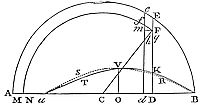
Let the arc of the cycloid, described in one entire oscillation, be expressed by the right line aB, equal to it, and the arc which would have been described in vacuo by the length AB. Bisect AB in C, and the point C will represent the lowest point of the cycloid, and CD will be as the force arising from gravity, with which the body in D is urged in the direction of the tangent of the cycloid, and will have the same ratio to the length of the pendulum as the force in D has to the force of gravity. Let that force, therefore, be expressed by that length CD, and the force of gravity by the length of the pendulum; and if in DE you take DK in the same ratio to the length of the pendulum as the resistance has to the gravity, DK will be the exponent of the resistance. From the centre C with the interval CA or CB describe a semi-circle BEeA. Let the body describe, in the least time, the space Dd; and, erecting the perpendiculars DE, de, meeting the circumference in E and e, they will be as the velocities which the body descending in vacuo from the point B would acquire in the places D and d. This appears by Prop. LII, Book I. Let therefore, these velocities be expressed by those perpendiculars DE, de; and let DF be the velocity which it acquires in D by falling from B in the resisting medium. And if from the centre C with the interval CF we describe the circle FfM meeting the right lines de and AB in f and M, then M will be the place to which it would thenceforward, without farther resistance, ascend, and df the velocity it would acquire in d. Whence, also, if Fg represent the moment of the velocity which the body D, in describing the least space Dd, loses by the resistance of the medium; and CN be taken equal to Cg; then will N be the place to which the body, if it met no farther resistance, would thenceforward ascend, and MN will be the decrement of the ascent arising from the loss of that velocity. Draw Fm perpendicular to df, and the decrement Fg of the velocity DF generated by the resistance DK will be to the increment fm of the same velocity, generated by the force CD, as the generating force DK to the generating force CD. But because of the similar triangles Fmf, Fhg, FDC, fm is to Fm or Dd as CD to DF; and, ex æquo, Fg to Dd as DK to DF. Also Fh is to Fg as DF to CF; and, ex æquo perturbatè, Fh or MN to Dd as DK to CF or CM; and therefore the sum of all the MN × CM will be equal to the sum of all the Dd × DK.
At the moveable point M suppose always a rectangular ordinate erected equal to the indeterminate CM, which by a continual motion is drawn into the whole length Aa; and the trapezium described by that motion, or its equal, the rectangle Aa × ^(1/2)aB, will be equal to the sum of all the MN × CM, and therefore to the sum of all the Dd × DK, that is, to the area BKVTa Q.E.D.
COR. Hence from the law of resistance, and the difference Aa of the arcs Ca, CB, may be collected the proportion of the resistance to the gravity nearly.
For if the resistance DK be uniform, the figure BKTa will be a rectangle under Ba and DK; and thence the rectangle under ^(1/2)Ba and Aa will be equal to the rectangle under Ba and DK, and DK will be equal to ^(1/2)Aa. Wherefore since DK is the exponent of the resistance, and the length of the pendulum the exponent of the gravity, the resistance will be to the gravity as ^(1/2)Aa to the length of the pendulum; altogether as in Prop. XXVIII is demonstrated.
If the resistance be as the velocity, the figure BKTa will be nearly an ellipsis. For if a body, in a non-resisting medium, by one entire oscillation, should describe the length BA, the velocity in any place D would be as the ordinate DE of the circle described on the diameter AB. Therefore since Ba in the resisting medium, and BA in the non-resisting one, are described nearly in the same times; and therefore the velocities in each of the points of Ba are to the velocities in the correspondent points of the length BA nearly as Ba is to BA, the velocity in the point D in the resisting medium will be as the ordinate of the circle or ellipsis described upon the diameter Ba; and therefore the figure BKVTa will be nearly an ellipsis. Since the resistance is supposed proportional to the velocity, let OV be the exponent of the resistance in the middle point O; and an ellipsis BRVSa described with the centre O, and the semi-axes OB, OV, will be nearly equal to the figure BKVTa, and to its equal the rectangle Aa × BO. Therefore Aa × BO is to OV × BO as the area of this ellipsis to OV × BO; that is, Aa is to OV as the area of the semi-circle to the square of the radius, or as 11 to 7 nearly; and, therefore, ^(7/11)Aa is to the length of the pendulum as the resistance of the oscillating body in O to its gravity.
Now if the resistance DK be in the duplicate ratio of the velocity, the figure BKVTa will be almost a parabola having V for its vertex and OV for its axis, and therefore will be nearly equal to the rectangle under ^(2/3)Ba and OV. Therefore the rectangle under ^(1/2)Ba and Aa is equal to the rectangle ^(2/3)Ba × OV, and therefore OV is equal to ^(3/4)Aa; and therefore the resistance in O made to the oscillating body is to its gravity as ^(3/4)Aa to the length of the pendulum.
And I take these conclusions to be accurate enough for practical uses. For since an ellipsis or parabola BRVSa falls in with the figure BKVTa in the middle point V, that figure, if greater towards the part BRV or VSa than the other, is less towards the contrary part, and is therefore nearly equal to it.