If the resistance made to an oscillating body in each of the proportional parts of the arcs described be augmented or diminished in a given ratio, the difference between the arc described in the descent and the arc described in the subsequent ascent will be augmented or diminished in the same ratio.
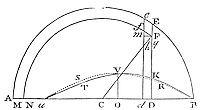
For that difference arises from the retardation of the pendulum by the resistance of the medium, and therefore is as the whole retardation and the retarding resistance proportional thereto. In the foregoing Proposition the rectangle under the right line ^(1/2)aB and the difference Aa of the arcs CB, Ca, was equal to the area BKTa. And that area, if the length aB remains, is augmented or diminished in the ratio of the ordinates DK; that is, in the ratio of the resistance and is therefore as the length aB and the resistance conjunctly. And therefore the rectangle under Aa and ^(1/2)aB is as aB and the resistance conjunctly, and therefore Aa is as the resistance. Q.E.D.
COR. 1. Hence if the resistance be as the velocity, the difference of the arcs in the same medium will be as the whole arc described: and the contrary.
COR. 2. If the resistance be in the duplicate ratio of the velocity, that difference will be in the duplicate ratio of the whole arc: and the contrary.
COR. 3. And universally, if the resistance be in the triplicate or any other ratio of the velocity, the difference will be in the same ratio of the whole arc: and the contrary.
COR. 4. If the resistance be partly in the simple ratio of the velocity, and partly in the duplicate ratio of the same, the difference will be partly in the ratio of the whole arc, and partly in the duplicate ratio of it: and the contrary. So that the law and ratio of the resistance will be the same for the velocity as the law and ratio of that difference for the length of the arc.
COR. 5. And therefore if a pendulum describe successively unequal arcs, and we can find the ratio of the increment or decrement of this difference for the length of the arc described, there will be had also the ratio of the increment or decrement of the resistance for a greater or less velocity.
GENERAL SCHOLIUM.
From these propositions we may find the resistance of mediums by pendulums oscillating therein. I found the resistance of the air by the following experiments. I suspended a wooden globe or ball weighing 57^(7/22) ounces troy, its diameter 6^(7/8) London inches, by a fine thread on a firm hook, so that the distance between the hook and the centre of oscillation of the globe was 10^(1/2) feet. I marked on the thread a point 10 feet and 1 inch distant from the centre of suspension; and even with that point I placed a ruler divided into inches, by the help whereof I observed the lengths of the arcs described by the pendulum. Then I numbered the oscillations in which the globe would lose ^(1/8) part of its motion. If the pendulum was drawn aside from the perpendicular to the distance of 2 inches, and thence let go, so that in its whole descent it described an arc of 2 inches, and in the first whole oscillation, compounded of the descent and subsequent ascent, an arc of almost 4 inches, the same in 164 oscillations lost ^(1/8) part of its motion, so as in its last ascent to describe an arc of 1^(3/4) inches. If in the first descent it described an arc of 4 inches, it lost ^(1/8) part of its motion in 121 oscillations, so as in its last ascent to describe an arc of 3^(1/2) inches. If in the first descent it described an arc of 8, 16, 32, or 64 inches, it lost ^(1/8) part of its motion in 69, 35^(1/2), 18^(1/2), 9^(2/3) oscillations, respectively. Therefore the difference between the arcs described in the first descent and the last ascent was in the 1st, 2d, 3d, 4th, 5th, 6th cases, ^(1/4), ^(1/2), 1, 2, 4, 8 inches respectively. Divide those differences by the number of oscillations in each case, and in one mean oscillation, wherein an arc of 3^(3/4), 7^(1/2), 15, 30 60, 120 inches was described, the difference of the arcs described in the descent and subsequent ascent will be ^(1/656), ^(1/242), ^(1/69), ^(4/71), ^(8/37), ^(24/29) parts of an inch, respectively. But these differences in the greater oscillations are in the duplicate ratio of the arcs described nearly, but in lesser oscillations something greater than in that ratio; and therefore (by Cor. 2, Prop. XXXI of this Book) the resistance of the globe, when it moves very swift, is in the duplicate ratio of the velocity, nearly; and when it moves slowly, somewhat greater than in that ratio.
Now let V represent the greatest velocity in any oscillation, and let A, B, and C be given quantities, and let us suppose the difference of the arcs to be AV+BV^(^(3/2))+CV². Since the greatest velocities are in the cycloid as ^(1/2) the arcs described in oscillating, and in the circle as ^(1/2) the chords of those arcs; and therefore in equal arcs are greater in the cycloid than in the circle in the ratio of ^(1/2) the arcs to their chords; but the times in the circle are greater than in the cycloid, in a reciprocal ratio of the velocity; it is plain that the differences of the arcs (which are as the resistance and the square of the time conjunctly) are nearly the same in both curves: for in the cycloid those differences must be on the one hand augmented, with the resistance, in about the duplicate ratio of the arc to the chord, because of the velocity augmented in the simple ratio of the same; and on the other hand diminished, with the square of the time, in the same duplicate ratio. Therefore to reduce these observations to the cycloid, we must take the same differences of the arcs as were observed in the circle, and suppose the greatest velocities analogous to the half, or the whole arcs, that is, to the numbers ^(1/2), 1, 2, 4, 8, 16. Therefore in the 2d, 4th, and 6th cases, put 1, 4, and 16 for V; and the difference of the arcs in the 2d case will become (^(1/2))/121 = A + B + C; in the 4th case, 2/(35^(1/2)) = 4A + 8B + 16C; in the 6th case, 8/(9^(2/3)) = 16A + 64B + 256C. These equations reduced give A = 0,0000916, B = 0,0010847, and C = 0,0029558. Therefore the difference of the arcs is as 0,0000916V+0,0010847V^(^(3/2))+0,0029558V²: and therefore since (by Cor. Prop. XXX, applied to this case) the resistance of the globe in the middle of the arc described in oscillating, where the velocity is V, is to its weight as ^(7/11)AV+^(7/10)BV^(^(3/2))+^(3/4)CV² to the length of the pendulum, if for A, B, and C you put the numbers found, the resistance of the globe will be to its weight as 0,0000583V+0,0007593V^(^(3/2))+0,0022169V² to the length of the pendulum between the centre of suspension and the ruler, that is, to 121 inches. Therefore since V in the second case represents 1, in the 4th case 4, and in the 6th case 16, the resistance will be to the weight of the globe, in the 2d case, as 0,0030345 to 121; in the 4th, as 0,041748 to 121; in the 6th, as 0,61705 to 121.
The arc, which the point marked in the thread described in the 6th case, was of 120−8/(9^(2/3)), or 119^(5/29) inches. And therefore since the radius was 121 inches, and the length of the pendulum between the point of suspension and the centre of the globe was 126 inches, the arc which the centre of the globe described was 124^(3/31) inches. Because the greatest velocity of the oscillating body, by reason of the resistance of the air, does not fall on the lowest point of the arc described, but near the middle place of the whole arc, this velocity will be nearly the same as if the globe in its whole descent in a non-resisting medium should describe 62^(3/62) inches, the half of that arc, and that in a cycloid, to which we have above reduced the motion of the pendulum; and therefore that velocity will be equal to that which the globe would acquire by falling perpendicularly from a height equal to the versed sine of that arc. But that versed sine in the cycloid is to that arc 62^(3/62) as the same arc to twice the length of the pendulum 252, and therefore equal to 15,278 inches. Therefore the velocity of the pendulum is the same which a body would acquire by falling, and in its fall describing a space of 15,278 inches. Therefore with such a velocity the globe meets with a resistance which is to its weight as 0,61705 to 121, or (if we take that part only of the resistance which is in the duplicate ratio of the velocity) as 0,56752 to 121.
I found, by an hydrostatical experiment, that the weight of this wooden globe was to the weight of a globe of water of the same magnitude as 55 to 97: and therefore since 121 is to 213,4 in the same ratio, the resistance made to this globe of water, moving forwards with the above-mentioned velocity, will be to its weight as 0,56752 to 213,4, that is, as 1 to 376^(1/50). Whence since the weight of a globe of water, in the time in which the globe with a velocity uniformly continued describes a length of 30,556 inches, will generate all that velocity in the falling globe, it is manifest that the force of resistance uniformly continued in the same time will take away a velocity, which will be less than the other in the ratio of 1 to 376^(1/50), that is, the 1/(376^(1/50)) part of the whole velocity. And therefore in the time that the globe, with the same velocity uniformly continued, would describe the length of its semi-diameter, or 3^(7/16) inches, it would lose the ^(1/3342) part of its motion.
I also counted the oscillations in which the pendulum lost ^(1/4) part of its motion. In the following table the upper numbers denote the length of the arc described in the first descent, expressed in inches and parts of an inch; the middle numbers denote the length of the arc described in the last ascent; and in the lowest place are the numbers of the oscillations. I give an account of this experiment, as being more accurate than that in which only ^(1/8) part of the motion was lost. I leave the calculation to such as are disposed to make it.
First descent 2 4 8 16 32 64
Last ascent 1^(1/2) 3 6 12 24 48
Numb. of oscill. 374 272 162^(1/2) 83^(1/3) 41^(2/3) 22^(1/1)
I afterward suspended a leaden globe of 2 inches in diameter, weighing 26^(1/4) ounces troy by the same thread, so that between the centre of the globe and the point of suspension there was an interval of 10^(1/2) feet, and I counted the oscillations in which a given part of the motion was lost. The first of the following tables exhibits the number of oscillations in which ^(1/8) part of the whole motion was lost; the second the number of oscillations in which there was lost ^(1/4) part of the same.
First descent 1 2 4 8 16 32 64
Last ascent ^(7/8) ^(7/4) 3^(1/2) 7 14 28 56
Numb. of oscill. 226 228 193 140 90^(1/2) 53 30
First descent 1 2 4 8 16 32 64
Last ascent ^(3/4) 1^(1/2) 3 6 12 24 48
Numb. of oscill. 510 518 420 318 204 121 70
Selecting in the first table the 3d, 5th, and 7th observations, and expressing the greatest velocities in these observations particularly by the numbers 1, 4, 16 respectively, and generally by the quantity V as above, there will come out in the 3d observation (^(1/2))/193 = A+B+C, in the 5th observation 2/(90^(1/2)) = 4A+8B+16C, in the 7th observation 8/30 = 16A+64B+256C. These equations reduced give A = 0,001414, B = 0,000297, C = 0,000879. And thence the resistance of the globe moving with the velocity V will be to its weight 26^(1/4) ounces in the same ratio as 0,0009V+0,000208V^(^(3/2))+0,000659V² to 121 inches, the length of the pendulum. And if we regard that part only of the resistance which is in the duplicate ratio of the velocity, it will be to the weight of the globe as 0,000659V² to 121 inches. But this part of the resistance in the first experiment was to the weight of the wooden globe of 57^(7/22) ounces as 0,002217V² to 121; and thence the resistance of the wooden globe is to the resistance of the leaden one (their velocities being equal) as 57^(7/22) into 0,002217 to 26^(1/4) into 0,000659, that is, as 7^(1/3) to 1. The diameters of the two globes were 6^(7/8) and 2 inches, and the squares of these are to each other as 47^(1/4) and 4, or 11^(13/16) and 1, nearly. Therefore the resistances of these equally swift globes were in less than a duplicate ratio of the diameters. But we have not yet considered the resistance of the thread, which was certainly very considerable, and ought to be subducted from the resistance of the pendulums here found. I could not determine this accurately, but I found it greater than a third part of the whole resistance of the lesser pendulum; and thence I gathered that the resistances of the globes, when the resistance of the thread is subducted, are nearly in the duplicate ratio of their diameters. For the ratio of 7^(1/3)−^(1/3) to 1−^(1/3), or 10^(1/2) to 1 is not very different from the duplicate ratio of the diameters 11^(13/16) to 1.
Since the resistance of the thread is of less moment in greater globes, I tried the experiment also with a globe whose diameter was 18^(3/4) inches. The length of the pendulum between the point of suspension and the centre of oscillation was 122^(1/2) inches, and between the point of suspension and the knot in the thread 109^(1/2) inches. The arc described by the knot at the first descent of the pendulum was 32 inches. The arc described by the same knot in the last ascent after five oscillations was 28 inches. The sum of the arcs, or the whole arc described in one mean oscillation, was 60 inches. The difference of the arcs 4 inches. The ^(1/10) part of this, or the difference between the descent and ascent in one mean oscillation, is ^(2/5) of an inch. Then as the radius 109^(1/2) to the radius 122^(1/2), so is the whole arc of 60 inches described by the knot in one mean oscillation to the whole arc of 67^(1/8) inches described by the centre of the globe in one mean oscillation; and so is the difference ^(2/5) to a new difference 0,4475. If the length of the arc described were to remain, and the length of the pendulum should be augmented in the ratio of 126 to 122^(1/2), the time of the oscillation would be augmented, and the velocity of the pendulum would be diminished in the subduplicate of that ratio; so that the difference 0,4475 of the arcs described in the descent and subsequent ascent would remain. Then if the arc described be augmented in the ratio of 124^(3/31) to 67^(1/8), that difference 0,4475 would be augmented in the duplicate of that ratio, and so would become 1,5295. These things would be so upon the supposition that the resistance of the pendulum were in the duplicate ratio of the velocity. Therefore if the pendulum describe the whole arc of 124^(3/31) inches, and its length between the point of suspension and the centre of oscillation be 126 inches, the difference of the arcs described in the descent and subsequent ascent would be 1,5295 inches. And this difference multiplied into the weight of the pendulous globe, which was 208 ounces, produces 318,136. Again; in the pendulum above-mentioned, made of a wooden globe, when its centre of oscillation, being 126 inches from the point of suspension, described the whole arc of 124^(3/31) inches, the difference of the arcs described in the descent and ascent was 126/121 into 8/(9^(3/2)). This multiplied into the weight of the globe, which was 57^(7/22) ounces, produces 49,396. But I multiply these differences into the weights of the globes, in order to find their resistances. For the differences arise from the resistances, and are as the resistances directly and the weights inversely. Therefore the resistances are as the numbers 318,136 and 49,396.
But that part of the resistance of the lesser globe, which is in the duplicate ratio of the velocity, was to the whole resistance as 0,56752 to 0,61675, that is, as 45,453 to 49,396; whereas that part of the resistance of the greater globe is almost equal to its whole resistance; and so those parts are nearly as 318,136 and 45,453, that is, as 7 and 1. But the diameters of the globes are 18^(3/4) and 6^(7/8); and their squares 351^(9/16) and 47^(17/64) are as 7,438 and 1, that is, as the resistances of the globes 7 and 1, nearly. The difference of these ratios is scarce greater than may arise from the resistance of the thread. Therefore those parts of the resistances which are, when the globes are equal, as the squares of the velocities, are also, when the velocities are equal, as the squares of the diameters of the globes.
But the greatest of the globes I used in these experiments was not perfectly spherical, and therefore in this calculation I have, for brevity's sake, neglected some little niceties; being not very solicitous for an accurate calculus in an experiment that was not very accurate. So that I could wish that these experiments were tried again with other globes, of a larger size, more in number, and more accurately formed; since the demonstration of a vacuum depends thereon. If the globes be taken in a geometrical proportion, as suppose whose diameters are 4, 8, 16, 32 inches; one may collect from the progression observed in the experiments what would happen if the globes were still larger.
In order to compare the resistances of different fluids with each other, I made the following trials. I procured a wooden vessel 4 feet long, 1 foot broad, and 1 foot high. This vessel, being uncovered, I filled with spring water, and, having immersed pendulums therein, I made them oscillate in the water. And I found that a leaden globe weighing 166^(1/6) ounces, and in diameter 3^(5/8) inches, moved therein as it is set down in the following table; the length of the pendulum from the point of suspension to a certain point marked in the thread being 126 inches, and to the centre of oscillation 134^(3/8) inches.
The arc described in
the first descent, by
a point marked in
the thread was
inches. ⎫⎭⎬ 64 32 16 8 4 2 1 ^(1/2) ^(1/4)
The arc described in
the last ascent was
inches. ⎫⎭⎬ 48 24 12 6 3 1^(1/2) ^(3/4) ^(3/8) ^(3/16)
The difference of the
arcs, proportional
to the motion lost,
was inches. ⎫⎭⎬ 16 8 4 2 1 ^(1/2) ^(1/4) ^(1/8) ^(1/16)
The number of the
oscillations in
water. ⎫⎭⎬
^(29/60) 1^(1/5) 3 7 11^(1/4) 12^(2/3) 13^(1/3)
The number of the
oscillations in air. ⎫⎭⎬ 85^(1/2) 287
535
In the experiments of the 4th column there were equal motions lost in 535 oscillations made in the air, and 1^(1/5) in water. The oscillations in the air were indeed a little swifter than those in the water. But if the oscillations in the water were accelerated in such a ratio that the motions of the pendulums might be equally swift in both mediums, there would be still the same number 1^(1/5) of oscillations in the water, and by these the same quantity of motion would be lost as before; because the resistance is increased, and the square of the time diminished in the same duplicate ratio. The pendulums, therefore, being of equal velocities, there were equal motions lost in 535 oscillations in the air, and 1^(1/5) in the water; and therefore the resistance of the pendulum in the water is to its resistance in the air as 535 to 1^(1/5). This is the proportion of the whole resistances in the case of the 4th column.
Now let AV + CV2 represent the difference of the arcs described in the descent and subsequent ascent by the globe moving in air with the greatest velocity V; and since the greatest velocity is in the case of the 4th column to the greatest velocity in the case of the 1st column as 1 to 8; and that difference of the arcs in the case of the 4th column to the difference in the case of the 1st column as 2/535 to 16/(85^(1/2)), or as 85^(1/2) to 4280; put in these cases 1 and 8 for the velocities, and 85^(1/2) and 4280 for the differences of the arcs, and A + C will be = 85 ^(1/2), and 8A + 64C = 4280 or A + 8C = 535; and then by reducing these equations, there will come out 7C = 449 ^(1/2) and C = 64 ^(3/14) and A = 21 ^(2/7); and therefore the resistance, which is as ^(7/11)AV+^(3/4)CV², will become as 13 ^(6/11)V+48^(9/56)V². Therefore in the case of the 4th column, where the velocity was 1, the whole resistance is to its part proportional to the square of the velocity as 13 ^(6/11)+48^(9/56) or 61 ^(12/17) to 48 ^(9/56); and therefore the resistance of the pendulum in water is to that part of the resistance in air, which is proportional to the square of the velocity, and which in swift motions is the only part that deserves consideration, as 61 ^(12/17) to 48 ^(9/56) and 535 to 1 ^(1/5) conjunctly, that is, as 571 to 1. If the whole thread of the pendulum oscillating in the water had been immersed, its resistance would have been still greater; so that the resistance of the pendulum oscillating in the water, that is, that part which is proportional to the square of the velocity, and which only needs to be considered in swift bodies, is to the resistance of the same whole pendulum, oscillating in air with the same velocity, as about 850 to 1, that is as, the density of water to the density of air, nearly.
In this calculation we ought also to have taken in that part of the resistance of the pendulum in the water which was as the square of the velocity; but I found (which will perhaps seem strange) that the resistance in the water was augmented in more than a duplicate ratio of the velocity. In searching after the cause, I thought upon this, that the vessel was too narrow for the magnitude of the pendulous globe, and by its narrowness obstructed the motion of the water as it yielded to the oscillating globe. For when I immersed a pendulous globe, whose diameter was one inch only, the resistance was augmented nearly in a duplicate ratio of the velocity. I tried this by making a pendulum of two globes, of which the lesser and lower oscillated in the water, and the greater and higher was fastened to the thread just above the water, and, by oscillating in the air, assisted the motion of the pendulum, and continued it longer. The experiments made by this contrivance proved according to the following table.
Arc descr. in first descent
16 8 4 2 1 ^(1/2) ^(1/4)
Arc descr. in last ascent
12 6 3 1^(1/2) ^(3/4) ^(3/8) ^(3/16)
Diff. of arcs, proport. to
motion lost ⎫⎭⎬ 4 2 1 ^(1/2) ^(1/4) ^(1/8) ^(1/16)
Number of oscillations
3^(3/8) 6^(1/2) 12^(1/12) 21^(1/5) 34 53 62^(1/5)
In comparing the resistances of the mediums with each other, I also caused iron pendulums to oscillate in quicksilver. The length of the iron wire was about 3 feet, and the diameter of the pendulous globe about ^(1/3) of an inch. To the wire, just above the quicksilver, there was fixed another leaden globe of a bigness sufficient to continue the motion of the pendulum for some time. Then a vessel, that would hold about 3 pounds of quicksilver, was filled by turns with quicksilver and common water, that, by making the pendulum oscillate successively in these two different fluids, I might find the proportion of their resistances; and the resistance of the quicksilver proved to be to the resistance of water as about 13 or 14 to 1; that is, as the density of quicksilver to the density of water. When I made use of a pendulous globe something bigger, as of one whose diameter was about ^(1/2) or ^(2/3) of an inch, the resistance of the quicksilver proved to be to the resistance of the water as about 12 or 10 to 1. But the former experiment is more to be relied on, because in the latter the vessel was too narrow in proportion to the magnitude of the immersed globe; for the vessel ought to have been enlarged together with the globe. I intended to have repeated these experiments with larger vessels, and in melted metals, and other liquors both cold and hot; but I had not leisure to try all: and besides, from what is already described, it appears sufficiently that the resistance of bodies moving swiftly is nearly proportional to the densities of the fluids in which they move. I do not say accurately; for more tenacious fluids, of equal density, will undoubtedly resist more than those that are more liquid; as cold oil more than warm, warm oil more than rain-water, and water more than spirit of wine. But in liquors, which are sensibly fluid enough, as in air, in salt and fresh water, in spirit of wine, of turpentine, and salts, in oil cleared of its fæces by distillation and warmed, in oil of vitriol, and in mercury, and melted metals, and any other such like, that are fluid enough to retain for some time the motion impressed upon them by the agitation of the vessel, and which being poured out are easily resolved into drops, I doubt not but the rule already laid down may be accurate enough, especially if the experiments be made with larger pendulous bodies and more swiftly moved.
Lastly, since it is the opinion of some that there is a certain æthereal medium extremely rare and subtile, which freely pervades the pores of all bodies; and from such a medium, so pervading the pores of bodies, some resistance must needs arise; in order to try whether the resistance, which we experience in bodies in motion, be made upon their outward superficies only, or whether their internal parts meet with any considerable resistance upon their superficies, I thought of the following experiment I suspended a round deal box by a thread 11 feet long, on a steel hook, by means of a ring of the same metal, so as to make a pendulum of the aforesaid length. The hook had a sharp hollow edge on its upper part, so that the upper arc of the ring pressing on the edge might move the more freely; and the thread was fastened to the lower arc of the ring. The pendulum being thus prepared, I drew it aside from the perpendicular to the distance of about 6 feet, and that in a plane perpendicular to the edge of the hook, lest the ring, while the pendulum oscillated, should slide to and fro on the edge of the hook: for the point of suspension, in which the ring touches the hook, ought to remain immovable. I therefore accurately noted the place to which the pendulum was brought, and letting it go, I marked three other places, to which it returned at the end of the 1st, 2d, and 3d oscillation. This I often repeated, that I might find those places as accurately as possible. Then I filled the box with lead and other heavy metals that were near at hand. But, first, I weighed the box when empty, and that part of the thread that went round it, and half the remaining part, extended between the hook and the suspended box; for the thread so extended always acts upon the pendulum, when drawn aside from the perpendicular, with half its weight. To this weight I added the weight of the air contained in the box. And this whole weight was about ^(1/78) of the weight of the box when filled with the metals. Then because the box when full of the metals, by extending the thread with its weight, increased the length of the pendulum, I shortened the thread so as to make the length of the pendulum, when oscillating, the same as before. Then drawing aside the pendulum to the place first marked, and letting it go, I reckoned about 77 oscillations before the box returned to the second mark, and as many afterwards before it came to the third mark, and as many after that before it came to the fourth mark. From whence I conclude that the whole resistance of the box, when full, had not a greater proportion to the resistance of the box, when empty, than 78 to 77.
For if their resistances were equal, the box, when full, by reason of its vis insita, which was 78 times greater than the vis insita of the same when empty, ought to have continued its oscillating motion so much the longer, and therefore to have returned to those marks at the end of 78 oscillations. But it returned to them at the end of 77 oscillations.
Let, therefore, A represent the resistance of the box upon its external superficies, and B the resistance of the empty box on its internal superficies; and if the resistances to the internal parts of bodies equally swift be as the matter, or the number of particles that are resisted, then 78B will be the resistance made to the internal parts of the box, when full; and therefore the whole resistance A + B of the empty box will be to the whole resistance A + 78B of the full box as 77 to 78, and, by division, A + B to 77B as 77 to 1; and thence A + B to B as 77 × 77 to 1, and, by division again, A to B as 5928 to 1. Therefore the resistance of the empty box in its internal parts will be above 5000 times less than the resistance on its external superficies. This reasoning depends upon the supposition that the greater resistance of the full box arises not from any other latent cause, but only from the action of some subtile fluid upon the included metal.
This experiment is related by memory, the paper being lost in which I had described it; so that I have been obliged to omit some fractional parts, which are split out of my memory; and I have no leisure to try it again. The first time I made it, the hook being weak, the full box was retarded sooner. The cause I found to be, that the hook was not strong enough to bear the weight of the box; so that, as it oscillated to and fro, the hook was bent sometimes this and sometimes that way. I therefore procured a hook of sufficient strength, so that the point of suspension might remain unmoved, and then all things happened as is above described.