Supposing that a body oscillating in a cycloid is resisted in a duplicate ratio of the velocity: to find the resistance in each place.
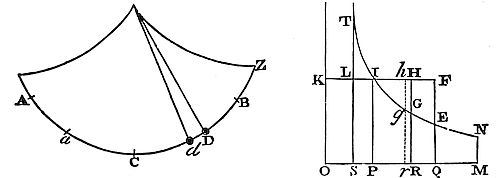
Let Ba be an arc described in one entire oscillation, C the lowest point of the cycloid, and CZ half the whole cycloidal arc, equal to the length of the pendulum; and let it be required to find the resistance of the body in any place D. Cut the indefinite right line OQ in the points O, S, P, Q, so that (erecting the perpendiculars OK, ST, PI, QE, and with the centre O, and the asymptotes OK, OQ, describing the hyperbola TIGE cutting the perpendiculars ST, PI, QE in T, I, and E, and through the point I drawing KF, parallel to the asymptote OQ, meeting the asymptote OK in K, and the perpendiculars ST and QE in L and F) the hyperbolic area PIEQ may be to the hyperbolic area PITS as the arc BC, described in the descent of the body, to the arc Ca described in the ascent; and that the area IEF may be to the area ILT as OQ to OS. Then with the perpendicular MN cut off the hyperbolic area PINM, and let that area be to the hyperbolic area PIEQ as the arc CZ to the arc BC described in the descent. And if the perpendicular RG cut off the hyperbolic area PIGR, which shall be to the area PIEQ as any arc CD to the arc BC described in the whole descent, the resistance in any place D will be to the force of gravity as the area OR/OQIEF−IGH to the area PINM.
For since the forces arising from gravity with which the body is urged in the places Z, B, D, a, are as the arcs CZ, CB, CD, Ca and those arcs are as the areas PINM, PIEQ, PIGR, PITS; let those areas be the exponents both of the arcs and of the forces respectively. Let Dd be a very small space described by the body in its descent: and let it be expressed by the very small area RGgr comprehended between the parallels RG, rg; and produce rg to h, so that GHhg and RGgr may be the contemporaneous decrements of the areas IGH, PIGR. And the increment GHℎg−Rr/OQIEF, or Rr × HG−Rr/OQIEF, of the area OR/OQIEF−IGH will be to the decrement RGgr, or Rr × RG, of the area PIGR, as HG−IEF/OQ to RG; and therefore as OR × HG−OR/OQIEF to OR × GR or OP × PI, that is (because of the equal quantities OR × HG, OR × HR - OR × GR, ORHK - OPIK, PIHR and PIGR + IGH), as PIGR+IGH−OR/OQIEF to OPIK. Therefore if the area OR/OQIEF−IGH be called Y, and RGgr the decrement of the area PIGR be given, the increment of the area Y will be as PIGR - Y.
Then if V represent the force arising from the gravity, proportional to the arc CD to be described, by which the body is acted upon in D, and R be put for the resistance, V - R will be the whole force with which the body is urged in D. Therefore the increment of the velocity is as V - R and the particle of time in which it is generated conjunctly. But the velocity itself is as the contemporaneous increment of the space described directly and the same particle of time inversely. Therefore, since the resistance is, by the supposition, as the square of the velocity, the increment of the resistance will (by Lem. II) be as the velocity and the increment of the velocity conjunctly, that is, as the moment of the space and V - R conjunctly; and, therefore, if the moment of the space be given, as V - R; that is, if for the force V we put its exponent PIGR, and the resistance R be expressed by any other area Z, as PIGR - Z.
Therefore the area PIGR uniformly decreasing by the subduction of given moments, the area Y increases in proportion of PIGR - Y, and the area Z in proportion of PIGR - Z. And therefore if the areas Y and Z begin together, and at the beginning are equal, these, by the addition of equal moments, will continue to be equal; and in like manner decreasing by equal moments, will vanish together. And, vice versa, if they together begin and vanish, they will have equal moments and be always equal; and that, because if the resistance Z be augmented, the velocity together with the arc Ca, described in the ascent of the body, will be diminished; and the point in which all the motion together with the resistance ceases coming nearer to the point C, the resistance vanishes sooner than the area Y. And the contrary will happen when the resistance is diminished.
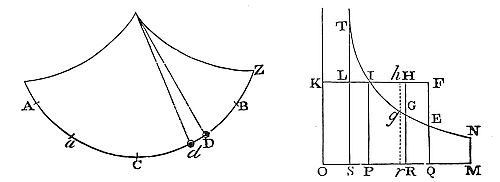
Now the area Z begins and ends where the resistance is nothing, that is, at the beginning of the motion where the arc CD is equal to the arc CB, and the right line RG falls upon the right line QE; and at the end of the motion where the arc CD is equal to the arc Ca, and RG falls upon the right line ST. And the area Y or OR/OQIEF−IGH begins and ends also where the resistance is nothing, and therefore where OR/OQIEF and IGH are equal; that is (by the construction), where the right line RG falls successively upon the right lines QE and ST. Therefore those areas begin and vanish together, and are therefore always equal. Therefore the area OR/OQIEF−IGH is equal to the area Z, by which the resistance is expressed, and therefore is to the area PINM, by which the gravity is expressed, as the resistance to the gravity. Q.E.D.
COR. 1. Therefore the resistance in the lowest place C is to the force of gravity as the area OP/OQIEF to the area PINM.
COR. 2. But it becomes greatest where the area PIHR is to the area IEF as OR to OQ. For in that case its moment (that is, PIGR - Y) becomes nothing.
COR. 3. Hence also may be known the velocity in each place, as being in the subduplicate ratio of the resistance, and at the beginning of the motion equal to the velocity of the body oscillating in the same cycloid without any resistance.
However, by reason of the difficulty of the calculation by which the resistance and the velocity are found by this Proposition, we have thought fit to subjoin the Proposition following.