In a sphere described about the centre S with the interval SA, if there be taken SI, SA, SP continually proportional; I say, that the attraction of a corpuscle within the sphere in any place I is to its attraction without the sphere in the place P in a ratio compounded of the subduplicate ratio of IS, PS, the distances from the centre, and the subduplicate ratio of the centripetal forces tending to the centre in those places P and I.
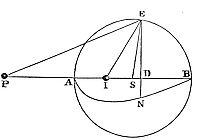
As if the centripetal forces of the particles of the sphere be reciprocally as the distances of the corpuscle attracted by them; the force with which the corpuscle situate in I is attracted by the entire sphere will be to the force with which it is attracted in P in a ratio compounded of the subduplicate ratio of the distance SI to the distance SP, and the subduplicate ratio of the centripetal force in the place I arising from any particle in the centre to the centripetal force in the place P arising from the same particle in the centre; that is, in the subduplicate ratio of the distances SI, SP to each other reciprocally. These two subduplicate ratios compose the ratio of equality, and therefore the attractions in I and P produced by the whole sphere are equal. By the like calculation, if the forces of the particles of the sphere are reciprocally in a duplicate ratio of the distances, it will be found that the attraction in I is to the attraction in P as the distance SP to the semi-diameter SA of the sphere. If those forces are reciprocally in a triplicate ratio of the distances, the attractions in I and P will be to each other as SP2 to SA2; if in a quadruplicate ratio, as SP3 to SA3. Therefore since the attraction in P was found in this last case to be reciprocally as PS3 × PI, the attraction in I will be reciprocally as SA3 × PI, that is, because SA3 is given reciprocally as PI. And the progression is the same in infinitum. The demonstration of this Theorem is as follows:
The things remaining as above constructed, and a corpuscle being in any place P, the ordinate DN was found to be as (DE² × PS)/(PE × V). Therefore if IE be drawn, that ordinate for any other place of the corpuscle, as I, will become (mutatis mutandis) as (DE² × IS)/(IE × V). Suppose the centripetal forces flowing from any point of the sphere, as E, to be to each other at the distances IE and PE as PEⁿ to IEⁿ (where the number n denotes the index of the powers of PE and IE), and those ordinates will become as (DE² × PS)/(PE × PEⁿ) and (DE² × IS)/(IE × IEⁿ) whose ratio to each other is as PS × IE × IEⁿ to IS × PE × PEⁿ. Because SI, SE, SP are in continued proportion, the triangles SPE, SEI are alike; and thence IE is to PE as IS to SE or SA. For the ratio of IE to PE write the ratio of IS to SA; and the ratio of the ordinates becomes that of PS × IEⁿ to SA × PEⁿ. But the ratio of PS to SA is subduplicate of that of the distances PS, SI; and the ratio of IEⁿ to PEⁿ (because IE is to PE as IS to SA) is subduplicate of that of the forces at the distances PS, IS. Therefore the ordinates, and consequently the areas which the ordinates describe, and the attractions proportional to them, are in a ratio compounded of those subduplicate ratios. Q.E.D.