The things remaining as above, it is required to measure the area ANB.
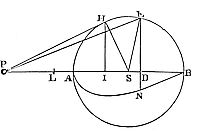
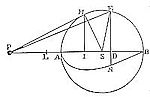
From the point P let there be drawn the right line PH touching the sphere in H; and to the axis PAB, letting fall the perpendicular HI, bisect PI in L; and (by Prop. XII, Book II, Elem.) PE2 is equal to PS2 + SE2 + 2PSD. But because the triangles SPH, SHI are alike, SE2 or SH2 is equal to the rectangle PSI, Therefore PE2 is equal to the rectangle contained under PS and PS + SI + 2SD; that is, under PS and 2LS + 2SD; that is, under PS and 2LD. Moreover DE2 is equal to SE2 - SD2, or SE2 - LS2 + 2SLD - LD2, that is, 2SLD - LD2 - ALB. For LS2 - SE2 or LS2 - SA2 (by Prop. VI, Book II, Elem.) is equal to the rectangle ALB. Therefore if instead of DE2 we write 2SLD - LD2 - ALB, the quantity (DE² × PS)/(PE × V), which (by Cor. 4 of the foregoing Prop.) is as the length of the ordinate DN, will now resolve itself into three parts (2SLD × PS)/(PE × V)−(LD² × PS)/(PE × V)−(ALB × PS)/(PE × V); where if instead of V we write the inverse ratio of the centripetal force, and instead of PE the mean proportional between PS and 2LD, those three parts will become ordinates to so many curve lines, whose areas are discovered by the common methods. Q.E.D.
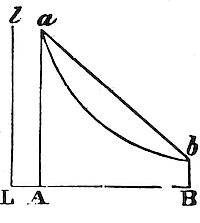
EXAMPLE 1. If the centripetal force tending to the several particles of the sphere be reciprocally as the distance; instead of V write PE the distance, then 2PS × LD for PE2; and DN will become as SL−^(1/2)LD−ALB/2LD. Suppose DN equal to its double 2SL−LD−ALB/LD; and 2SL the given part of the ordinate drawn into the length AB will describe the rectangular area 2SL × AB; and the indefinite part LD, drawn perpendicularly into the same length with a continued motion, in such sort as in its motion one way or another it may either by increasing or decreasing remain always equal to the length LD, will describe the area (LB²−LA²)/2, that is, the area SL × AB; which taken from the former area 2SL × AB, leaves the area SL × AB. But the third part ALB/LD, drawn after the same manner with a continued motion perpendicularly into the same length, will describe the area of an hyperbola, which subducted from the area SL × AB will leave ANB the area sought. Whence arises this construction of the Problem. At the points, L, A, B, erect the perpendiculars Ll, Aa, Bb; making Aa equal to LB, and Bb equal to LA. Making Ll and LB asymptotes, describe through the points a, b, the hyperbolic curve ab. And the chord ba being drawn, will inclose the area aba equal to the area sought ANB.
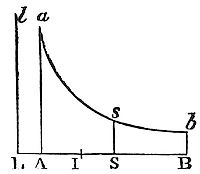
EXAMPLE 2. If the centripetal force tending to the several particles of the sphere be reciprocally as the cube of the distance, or (which is the same thing) as that cube applied to any given plane; write PE³/2AS² for V, and 2PS × LD for PE2; and DN will become as (SL × AS²)/(PS × LD)−AS²/2PS−(ALB × AS²)/(2PS × LD²) that is (because PS, AS, SI are continually proportional), as LSI/LD−^(1/2)SI−(ALB × SI)/2LD². If we draw then these three parts into the length AB, the first LSI/LD will generate the area of an hyperbola; the second ^(1/2)SI the area ^(1/2)AB × SI; the third (ALB × SI)/2LD² the area (ALB × SI)/2LA−(ALB × SI)/2LB, that is, ^(1/2)AB × SI. From the first subduct the sum of the second and third, and there will remain ANB, the area sought. Whence arises this construction of the problem. At the points L, A, S, B, erect the perpendiculars Ll Aa, Ss, Bb, of which suppose Ss equal to SI; and through the point s, to the asymptotes Ll, LB, describe the hyperbola asb meeting the perpendiculars Aa, Bb, in a and b; and the rectangle 2ASI, subducted from the hyperbolic area AasbB, will leave ANB the area sought.
EXAMPLE 3. If the centripetal force tending to the several particles of the spheres decrease in a quadruplicate ratio of the distance from the particles; write PE⁴/2AS³ for V, then √2PS+LD for PE, and DN will become as (SI² × SL)/√2SI × 1/√LD³−SI²/2√2SI × 1/√LD−(SI² × ALB)/2√2SI × 1/√LD⁵. These three parts drawn into the length AB, produce so many areas, viz. (2SI² × SL)/√2SI into 1/√LA−1/√LB; SI²/√2SI into √LB−√LA; and (SI² × ALB)/3√2SI into 1/√LA³−1/√LB³. And these after due reduction come forth (2SI² × SL)/LI, SI², and SI²+2SI³/3LI. And these by subducting the last from the first, become 4SI³/3LI. Therefore the entire force with which the corpuscle P is attracted towards the centre of the sphere is as SI³/PI, that is, reciprocally as PS³ × PI Q.E.I.
By the same method one may determine the attraction of a corpuscle situate within the sphere, but more expeditiously by the following Theorem.