If to the several equal parts of a sphere ABE described about the centre S there tend equal centripetal forces; and from the several points D in the axis of the sphere AB in which a corpuscle, as P, is placed, there be erected the perpendiculars DE meeting the sphere in E, and if in those perpendiculars the lengths DN be taken as the quantity (DE² × PS)/PE, and as the force which a particle of the sphere situate in the axis exerts at the distance PE upon the corpuscle P conjunctly; I say, that the whole force with which the corpuscle P is attracted towards the sphere is as the area ANB, comprehended under the axis of the sphere AB, and the curve line ANB, the locus of the point N.
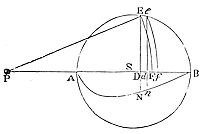
For supposing the construction in the last Lemma and Theorem to stand, conceive the axis of the sphere AB to be divided into innumerable equal particles Dd, and the whole sphere to be divided into so many sphærical concavo-convex laminæ EFfe; and erect the perpendicular dn. By the last Theorem, the force with which the laminæ EFfe attracts the corpuscle P is as DE2 × Ff and the force of one particle exerted at the distance PE or PF, conjunctly. But (by the last Lemma) Dd is to Ff as PE to PS, and therefore Ff is equal to (PS × Dd)/PE; and DE2 × Ff is equal to Dd × (DE² × PS)/PE; and therefore the force of the lamina EFfe is as Dd × (DE² × PS)/PE and the force of a particle exerted at the distance PF conjunctly; that is, by the supposition, as DN × Dd, or as the evanescent area DNnd. Therefore the forces of all the laminæ exerted upon the corpuscle P are as all the areas DNnd, that is, the whole force of the sphere will be as the whole area ANB. Q.E.D.
COR. 1. Hence if the centripetal force tending to the several particles remain always the same at all distances, and DN be made as (DE² × PS)/PE, the whole force with which the corpuscle is attracted by the sphere is as the area ANB.
COR. 2. If the centripetal force of the particles be reciprocally as the distance of the corpuscle attracted by it, and DN be made as (DE² × PS)/PE², the force with which the corpuscle P is attracted by the whole sphere will be as the area ANB.
COR. 3. If the centripetal force of the particles be reciprocally as the cube of the distance of the corpuscle attracted by it, and DN be made as (DE² × PS)/PE⁴, the force with which the corpuscle is attracted by the whole sphere will be as the area ANB.
COR. 4. And universally if the centripetal force tending to the several particles of the sphere be supposed to be reciprocally as the quantity V; and DN be made as (DE² × PS)/(PE × V); the force with which a corpuscle is attracted by the whole sphere will be as the area ANB.