Suppose a superficies as EFfe to have its breadth infinitely diminished, and to be just vanishing; and that the same superficies by its revolution round the axis PS describes a sphærical concavo-convex solid, to the several equal particles of which there tend equal centripetal forces; I say, that the force with which that solid attracts a corpuscle situate in P is in a ratio compounded of the ratio of the solid DE2 × Ff and the ratio of the force with which the given particle in the place Ff would attract the same corpuscle.
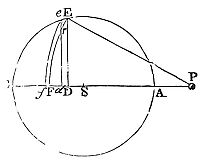
For if we consider, first, the force of the sphærical superficies FE which is generated by the revolution of the arc FE, and is cut any where, as in r, by the line de, the annular part of the superficies generated by the revolution of the arc rE will be as the lineola Dd, the radius of the sphere PE remaining the same; as Archimedes has demonstrated in his Book of the Sphere and Cylinder. And the force of this superficies exerted in the direction of the lines PE or Pr situate all round in the conical superficies, will be as this annular superficies itself; that is as the lineola Dd, or, which is the same, as the rectangle under the given radius PE of the sphere and the lineola Dd; but that force, exerted in the direction of the line PS tending to the centre S, will be less in the ratio PD to PE, and therefore will be as PD × Dd. Suppose now the line DF to be divided into innumerable little equal particles, each of which call Dd, and then the superficies FE will be divided into so many equal annuli, whose forces will be as the sum of all the rectangles PD × Dd, that is, as ^(1/2)PF²−^(1/2)PD², and therefore as DE2. Let now the superficies FE be drawn into the altitude Ff; and the force of the solid EFfe exerted upon the corpuscle P will be as DE2 × Ff; that is, if the force be given which any given particle as Ff exerts upon the corpuscle P at the distance PF. But if that force be not given, the force of the solid EFfe will be as the solid DE2 × Ff and that force not given, conjunctly. Q.E.D.