To find the force with which a corpuscle placed in the centre of a sphere is attracted towards any segment of that sphere whatsoever.
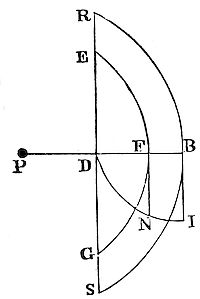
Let P be a body in the centre of that sphere and RBSD a segment thereof contained under the plane RDS, and the sphærical superficies RBS. Let DB be cut in F by a sphærical superficies EFG described from the centre P, and let the segment be divided into the parts BREFGS, FEDG. Let us suppose that segment to be not a purely mathematical but a physical superficies, having some, but a perfectly inconsiderable thickness. Let that thickness be called O, and (by what Archimedes has demonstrated) that superficies will be as PF × DF × O. Let us suppose besides the attractive forces of the particles of the sphere to be reciprocally as that power of the distances, of which n is index; and the force with which the superficies EFG attracts the body P will be (by Prop. LXXIX) as (DE² × O)/PFⁿ, that is, as (2DF × O)/PFⁿ⁻¹−(DF² × O)/PFⁿ. Let the perpendicular FN drawn into O be proportional to this quantity; and the curvilinear area BDI, which the ordinate FN, drawn through the length DB with a continued motion will describe, will be as the whole force with which the whole segment RBSD attracts the body P. Q.E.I.