If from the lowest point of a vertical circle, a chord is drawn subtending an arc not greater than a quadrant, and if from the two ends of this chord two other chords be drawn to any point on the arc, the time of descent along the two latter chords will be shorter than along the first, and shorter also, by the same amount, than along the lower of these two latter chords.
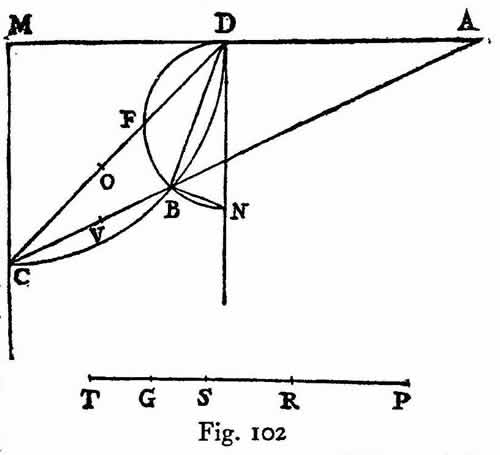
Let CBD be an arc, not exceeding a quadrant, taken from a vertical circle whose lowest point is C; let CD be the chord [planum elevatum] subtending this arc, and let there be two other chords drawn from C and D to any point B on the arc. Then, I say, the time of descent along the two chords [plana] DB and BC is shorter than along DC alone, or along BC alone, starting from rest at B. Through the point D, draw the horizontal line MDA cutting CB extended at A: draw DN and MC at right angles to MD, and BN at right angles to BD; about the right-angled triangle DBN describe the semicircle DFBN, cutting DC at F. Choose the point O such that DO will be a mean proportional between CD and DF; in like manner select V so that AV is a mean proportional between CA and AB. Let the length PS represent the time of descent along the whole distance DC or BC, both of which require the same time. Lay off PR such that CD:DO=_time_PS. time_PR. Then PR will represent the time in which a body, starting from D, will traverse the distance DF, while RS will measure the time in which the remaining distance, FC, will be traversed. But since PS is also the time of descent, from rest at B, along BC, and if we choose T such that BC:CD=PS:PT then PT will measure the time of descent from A to C, for we have already shown [Lemma] that DC is a mean proportional between AC and CB. Finally choose the point G such that CA:AV=PT:PG, then PG will be the time of descent from A to B, while GT will be the residual time of descent along BC following descent from A to B. But, since the diameter, DN, of the circle DFN is a vertical line, the chords DF and DB will be traversed in equal times; wherefore if one can prove that a body will traverse BC, after descent along DB, in a shorter time than it will FC after descent along DF he will have proved the theorem. But a body descending from D along DB will traverse BC in the same time as if it had come from A along AB, seeing that the body acquires the same momentum in descending along DB as along AB. Hence it remains only to show that descent along BC after AB is quicker than along FC after DF. But we have already shown that GT represents the time along BC after AB; also that RS measures the time along FC after DF. Accordingly it must be shown that RS is greater than GT, which may be done as follows: Since SP:PR=CD:DO, it follows, _invertendo et convertendo, that RS:SP=OC:CD; also we have SP:PT=DC:CA. And since TP:PG=CA:AV, it follows, invertendo, that PT:TG=AC:CV, therefore, ex æquali, RS:GT=OC:CV.
But, as we shall presently show, OC is greater than CV; hence the time RS is greater than the time GT, which was to be shown. Now, since [Lemma] CF is greater than CB and FD smaller than BA, it follows that CD:DF>CA:AB. But CD:DF=CO:OF, seeing that CD:DO=DO:DF; and CA:AB=CVmacronsup2:VBmacronsup2. Therefore CO:OF>CV:VB, and, according to the preceding lemma, CO>CV. Besides this it is clear that the time of descent along DC is to the time along DBC as DOC is to the sum of DO and CV.
SCHOLIUM
From the preceding it is possible to infer that the path of quickest descent [lationem omnium velocissimam] from one point to another is not the shortest path, namely, a straight line, but the arc of a circle. In the quadrant BAEC, having the side BC vertical, divide the arc AC into any number of equal parts, AD, DE, EF, FG, GC, and from C draw straight lines to the points A, D, E, F, G; draw also the straight lines AD, DE, EF, FG, GC. Evidently descent along the path ADC is quicker than along AC alone or along DC from rest at D. But a body, starting from rest at A, will traverse DC more quickly than the path ADC; while, if it starts from rest at A, it will traverse the path DEC in a shorter time than DC alone. Hence descent along the three chords, ADEC, will take less time than along the two chords ADC. Similarly, following descent along ADE, the time required to traverse EFC is less than that needed for EC alone. Therefore descent is more rapid along the four chords ADEFC than along the three ADEC. And finally a body, after descent along ADEF, will traverse the two chords, FGC, more quickly than FC alone. Therefore, along the five chords, ADEFGC, descent will be more rapid than along the four, ADEFC. Consequently the nearer the inscribed polygon approaches a circle the shorter is the time required for descent from A to C.
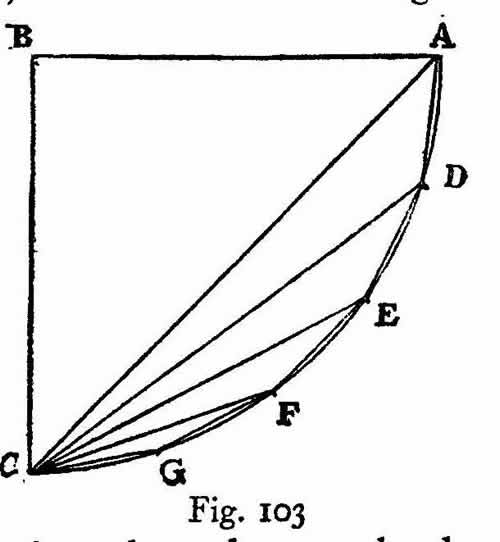
What has been proven for the quadrant holds true also for smaller arcs; the reasoning is the same.