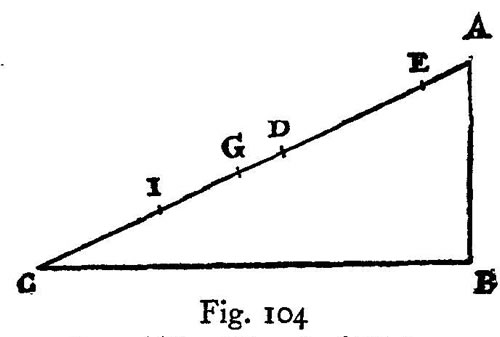
Given a limited vertical line and an inclined plane of equal altitude; it is required to find a distance on the inclined plane which is equal to the vertical line and which is traversed in an interval equal to the time of fall along the vertical line.
Let AB be the vertical line and AC the inclined plane. We must locate, on the inclined plane, a distance equal to the vertical line AB and which will be traversed by a body starting from rest at A in the same time needed for fall along the vertical line. Lay off AD equal to AB, and bisect the remainder DC at I. Choose the point E such that AC:CI=CI:AE and lay off DG equal to AE. Clearly EG is equal to AD, and also to AB. And further, I say that EG is that distance which will be traversed by a body, starting from rest at A, in the same time which is required for that body to fall through the distance AB. For since AC:CI=CI:AE=ID:DG, we have, convertendo, CA:AI=DI:IG. And since the whole of CA is to the whole of AI as the portion CI is to the portion IG, it follows that the remainder IA is to the remainder AG as the whole of CA is to the whole of AI. Thus AI is seen to be a mean proportional between CA and AG, while CI is a mean proportional between CA and AE. If therefore the time of fall along AB is represented by the length AB, the time along AC will be represented by AC, while CI, or ID, will measure the time along AE. Since AI is a mean proportional between CA and AG, and since CA is a measure of the time along the entire distance AC, it follows that AI is the time along AG, and the difference IC is the time along the difference GC; but DI was the time along AE. Consequently the lengths DI and IC measure the times along AE and CG respectively. Therefore the remainder DA represents the time along EG, which of course is equal to the time along AB.
q. e. f.
COROLLARY
From this it is clear that the distance sought is bounded at each end by portions of the inclined plane which are traversed in equal times.