Given an inclined plane and a limited vertical line, it is required to find a distance on the inclined plane which a body, starting from rest, will traverse in the same time as that needed to traverse both the vertical and the inclined plane.
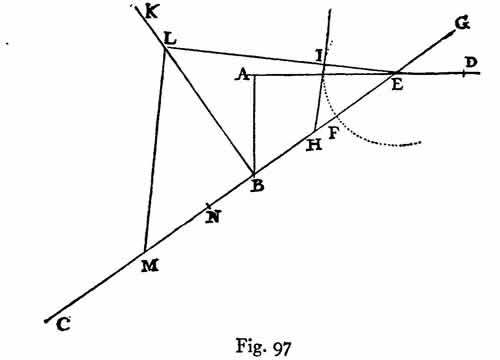
Let AB be the vertical line and BC the inclined plane. It is required to lay off on BC a distance which a body, starting from rest, will traverse in a time equal to that which is occupied by fall through the vertical AB and by descent of the plane. Draw the horizontal line AD, which intersects at E the prolongation of the inclined plane CB; lay off BF equal to BA, and about E as center, with EF as radius describe the circle FIG. Prolong FE until it intersects the circumference at G. Choose a point H such that GB:BF=BH:HF. Draw the line HI tangent to the circle at I. At B draw the line BK perpendicular to FC, cutting the line EIL at L; also draw LM perpendicular to EL and cutting BC at M. Then, I say, BM is the distance which a body, starting from rest at B, will traverse in the same time which is required to descend from rest at A through both distances, AB and BM. Lay off EN equal to EL; then since GB:BF=BH:HF, we shall have, permutando, GB:BH=BF:HF, and, dividendo, GH:BH=BH:HF. Consequently the rectangle GH.HF is equal to the square on BH; but this same rectangle is also equal to the square on HI; therefore BH is equal to HI. Since, in the quadrilateral ILBH, the sides HB and HI are equal and since the angles at B and I are right angles, it follows that the sides BL and LI are also equal: but EI=EF; therefore the total length LE, or NE, is equal to the sum of LB and EF. If we subtract the common part EF, the remainder FN will be equal to LB: but, by construction, FB=BA and, therefore, LB=AB+BN. If again we agree to represent the time of fall through AB by the length AB, then the time of descent along EB will be measured by EB; moreover since EN is a mean proportional between ME and EB it will represent the time of descent along the whole distance EM; therefore the difference of these distances, BM, will be traversed, after fall from EB, or AB, in a time which is represented by BN. But having already assumed the distance AB as a measure of the time of fall through AB, the time of descent along AB and BM is measured by AB+BN. Since EB measures the time of fall, from rest at E, along EB, the time from rest at B along BM will be the mean proportional between BE and BM, namely, BL. The time therefore for the path AB+BM, starting from rest at A is AB+BN; but the time for BM alone, starting from rest at B, is BL; and since it has already been shown that BL = AB + BN, the proposition follows.
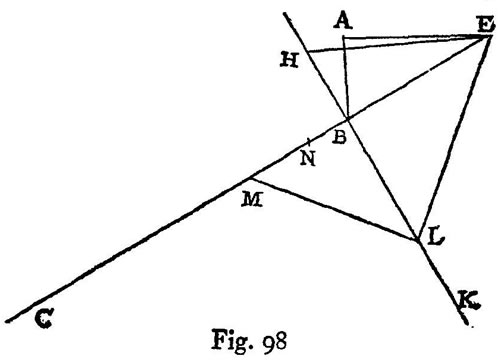
Another and shorter proof is the following: Let BC be the inclined plane and BA the vertical; at B draw a perpendicular to EC, extending it both ways; lay off BH equal to the excess of BE over BA; make the angle HEL equal to the angle BHE; prolong EL until it cuts BK in L; at L draw LM perpendicular to EL and extend it till it meets BC in M; then, I say, BM is the portion of BC sought. For, since the angle MLE is a right angle, BL will be a mean proportional between MB and BE, while LE is a mean proportional between ME and BE; lay off EN equal to LE; then NE=EL=LH, and HB=NE-BL. But also HB=NE-(NB+BA); therefore BN+BA=BL. If now we assume the length EB as a measure of the time of descent along EB, the time of descent, from rest at B, along BM will be represented by BL; but, if the descent along BM is from rest at E or at A, then the time of descent will be measured by BN; and AB will measure the time along AB. Therefore the time required to traverse AB and BM, namely, the sum of the distances AB and BN, is equal to the time of descent, from rest at B, along BM alone.
q. e. f.
LEMMA
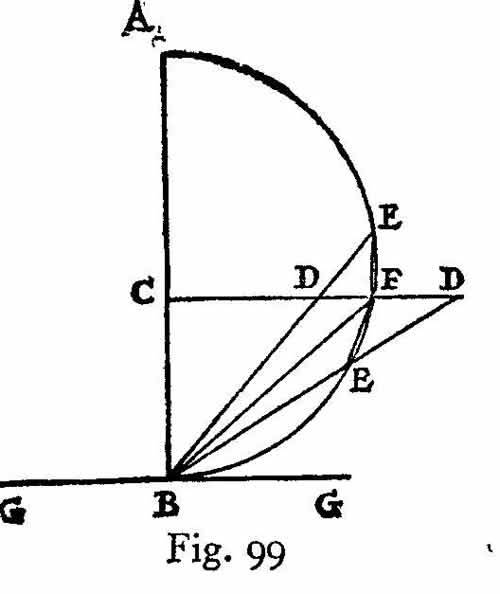
Let DC be drawn perpendicular to the diameter BA; from the extremity B draw the line BED at random; draw the line FB. Then, I say, FB is a mean proportional between DB and BE. Join the points E and F. Through B, draw the tangent BG which will be parallel to CD. Now, since the angle DBG is equal to the angle FDB, and since the alternate angle of GBD is equal to EFB, it follows that the triangles FDB and FEB are similar and hence BD:BF=FB:BE.
LEMMA
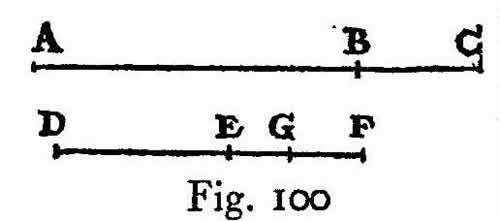
Let AC be a line which is longer than DF, and let the ratio of AB to BC be greater than that of DE to EF. Then, I say, AB is greater than DE. For, if AB bears to BC a ratio greater than that of DE to EF, then DE will bear to some length shorter than EF, the same ratio which AB bears to BC. Call this length EG; then since AB:BC=DE:EG, it follows, componendo et convertendo, that CA:AB=GD:DE. But since CA is greater than GD, it follows that BA is greater than DE.
LEMMA
Let ACIB be the quadrant of a circle; from B draw BE parallel to AC; about any point in the line BE describe a circle BOES, touching AB at B and intersecting the circumference of the quadrant at I. Join the points C and B; draw the line CI, prolonging it to S. Then, I say, the line CI is always less than CO. Draw the line AI touching the circle BOE. Then, if the line DI be drawn, it will be equal to DB; but, since DB touches the quadrant, DI will also be tangent to it and will be at right angles to AI; thus AI touches the circle BOE at I. And since the angle AIC is greater than the angle ABC, subtending as it does a larger arc, it follows that the angle SIN is also greater than the angle ABC. Wherefore the arc IES is greater than the arc BO, and the line CS, being nearer the center, is longer than CB. Consequently CO is greater than CI, since SC:CB=OC:CI.
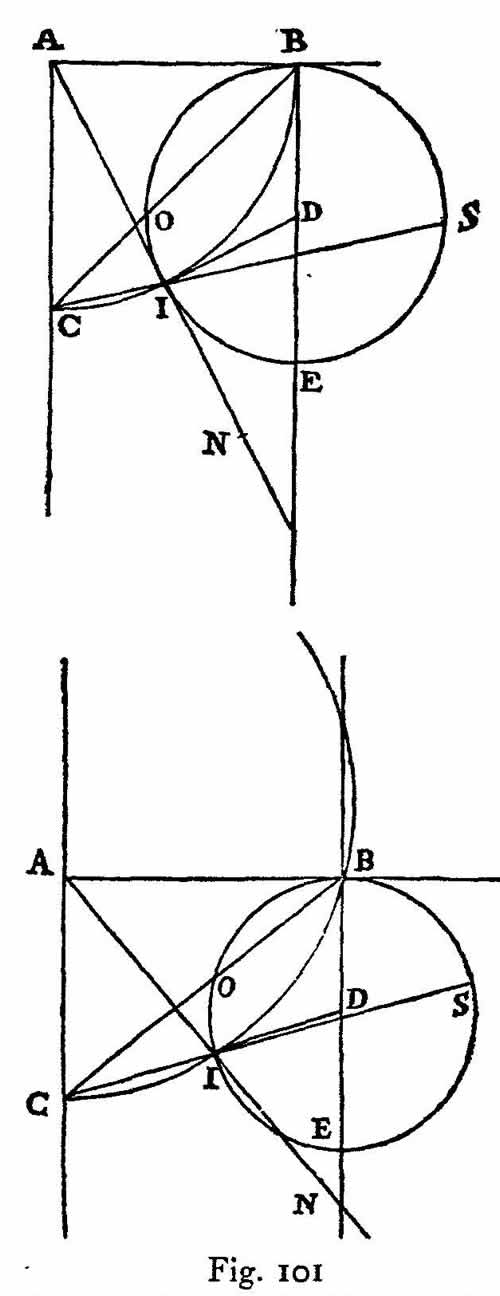
This result would be all the more marked if, as in the second figure, the arc BIC were less than a quadrant. For the perpendicular DB would then cut the circle CIB; and so also would DI which is equal to BD; the angle DIA would be obtuse and therefore the line AIN would cut the circle BIE. Since the angle ABC is less than the angle AIC, which is equal to SIN, and still less than the angle which the tangent at I would make with the line SI, it follows that the arc SEI is far greater than the arc BO; whence, etc.
q. e. d.