Given a limited inclined plane and a vertical line having their highest point in common, it is required to find a point in the vertical line extended such that a body will fall from it and then traverse the inclined plane in the same time which is required to traverse the inclined plane alone starting from rest at the top of said plane.
Let AC and AB be an inclined plane and a vertical line respectively, having a common highest point at A. It is required to find a point in the vertical line, above A, such that a body, falling from it and afterwards having its motion directed along AB, will traverse both the assigned part of the vertical line and the plane AB in the same time which is required for the plane AB alone, starting from rest at A. Draw BC a horizontal line and lay off AN equal to AC; choose the point L so that AB:BN=AL:LC, and lay off AI equal to AL; choose the point E such that CE, laid off on the vertical AC produced, will be a third proportional to AC and BI. Then, I say, CE is the distance sought; so that, if the vertical line is extended above A and if a portion AX is laid off equal to CE, then a body falling from X will traverse both the distances, XA and AB, in the same time as that required, when starting from A, to traverse AB alone.
Draw XR parallel to BC and intersecting BA produced in R; next draw ED parallel to BC and meeting BA produced in D; on AD as diameter describe a semicircle; from B draw BF perpendicular to AD, and prolong it till it meets the circumference of the circle; evidently FB is a mean proportional between AB and BD, while FA is a mean proportional between DA and AB. Take BS equal to BI and FH equal to FB. Now since AB:BD=AC:CE and since BF is a mean proportional between AB and BD, while BI is a mean proportional between AC and CE, it follows that BA:AC=FB:BS, and since BA:AC=BA:BN=FB:BS we shall have, convertendo, BF:FS=AB:BN=AL:LC. Consequently the rectangle formed by FB and CL is equal to the rectangle whose sides are AL and SF; moreover, this rectangle AL.SF is the excess of the rectangle AL.FB, or AI.BF, over the rectangle AI.BS, or AI.IB. But the rectangle FB.LC is the excess of the rectangle AC.BF over the rectangle AL.BF; and moreover the rectangle AC.BF is equal to the rectangle AB.BI since BA:AC=FB:BI; hence the excess of the rectangle AB.BI over the rectangle AI.BF, or AI.FH, is equal to the excess of the rectangle AI.FH over the rectangle AI.IB; therefore twice the rectangle AI.FH is equal to the sum of the rectangles AB.BI and AI.IB, or 2AI.FH=2AI.IB+BImacronsup2. Add AImacronsup2 to each side, then 2AI.IB+BImacronsup2 +AImacronsup2=ABmacronsup2=2AI.FH+AI2. Again add BFmacronsup2 to each side, then AB2+BF2=AFmacronsup2 = 2AI.FH + AImacronsup2 + BFmacronsup2 = 2AI.FH + AImacronsup2 + FHmacronsup2. But AFmacronsup2=2AH.HF + AHmacronsup2 + HFmacronsup2 and hence 2AI.FH + AImacronsup2 + FHmacronsup2 = 2AH.HF + AHmacronsup2 + HFmacronsup2. Subtracting HFmacronsup2 from each side we have 2AI.FH+AImacronsup2=2AH.HF+AHmacronsup2. Since now FH is a factor common to both rectangles, it follows that AH is equal to AI; for if AH were either greater or smaller than AI, then the two rectangles AH.HF plus the square of HA would be either larger or smaller than the two rectangles AI.FH plus the square of IA, a result which is contrary to what we have just demonstrated.
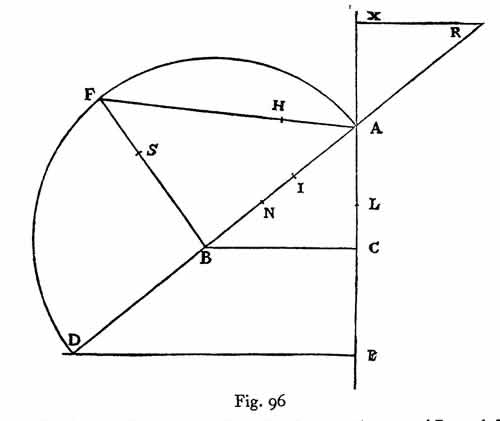
If now we agree to represent the time of descent along AB by the length AB, then the time through AC will likewise be measured by AC; and IB, which is a mean proportional between AC and CE, will represent the time through CE, or XA, from rest at X. Now, since AF is a mean proportional between DA and AB, or between RB and AB, and since BF, which is equal to FH, is a mean proportional between AB and BD, that is between AB and AR, it follows, from a preceding proposition [Proposition XIX, corollary], that the difference AH represents the time of descent along AB either from rest at R or after fall from X, while the time of descent along AB, from rest at A, is measured by the length AB. But as has just been shown, the time of fall through XA is measured by IB, while the time of descent along AB, after fall, through RA or through XA, is IA. Therefore the time of descent through XA plus AB is measured by the length AB, which, of course, also measures the time of descent, from rest at A, along AB alone.
q. e. f.