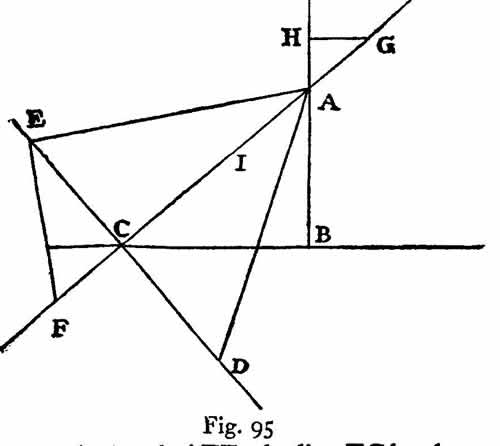
Given a limited vertical line and an inclined plane of equal height, having a common upper terminal; it is required to find a point on the vertical line, extended upwards, from which a body will fall and, when deflected along the inclined plane, will traverse it in the same time-interval which is required for fall, from rest, through the given vertical height.
Let AB be the given limited vertical line and AC an inclined plane having the same altitude. It is required to find on the vertical BA, extended above A, a point from which a falling body will traverse the distance AC in the same time which is spent in falling, from rest at A, through the given vertical line AB. Draw the line DCE at right angles to AC, and lay off CD equal to AB; also join the points A and D; then the angle ADC will be greater than the angle CAD, since the side CA is greater than either AB or CD. Make the angle DAE equal to the angle ADE, and draw EF perpendicular to AE; then EF will cut the inclined plane, extended both ways, at F. Lay off AI and AG each equal to CF; through G draw the horizontal line GH. Then, I say, H is the point sought.
For, if we agree to let the length AB represent the time of fall along the vertical AB, then AC will likewise represent the time of descent from rest at A, along AC; and since, in the right-angled triangle AEF, the line EC has been drawn from the right angle at E perpendicular to the base AF, it follows that AE will be a mean proportional between FA and AC, while CE will be a mean proportional between AC and CF, that is between CA and AI. Now, since AC represents the time of descent from A along AC, it follows that AE will be the time along the entire distance AF, and EC the time along AI. But since in the isosceles triangle AED the side EA is equal to the side ED it follows that ED will represent the time of fall along AF, while EC is the time of fall along AI. Therefore CD, that is AB, will represent the time of fall, from rest at A, along IF; which is the same as saying that AB is the time of fall, from G or from H, along AC.
e. f.