Given two unequal time-intervals, also the distance through which a body will fall along a vertical line, from rest, during the shorter of these intervals, it is required to pass through the highest point of this vertical line a plane so inclined that the time of descent along it will be equal to the longer of the given intervals.
Let A represent the longer and B the shorter of the two unequal time-intervals, also let CD represent the length of the vertical fall, from rest, during the time B. It is required to pass through the point C a plane of such a slope that it will be traversed in the time A.
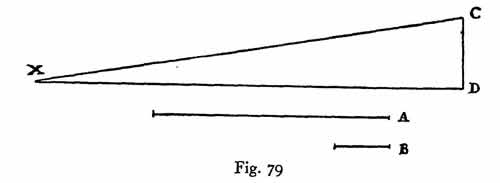
Draw from the point C to the horizontal a line CX of such a length that B:A=CD:CX. It is clear that CX is the plane along which a body will descend in the given time A. For it has been shown that the time of descent along an inclined plane bears to the time of fall through its vertical height the same ratio which the length of the plane bears to its vertical height. Therefore the time along CX is to the time along CD as the length CX is to the length CD, that is, as the time-interval A is to the time-interval B: but B is the time required to traverse the vertical distance, CD, starting from rest; therefore A is the time required for descent along the plane CX.