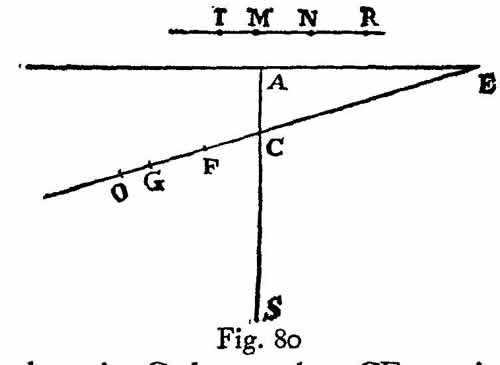
Given the time employed by a body in falling through a certain distance along a vertical line, it is required to pass through the lower terminus of this vertical fall, a plane so inclined that this body will, after its vertical fall, traverse on this plane, during a time-interval equal to that of the vertical fall, a distance equal to any assigned distance, provided this assigned distance is more than twice and less than three times, the vertical fall.
Let AS be any vertical line, and let AC denote both the length of the vertical fall, from rest at A, and also the time required for this fall. Let IR be a distance more than twice and less than three times, AC. It is required to pass a plane through the point C so inclined that a body, after fall through AC, will, during the time AC, traverse a distance equal to IR. Lay off RN and NM each equal to AC. Through the point C, draw a plane CE meeting the horizontal, AE, at such a point that IM:MN=AC:CE. Extend the plane to O, and lay off CF, FG and GO equal to RN, NM, and MI respectively. Then, I say, the time along the inclined plane CO, after fall through AC, is equal to the time of fall, from rest at A, through AC. For since OG:GF=FC:CE, it follows, componendo, that OF:FG=OF:FC=FE:EC, and since an antecedent is to its consequent as the sum of the antecedents is to the sum of the consequents, we have OE:EF=EF:EC. Thus EF is a mean proportional between OE and EC. Having agreed to represent the time of fall through AC by the length AC it follows that EC will represent the time along EC, and EF the time along the entire distance EO, while the difference CF will represent the time along the difference CO; but CF=CA; therefore the problem is solved. For the time CA is the time of fall, from rest at A, through CA while CF (which is equal to CA) is the time required to traverse CO after descent along EC or after fall through AC.
q. e. f.
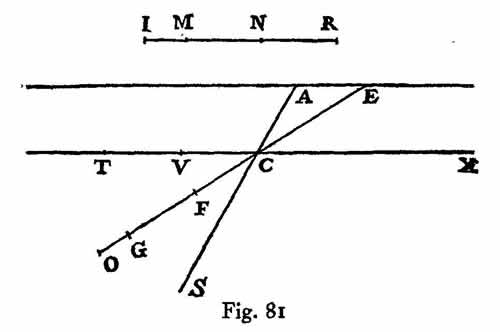
It is to be remarked also that the same solution holds if the antecedent motion takes place, not along a vertical, but along an inclined plane. This case is illustrated in the following figure where the antecedent motion is along the inclined plane AS underneath the horizontal AE. The proof is identical with the preceding.
SCHOLIUM
On careful attention, it will be clear that, the nearer the given line IR approaches to three times the length AC, the nearer the inclined plane, CO, along which the second motion takes place, approaches the perpendicular along which the space traversed, during the time AC, will be three times the distance AC. For if IR be taken nearly equal to three times AC, then IM will be almost equal to MN; and since, by construction, IM:MN=AC:CE, it follows that CE is but little greater than CA: consequently the point E will lie near the point A, and the lines CO and CS, forming a very acute angle, will almost coincide. But, on the other hand, if the given line, IR, be only the least bit longer than twice AC, the line IM will be very short; from which it follows that AC will be very small in comparison with CE which is now so long that it almost coincides with the horizontal line drawn through C. Hence we can infer that, if, after descent along the inclined plane AC of the adjoining figure, the motion is continued along a horizontal line, such as CT, the distance traversed by a body, during a time equal to the time of fall through AC, will be exactly twice the distance AC. The argument here employed is the same as the preceding. For it is clear, since OE:EF=EF:EC, that FC measures the time of descent along CO. But, if the horizontal line TC which is twice as long as CA, be divided into two equal parts at V then this line must be extended indefinitely in the direction of X before it will intersect the line AE produced; and accordingly the ratio of the infinite length TX to the infinite length VX is the same as the ratio of the infinite distance VX to the infinite distance CX.
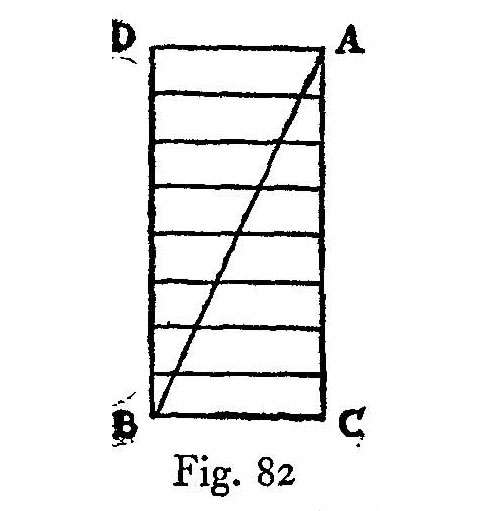
The same result may be obtained by another method of approach, namely, by returning to the same line of argument which was employed in the proof of the first proposition. Let us consider the triangle ABC, which, by lines drawn parallel to its base, represents for us a velocity increasing in proportion to the time; if these lines are infinite in number, just as the points in the line AC are infinite or as the number of instants in any interval of time is infinite, they will form the area of the triangle. Let us now suppose that the maximum velocity attained—that represented by the line BC—to be continued, without acceleration and at constant value through another interval of time equal to the first. From these velocities will be built up, in a similar manner, the area of the parallelogram ADBC, which is twice that of the triangle ABC; accordingly the distance traversed with these velocities during any given interval of time will be twice that traversed with the velocities represented by the triangle during an equal interval of time. But along a horizontal plane the motion is uniform since here it experiences neither acceleration nor retardation; therefore we conclude that the distance CD traversed during a time-interval equal to AC is twice the distance AC; for the latter is covered by a motion, starting from rest and increasing in speed in proportion to the parallel lines in the triangle, while the former is traversed by a motion represented by the parallel lines of the parallelogram which, being also infinite in number, yield an area twice that of the triangle.
Furthermore we may remark that any velocity once imparted to a moving body will be rigidly maintained as long as the external causes of acceleration or retardation are removed, a condition which is found only on horizontal planes; for in the case of planes which slope downwards there is already present a cause of acceleration, while on planes sloping upward there is retardation; from this it follows that motion along a horizontal plane is perpetual; for, if the velocity be uniform, it cannot be diminished or slackened, much less destroyed. Further, although any velocity which a body may have acquired through natural fall is permanently maintained so far as its own nature [suapte natura] is concerned, yet it must be remembered that if, after descent along a plane inclined downwards, the body is deflected to a plane inclined upward, there is already existing in this latter plane a cause of retardation; for in any such plane this same body is subject to a natural acceleration downwards. Accordingly we have here the superposition of two different states, namely, the velocity acquired during the preceding fall which if acting alone would carry the body at a uniform rate to infinity, and the velocity which results from a natural acceleration downwards common to all bodies. It seems altogether reasonable, therefore, if we wish to trace the future history of a body which has descended along some inclined plane and has been deflected along some plane inclined upwards, for us to assume that the maximum speed acquired during descent is permanently maintained during the ascent. In the ascent, however, there supervenes a natural inclination downwards, namely, a motion which, starting from rest, is accelerated at the usual rate. If perhaps this discussion is a little obscure, the following figure will help to make it clearer.
Let us suppose that the descent has been made along the downward sloping plane AB, from which the body is deflected so as to continue its motion along the upward sloping plane BC; and first let these planes be of equal length and placed so as to make equal angles with the horizontal line GH. Now it is well known that a body, starting from rest at A, and descending along AB, acquires a speed which is proportional to the time, which is a maximum at B, and which is maintained by the body so long as all causes of fresh acceleration or retardation are removed; the acceleration to which I refer is that to which the body would be subject if its motion were continued along the plane AB extended, while the retardation is that which the body would encounter if its motion were deflected along the plane BC inclined upwards; but, upon the horizontal plane GH, the body would maintain a uniform velocity equal to that which it had acquired at B after fall from A; moreover this velocity is such that, during an interval of time equal to the time of descent through AB, the body will traverse a horizontal distance equal to twice AB. Now let us imagine this same body to move with the same uniform speed along the plane BC so that here also during a time-interval equal to that of descent along AB, it will traverse along BC extended a distance twice AB; but let us suppose that, at the very instant the body begins its ascent it is subjected, by its very nature, to the same influences which surrounded it during its descent from A along AB, namely, it descends from rest under the same acceleration as that which was effective in AB, and it traverses, during an equal interval of time, the same distance along this second plane as it did along AB; it is clear that, by thus superposing upon the body a uniform motion of ascent and an accelerated motion of descent, it will be carried along the plane BC as far as the point C where these two velocities become equal.
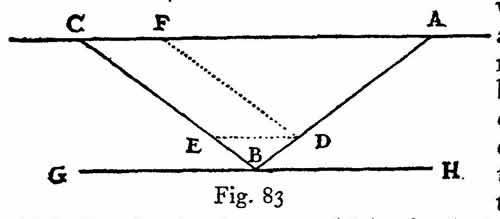
If now we assume any two points D and E, equally distant from the vertex B, we may then infer that the descent along BD takes place in the same time as the ascent along BE. Draw DF parallel to BC; we know that, after descent along AD, the body will ascend along DF; or, if, on reaching D, the body is carried along the horizontal DE, it will reach E with the same momentum [impetus] with which it left D; hence from E the body will ascend as far as C, proving that the velocity at E is the same as that at D.
From this we may logically infer that a body which descends along any inclined plane and continues its motion along a plane inclined upwards will, on account of the momentum acquired, ascend to an equal height above the horizontal; so that if the descent is along AB the body will be carried up the plane BC as far as the horizontal line ACD: and this is true whether the inclinations of the planes are the same or different, as in the case of the planes AB and BD. But by a previous postulate [p. 184] the speeds acquired by fall along variously inclined planes having the same vertical height are the same. If therefore the planes EB and BD have the same slope, the descent along EB will be able to drive the body along BD as far as D; and since this propulsion comes from the speed acquired on reaching the point B, it follows that this speed at B is the same whether the body has made its descent along AB or EB. Evidently then the body will be carried up BD whether the descent has been made along AB or along EB. The time of ascent along BD is however greater than that along BC, just as the descent along EB occupies more time than that along AB; moreover it has been demonstrated that the ratio between the lengths of these times is the same as that between the lengths of the planes. We must next discover what ratio exists between the distances traversed in equal times along planes of different slope, but of the same elevation, that is, along planes which are included between the same parallel horizontal lines. This is done as follows: