If, on the path of a body falling vertically from rest, one lays off a portion which is traversed in any time you please and whose upper terminus coincides with the point where the motion begins, and if this fall is followed by a motion deflected along any inclined plane, then the space traversed along the inclined plane, during a time-interval equal to that occupied in the previous vertical fall, will be greater than twice, and less than three times, the length of the vertical fall.
Let AB be a vertical line drawn downwards from the horizontal line AE, and let it represent the path of a body falling from rest at A; choose any portion AC of this path. Through C draw any inclined plane, CG, along which the motion is continued after fall through AC. Then, I say, that the distance traversed along this plane CG, during the time-interval equal to that of the fall through AC, is more than twice, but less than three times, this same distance AC. Let us lay off CF equal to AC, and extend the plane GC until it meets the horizontal in E; choose G such that CE:EF=EF:EG. If now we assume that the time of fall along AC is represented by the length AC, then CE will represent the time of descent along CE, while CF, or CA, will represent the time of descent along CG. It now remains to be shown that the distance CG is more than twice, and less than three times, the distance CA itself. Since CE:EF=EF:EG, it follows that CE:EF=CF:FG; but EC<EF; therefore CF will be less than FG and GC will be more than twice FC, or AC. Again since FE<2EC (for EC is greater than CA, or CF), we have GF less than twice FC, and also GC less than three times CF, or CA.
q. e. d.
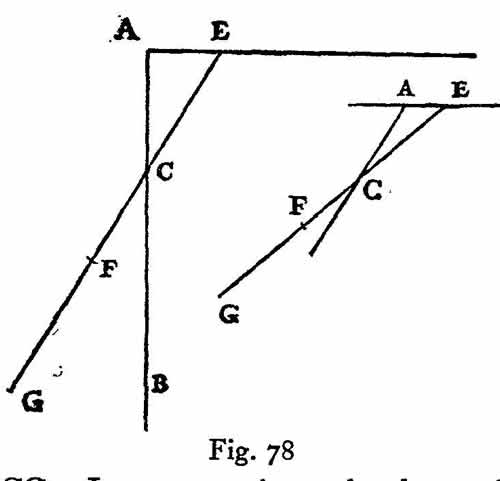
This proposition may be stated in a more general form; since what has been proven for the case of a vertical and inclined plane holds equally well in the case of motion along a plane of any inclination followed by motion along any plane of less steepness, as can be seen from the adjoining figure. The method of proof is the same.