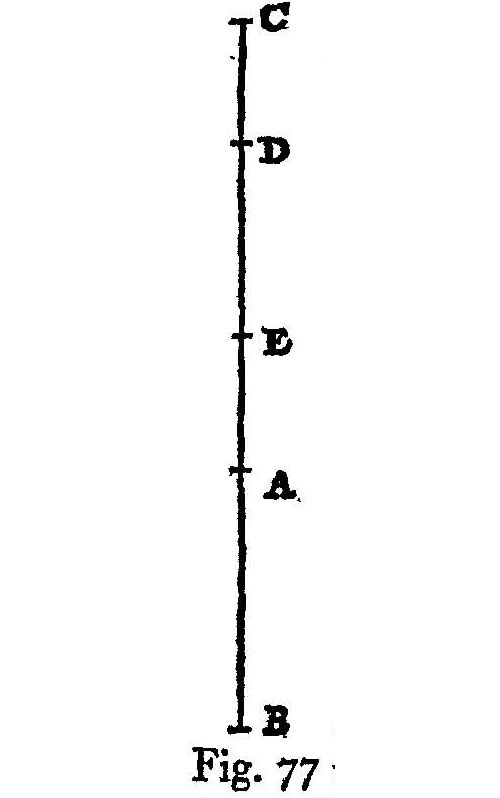
Given any distance whatever and a portion of it laid off from the point at which motion begins, it is required to find another portion which lies at the other end of the distance and which is traversed in the same time as the first given portion.
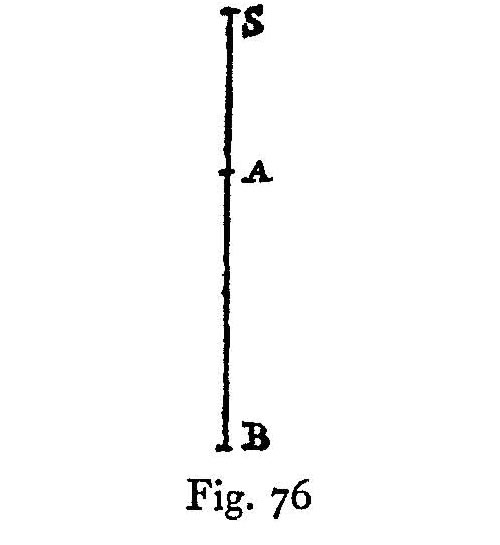
Let the given distance be CB and let CD be that part of it which is laid off from the beginning of motion. It is required to find another part, at the end B, which is traversed in the same time as the assigned portion CD. Let BA be a mean proportional between BC and CD; also let CE be a third proportional to BC and CA. Then, I say, EB will be the distance which, after fall from C, will be traversed in the same time as CD itself. For if we agree that CB shall represent the time through the entire distance CB, then BA (which, of course, is a mean proportional between BC and CD) will represent the time along CD; and since CA is a mean proportional between BC and CE, it follows that CA will be the time through CE; but the total length CB represents the time through the total distance CB. Therefore the difference BA will be the time along the difference of distances, EB, after falling from C; but this same BA was the time of fall through CD. Consequently the distances CD and EB are traversed, from rest at A, in equal times.
q. e. f.