Given the distance through which a body falls in a vertical line from rest and given also the time of fall, it is required to find the time in which the same body will, later, traverse an equal distance chosen anywhere in the same vertical line.
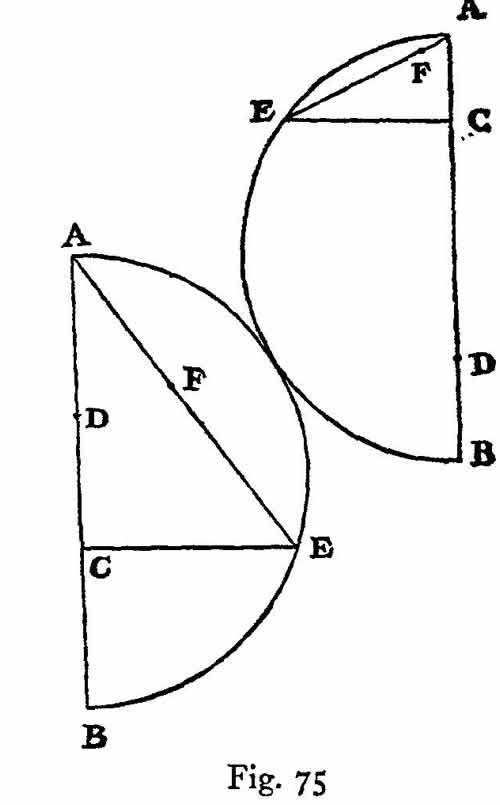
On the vertical line AB, lay off AC equal to the distance fallen from rest at A, also locate at random an equal distance DB. Let the time of fall through AC be represented by the length AC. It is required to find the time necessary to traverse DB after fall from rest at A. About the entire length AB describe the semicircle AEB; from C draw CE perpendicular to AB; join the points A and E; the line AE will be longer than EC; lay off EF equal to EC. Then, I say, the difference FA will represent the time required for fall through DB. For since AE is a mean proportional between BA and AC and since AC represents the time of fall through AC, it follows that AE will represent the time through the entire distance AB. And since CE is a mean proportional between DA and AC (seeing that DA=BC) it follows that CE, that is, EF, will represent the time of fall through AD. Hence the difference AF will represent the time of fall through the difference DB.
q. e. d.
COROLLARY
Hence it is inferred that if the time of fall from rest through any given distance is represented by that distance itself, then the time of fall, after the given distance has been increased by a certain amount, will be represented by the excess of the mean proportional between the increased distance and the original distance over the mean proportional between the original distance and the increment. Thus, for instance, if we agree that AB represents the time of fall, from rest at A, through the distance AB, and that AS is the increment, the time required to traverse AB, after fall through SA, will be the excess of the mean proportional between SB and BA over the mean proportional between BA and AS.