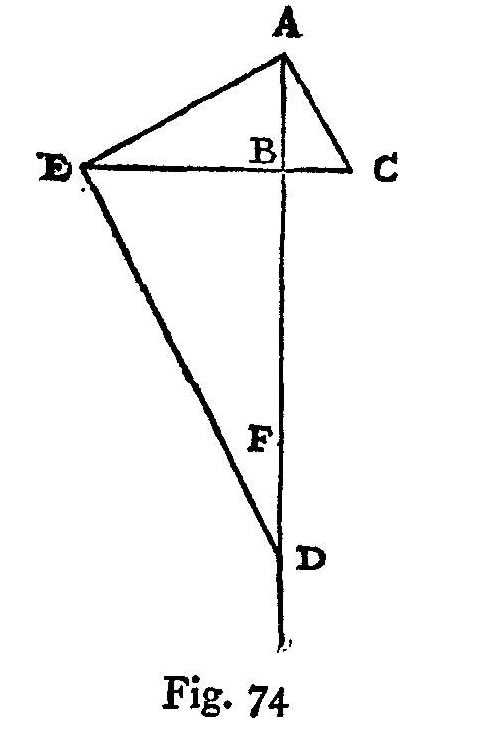
Given the distance through which a body will fall vertically from rest during a given time-interval, and given also a smaller time-interval, it is required to locate another [equal] vertical distance which the body will traverse during this given smaller time-interval.
Let the vertical line be drawn through A, and on this line lay off the distance AB which is traversed by a body falling from rest at A, during a time which may also be represented by AB. Draw the horizontal line CBE, and on it lay off BC to represent the given interval of time which is shorter than AB. It is required to locate, in the perpendicular above mentioned, a distance which is equal to AB and which will be described in a time equal to BC. Join the points A and C; then, since BC<BA, it follows that the angle BAC<angle BCA. Construct the angle CAE equal to BCA and let E be the point where AE intersects the horizontal line; draw ED at right angles to AE, cutting the vertical at D; lay off DF equal to BA. Then, I say, that FD is that portion of the vertical which a body starting from rest at A will traverse during the assigned time-interval BC. For, if in the right-angled triangle AED a perpendicular be drawn from the right-angle at E to the opposite side AD, then AE will be a mean proportional between DA and AB while BE will be a mean proportional between BD and BA, or between FA and AB (seeing that FA is equal to DB); and since it has been agreed to represent the time of fall through AB by the distance AB, it follows that AE, or EC, will represent the time of fall through the entire distance AD, while EB will represent the time through AF. Consequently the remainder BC will represent the time of fall through the remaining distance FD.
q. e. f.