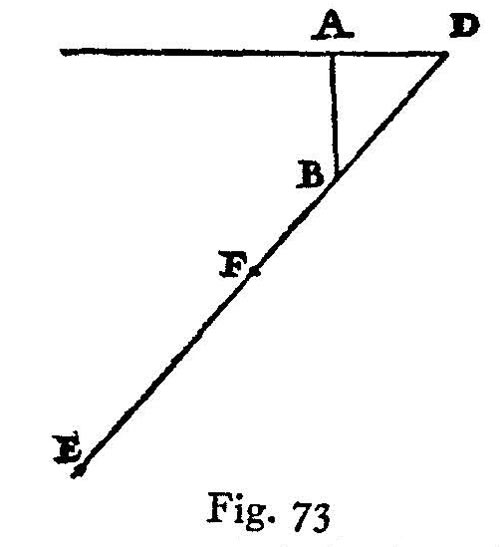
Given a vertical line and an inclined plane, it is required to lay off a distance along the given plane which will be traversed by a body, after fall along the perpendicular, in the same time-interval which is needed for this body to fall from rest through the given perpendicular.
Let AB be the vertical line and BE the inclined plane. The problem is to determine on BE a distance such that a body, after falling through AB, will traverse it in a time equal to that required to traverse the perpendicular AB itself, starting from rest.
Draw the horizontal AD and extend the plane until it meets this line in D. Lay off FB equal to BA; and choose the point E such that BD:FD=DF:DE. Then, I say, the time of descent along BE, after fall through AB, is equal to the time of fall, from rest at A, through AB. For, if we assume that the length AB represents the time of fall through AB, then the time of fall through DB will be represented by the time DB; and since BD:FD=DF:DE, it follows that DF will represent the time of descent along the entire plane DE while BF represents the time through the portion BE starting from rest at D; but the time of descent along BE after the preliminary descent along DB is the same as that after a preliminary fall through AB. Hence the time of descent along BE after AB will be BF which of course is equal to the time of fall through AB from rest at A.
q. e. f.