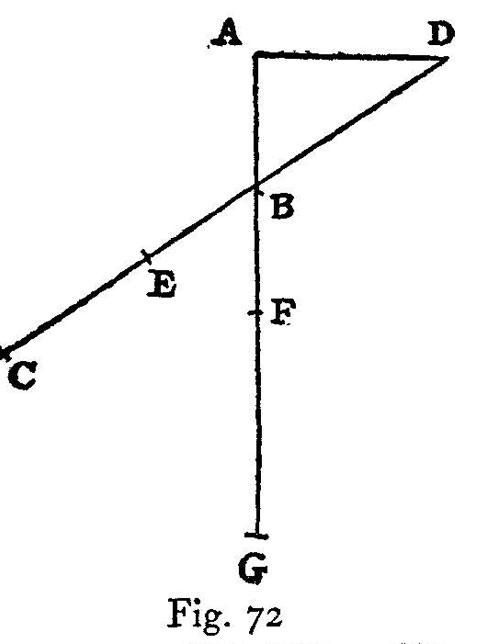
If a limited inclined plane and a limited vertical line are drawn from the same point, and if the time required for a body, starting from rest, to traverse each of these is the same, then a body falling from any higher altitude will traverse the inclined plane in less time than is required for the vertical line.
Let EB be the vertical line and CE the inclined plane, both starting from the common point E, and both traversed in equal times by a body starting from rest at E; extend the vertical line upwards to any point A, from which falling bodies are allowed to start. Then, I say that, after the fall through AE, the inclined plane EC will be traversed in less time than the perpendicular EB. Join CB, draw the horizontal AD, and prolong CE backwards until it meets the latter in D; let DF be a mean proportional between CD and DE while AG is made a mean proportional between BA and AE. Draw FG and DG; then since the times of descent along EC and EB, starting from rest at E, are equal, it follows, according to Corollary II of Proposition VI that the angle at C is a right angle; but the angle at A is also a right angle and the angles at the vertex E are equal; hence the triangles AED and CEB are equiangular and the sides about the equal angles are proportional; hence BE:EC=DE:EA. Consequently the rectangle BE.EA is equal to the rectangle CE.ED; and since the rectangle CD.DE exceeds the rectangle CE.ED by the square of ED, and since the rectangle BA.AE exceeds the rectangle BE.EA by the square of EA, it follows that the excess of the rectangle CD.DE over the rectangle BA.AE, or what is the same thing, the excess of the square of FD over the square of AG, will be equal to the excess of the square of DE over the square of AE, which excess is equal to the square of AD. Therefore FDmacronsup2=GAmacronsup2 + ADmacronsup2=GDmacronsup2. Hence DF is equal to DG, and the angle DGF is equal to the angle DFG while the angle EGF is less than the angle EFG, and the opposite side EF is less than the opposite side EG. If now we agree to represent the time of fall through AE by the length AE, then the time along DE will be represented by DE. And since AG is a mean proportional between BA and AE, it follows that AG will represent the time of fall through the total distance AB, and the difference EG will represent the time of fall, from rest at A, through the difference of path EB.
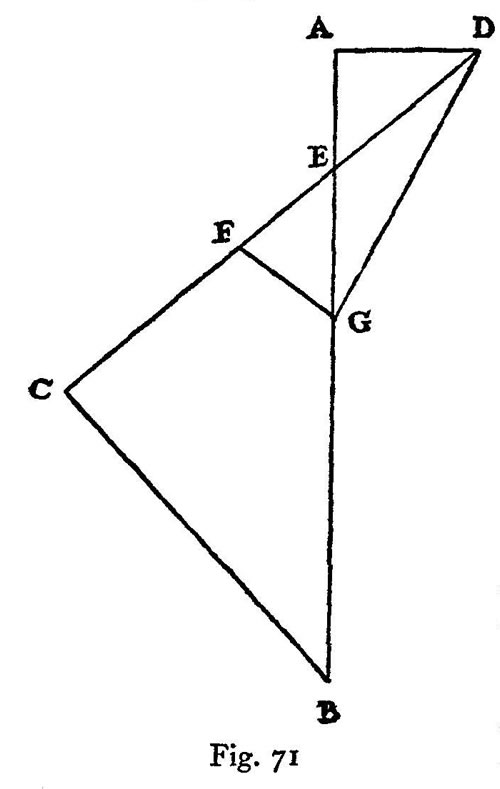
In like manner EF represents the time of descent along EC, starting from rest at D or falling from rest at A. But it has been shown that EF is less than EG; hence follows the theorem.
COROLLARY
From this and the preceding proposition, it is clear that the vertical distance covered by a freely falling body, after a preliminary fall, and during the time-interval required to traverse an inclined plane, is greater than the length of the inclined plane, but less than the distance traversed on the inclined plane during an equal time, without any preliminary fall. For since we have just shown that bodies falling from an elevated point A will traverse the plane EC in Fig. 71 in a shorter time than the vertical EB, it is evident that the distance along EB which will be traversed during a time equal to that of descent along EC will be less than the whole of EB. But now in order to show that this vertical distance is greater than the length of the inclined plane EC, we reproduce Fig. 70 of the preceding theorem in which the vertical length BG is traversed in the same time as BC after a preliminary fall through AB. That BG is greater than BC is shown as follows: since BE and FB are equal while BA is less than BD, it follows that FB will bear to BA a greater ratio than EB bears to BD; and, componendo, FA will bear to BA a greater ratio than ED to DB; but FA:AB=GF:FB (since AF is a mean proportional between BA and AG) and in like manner ED:BD=CE:EB. Hence GB bears to BF a greater ratio than CB bears to BE; therefore GB is greater than BC.