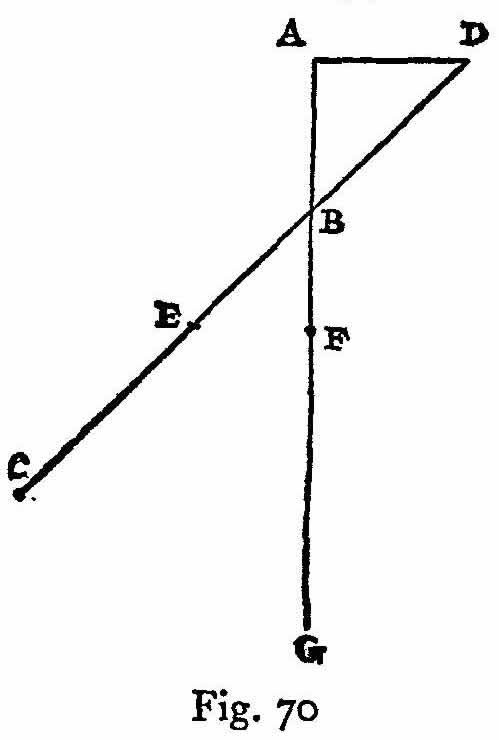
Given a vertical line and a plane inclined to it, it is required to find a length on the vertical line below its point of intersection which will be traversed in the same time as the inclined plane, each of these motions having been preceded by a fall through the given vertical line.
Let AB represent the vertical line and BC the inclined plane; it is required to find a length on the perpendicular below its point of intersection, which after a fall from A will be traversed in the same time which is needed for BC after an identical fall from A. Draw the horizontal AD, intersecting the prolongation of CB at D; let DE be a mean proportional between CD and DB; lay off BF equal to BE; also let AG be a third proportional to BA and AF. Then, I say, BG is the distance which a body, after falling through AB, will traverse in the same time which is needed for the plane BC after the same preliminary fall. For if we assume that the time of fall along AB is represented by AB, then the time for DB will be represented by DB. And since DE is a mean proportional between BD and DC, this same DE will represent the time of descent along the entire distance DC while BE will represent the time required for the difference of these paths, namely, BC, provided in each case the fall is from rest at D or at A. In like manner we may infer that BF represents the time of descent through the distance BG after the same preliminary fall; but BF is equal to BE. Hence the problem is solved.