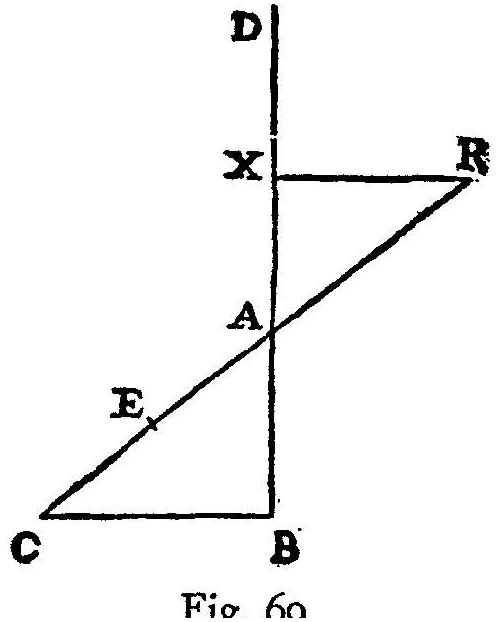
Given an inclined plane and a perpendicular passing through it, to find a length on the upper part of the perpendicular through which a body will fall from rest in the same time which is required to traverse the inclined plane after fall through the vertical distance just determined.
Let AC be the inclined plane and DB the perpendicular. It is required to find on the vertical AD a length which will be traversed by a body, falling from rest, in the same time which is needed by the same body to traverse the plane AC after the aforesaid fall. Draw the horizontal CB; lay off AE such that BA + 2AC:AC=AC:AE, and lay off AR such that BA:AC=EA:AR. From R draw RX perpendicular to DB; then, I say, X is the point sought. For since BA + 2AC:AC=AC:AE, it follows, dividendo, that BA + AC:AC=CE:AE. And since BA:AC=EA:AR, we have, componendo, BA + AC:AC=ER:RA. But BA + AC:AC=CE:AE, hence CE:EA=ER:RA=sum of the antecedents: sum of the consequents=CR:RE. Thus RE is seen to be a mean proportional between CR and RA. Moreover since it has been assumed that BA:AC=EA:AR, and since by similar triangles we have BA:AC=XA:AR, it follows that EA:AR=XA:AR. Hence EA and XA are equal. But if we agree that the time of fall through RA shall be represented by the length RA, then the time of fall along RC will be represented by the length RE which is a mean proportional between RA and RC; likewise AE will represent the time of descent along AC after descent along RA or along AX. But the time of fall through XA is represented by the length XA, while RA represents the time through RA. But it has been shown that XA and AE are equal.
q. e. f.