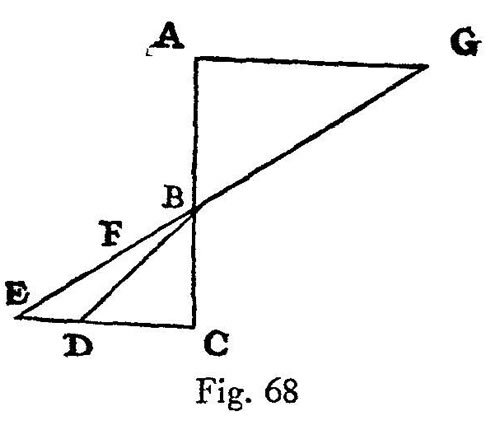
Given a perpendicular line of limited length, it is required to find a plane having a vertical height equal to the given perpendicular and so inclined that a body, having fallen from rest along the perpendicular, will make its descent along the inclined plane in the same time which it occupied in falling through the given perpendicular.
Let AB denote the given perpendicular: prolong this line to C making BC equal to AB, and draw the horizontal lines CE and AG. It is required to draw a plane from B to the horizontal line CE such that after a body starting from rest at A has fallen through the distance AB, it will complete its path along this plane in an equal time. Lay off CD equal to BC, and draw the line BD. Construct the line BE equal to the sum of BD and DC; then, I say, BE is the required plane. Prolong EB till it intersects the horizontal AG at G. Let GF be a mean proportional between GE and GB; then EF:FB=EG:GF, and EFmacronsup2:FBmacronsup2=EGmacronsup2:GFmacronsup2=EG:GB. But EG is twice GB; hence the square of EF is twice the square of FB; so also is the square of DB twice the square of BC. Consequently EF:FB=DB:BC, and componendo et permutando, EB:DB + BC=BF:BC. But EB=DB + BC; hence BF=BC=BA. If we agree that the length AB shall represent the time of fall along the line AB, then GB will represent the time of descent along GB, and GF the time along the entire distance GE; therefore BF will represent the time of descent along the difference of these paths, namely, BE, after fall from G or from A.
q. e. f.