If a vertical plane and any inclined plane are limited by two horizontals, and if we take mean proportionals between the lengths of these planes and those portions of them which lie between their point of intersection and the upper horizontal, then the time of fall along the perpendicular bears to the time required to traverse the upper part of the perpendicular plus the time required to traverse the lower part of the intersecting plane the same ratio which the entire length of the vertical bears to a length which is the sum of the mean proportional on the vertical plus the excess of the entire length of the inclined plane over its mean proportional.
Let AF and CD be two horizontal planes limiting the vertical plane AC and the inclined plane DF; let the two last-mentioned planes intersect at B. Let AR be a mean proportional between the entire vertical AC and its upper part AB; and let FS be a mean proportional between FD and its upper part FB. Then, I say, the time of fall along the entire vertical path AC bears to the time of fall along its upper portion AB plus the time of fall along the lower part of the inclined plane, namely, BD, the same ratio which the length AC bears to the mean proportional on the vertical, namely, AR, plus the length SD which is the excess of the entire plane DF over its mean proportional FS.
Join the points R and S giving a horizontal line RS. Now since the time of fall through the entire distance AC is to the time along the portion AB as CA is to the mean proportional AR it follows that, if we agree to represent the time of fall through AC by the distance AC, the time of fall through the distance AB will be represented by AR; and the time of descent through the remainder, BC, will be represented by RC. But, if the time along AC is taken to be equal to the length AC, then the time along FD will be equal to the distance FD; and we may likewise infer that the time of descent along BD, when preceded by a fall along FB or AB, is numerically equal to the distance DS. Therefore the time required to fall along the path AC is equal to AR plus RC; while the time of descent along the broken line ABD will be equal to AR plus SD.
q. e. d.
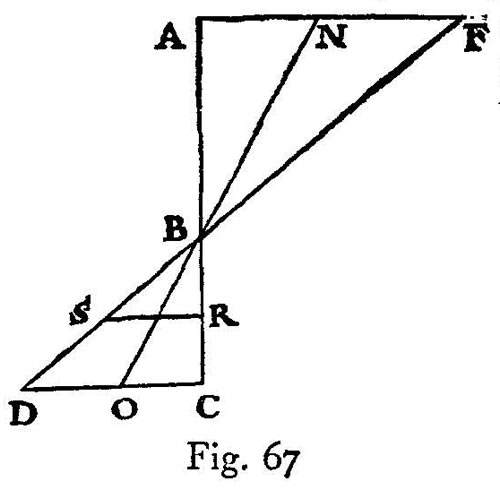
The same thing is true if, in place of a vertical plane, one takes any other plane, as for instance NO; the method of proof is also the same.