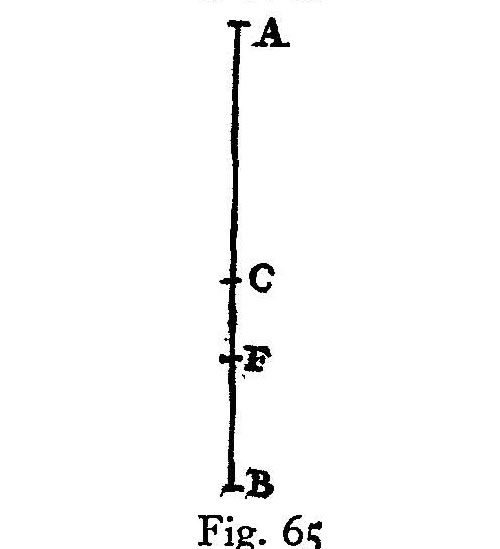
If a plane be divided into any two parts and if motion along it starts from rest, then the time of descent along the first part is to the time of descent along the remainder as the length of this first part is to the excess of a mean proportional between this first part and the entire length over this first part.
Let the fall take place, from rest at A, through the entire distance AB which is divided at any point C; also let AF be a mean proportional between the entire length BA and the first part AC; then CF will denote the excess of the mean proportional FA over the first part AC. Now, I say, the time of descent along AC will be to the time of subsequent fall through CB as the length AC is to CF. This is evident, because the time along AC is to the time along the entire distance AB as AC is to the mean proportional AF. Therefore, dividendo, the time along AC will be to the time along the remainder CB as AC is to CF. If we agree to represent the time along AC by the length AC then the time along CB will be represented by CF.
q. e. d.
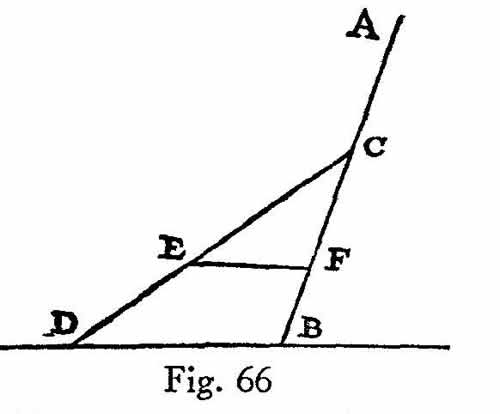
In case the motion is not along the straight line ACB but along the broken line ACD to the horizontal line BD, and if from F we draw the horizontal line FE, it may in like manner be proved that the time along AC is to the time along the inclined line CD as AC is to CE. For the time along AC is to the time along CB as AC is to CF; but it has already been shown that the time along CB, after the fall through the distance AC, is to the time along CD, after descent through the same distance AC, as CB is to CD, or, as CF is to CE; therefore, ex æquali, the time along AC will be to the time along CD as the length AC is to the length CE.