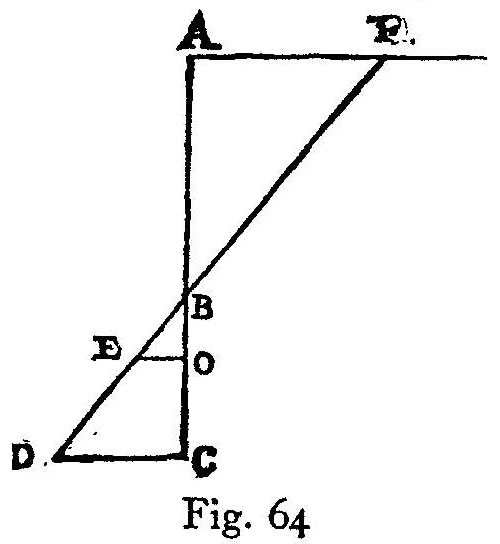
The times of descent along inclined planes of the same height, but of different slope, are to each other as the lengths of these planes; and this is true whether the motion starts from rest or whether it is preceded by a fall from a constant height.
Let the paths of descent be along ABC and ABD to the horizontal plane DC so that the falls along BD and BC are preceded by the fall along AB; then, I say, that the time of descent along BD is to the time of descent along BC as the length BD is to BC. Draw the horizontal line AF and extend DB until it cuts this line at F; let FE be a mean proportional between DF and FB; draw EO parallel to DC; then AO will be a mean proportional between CA and AB. If now we represent the time of fall along AB by the length AB, then the time of descent along FB will be represented by the distance FB; so also the time of fall through the entire distance AC will be represented by the mean proportional AO: and for the entire distance FD by FE. Hence the time of fall along the remainder, BC, will be represented by BO, and that along the remainder, BD, by BE; but since BE:BO=BD:BC, it follows, if we allow the bodies to fall first along AB and FB, or, what is the same thing, along the common stretch AB, that the times of descent along BD and BC will be to each other as the lengths BD and BC.
But we have previously proven that the time of descent, from rest at B, along BD is to the time along BC in the ratio which the length BD bears to BC. Hence the times of descent along different planes of constant height are to each other as the lengths of these planes, whether the motion starts from rest or is preceded by a fall from a constant height.
q. e. d.