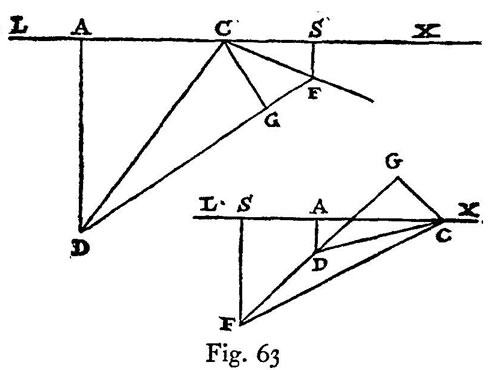
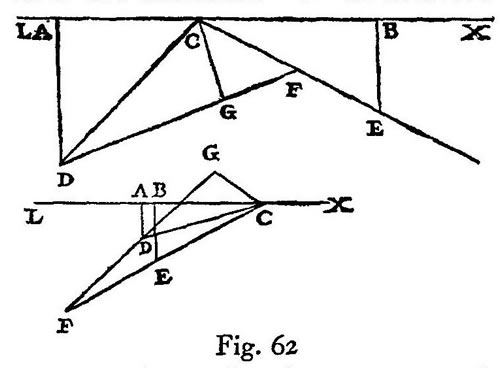
If from any point on a horizontal line two planes, inclined at any angle, are drawn, and if they are cut by a line which makes with them angles alternately equal to the angles between these planes and the horizontal, then the times required to traverse those portions of the plane cut off by the aforesaid line are equal.
Through the point C on the horizontal line X, draw two planes CD and CE inclined at any angle whatever: at any point in the line CD lay off the angle CDF equal to the angle XCE; let the line DF cut CE at F so that the angles CDF and CFD are alternately equal to XCE and LCD; then, I say, the times of descent over CD and CF are equal. Now since the angle CDF is equal to the angle XCE by construction, it is evident that the angle CFD must be equal to the angle DCL. For if the common angle DCF be subtracted from the three angles of the triangle CDF, together equal to two right angles, (to which are also equal all the angles which can be described about the point C on the lower side of the line LX) there remain in the triangle two angles, CDF and CFD, equal to the two angles XCE and LCD; but, by hypothesis, the angles CDF and XCE are equal; hence the remaining angle CFD is equal to the remainder DCL. Take CE equal to CD; from the points D and E draw DA and EB perpendicular to the horizontal line XL; and from the point C draw CG perpendicular to DF. Now since the angle CDG is equal to the angle ECB and since DGC and CBE are right angles, it follows that the triangles CDG and CBE are equiangular; consequently DC:CG=CE:EB. But DC is equal to CE, and therefore CG is equal to EB. Since also the angles at C and at A, in the triangle DAC, are equal to the angles at F and G in the triangle CGF, we have CD:DA=FC:CG and, permutando, DC:CF=DA:CG=DA:BE. Thus the ratio of the heights of the equal planes CD and CE is the same as the ratio of the lengths DC and CF. Therefore, by Corollary I of Prop. VI, the times of descent along these planes will be equal.
q. e. d.
An alternative proof is the following: Draw FS perpendicular to the horizontal line AS. Then, since the triangle CSF is similar to the triangle DGC, we have SF:FC=GC:CD; and since the triangle CFG is similar to the triangle DCA, we have FC:CG=CD:DA. Hence, ex æquali, SF:CG=CG:DA. Therefore CG is a mean proportional between SF and DA, while DA:SF=DAmacronsup2:CGmacronsup2. Again since the triangle ACD is similar to the triangle CGF, we have DA:DC=GC:CF and, permutando, DA:CG = DC:CF: also DAmacronsup2:CGmacronsup2=DCmacronsup2:CFmacronsup2. But it has been shown that DAmacronsup2:CGmacronsup2=DA:SF. Therefore DCmacronsup2:CFmacronsup2=DA:FS. Hence from the above Prop. VII, since the heights DA and FS of the planes CD and CF are to each other as the squares of the lengths of the planes, it follows that the times of descent along these planes will be equal.