Theorem. 1. The perpendicular (BI) to the diameter (AB) of a circle at its extremity (B) touches the circle at that point. 2. Any other line (BH) through the same point cuts the circle.
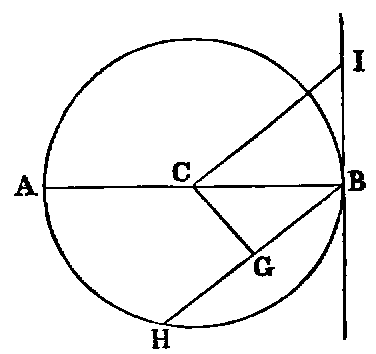
Dem.—1. Take any point I, and join it to the centre C. Then because the angle CBI is a right angle, CI2 is equal to CB2 + BI2 [I. xlvii.]; therefore CI2 is greater than CB2. Hence CI is greater than CB, and the point I [note on I., Def. xxxii.] is without the circle. In like manner, every other point in BI, except B, is without the circle. Hence, since BI meets the circle at B, but does not cut it, it must touch it.
2. To prove that BH, which is not perpendicular to AB, cuts the circle. Draw CG perpendicular to HB. Now BC2 is equal to CG2 + GB2. Therefore BC2 is greater than CG2, and BC is greater than CG. Hence [note on I., Def. xxxii.] the point G must be within the circle, and consequently the line BG produced must meet the circle again, and must therefore cut it.
This Proposition may be proved as follows:
At every point on a circle the tangent is perpendicular to the radius.
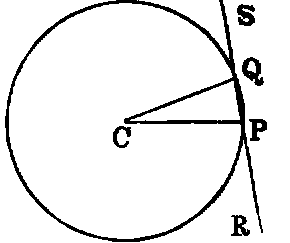
Let P and Q be two consecutive points on the circumference. Join CP, CQ, PQ; produce PQ both ways. Now since P and Q are consecutive points, PQ is a tangent (Def. iii.). Again, the sum of the three angles of the triangle CPQ is equal to two right angles; but the angle C is infinitely small, and the others are equal. Hence each of them is a right angle. Therefore the tangent is perpendicular to the
diameter.
Or thus: A tangent is a limiting position of a secant, namely, when the secant moves out until the two points of intersection with the circle become consecutive; but the line through the centre which bisects the part of the secant within the circle [iii.] is perpendicular to it. Hence, in the limit the tangent is perpendicular to the line from the centre to the point of contact.
Or again: The angle CPR is always equal to CQS; hence, when P and Q come together each is a right angle, and the tangent is perpendicular to the radius.