Theorem. The diameter (AB) is the greatest chord in a circle; and of the others, the chord (CD) which is nearer to the centre is greater than (EF) one more remote, and the greater is nearer to the centre than the less.
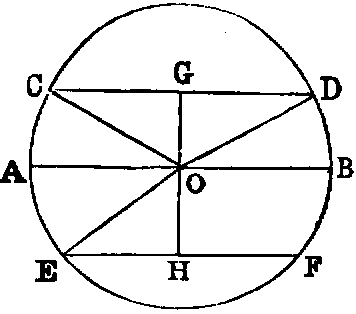
Dem.—1. Join OC, OD, OE, and draw the perpendiculars OG, OH; then because O is the centre, OA is equal to OC [I., Def. xxxii.], and OB is equal to OD. Hence AB is equal to the sum of OC and OD; but the sum of OC, OD is greater than CD [I. xx.]. Therefore AB is greater than CD.
2. Because the chord CD is nearer to the centre than EF, OG is less than OH; and since the triangles OGC, OHE are right-angled, we have OC2 = OG2 + GC2, and OE2 = OH2 + HE2; therefore OG2 + GC2 = OH2 + HE2; but OG2 is less than OH2; therefore GC2 is greater than HE2, and GC is greater than HE, but CD and EF are the doubles of GC and HE. Hence CD is greater than EF.
3. Let CD be greater than EF, it is required to prove that OG is less than OH.
As before, we have OG2 + GC2 equal to OH2 + HE2; but CG2 is greater than EH2; therefore OG2 is less than OH2. Hence OG is less than OH.