Theorem. In equal circles—1. equal chords (AB, CD) are equally distant from the centre. 2. chords which are equally distant from the centre are equal.
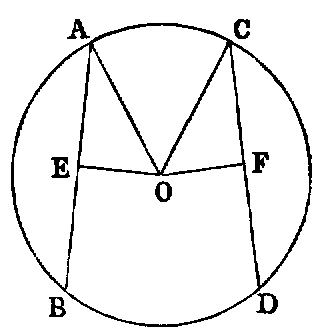
Dem.—1. Let O be the centre. Draw the perpendiculars OE, OF. Join AO, CO. Then because AB is a chord in a circle, and OE is drawn from the centre cutting it at right angles, it bisects it [iii.]; therefore AE is the half of AB. In like manner, CF is the half of CD; but AB is equal to CD (hyp.). Therefore AE is equal to CF [I., Axiom vii.]. And because E is a right angle, AO2 is equal to AE2 + EO2. In like manner, CO2 is equal to CF2 + FO2; but AO2 is equal to CO2. Therefore AE2 + EO2 is equal to CF2 + FO2; and AE2 has been proved equal to CF2. Hence EO2 is equal to FO2; therefore EO is equal to FO. Hence AB, CD are (Def. vi.) equally distant from the centre.
2. Let EO be equal to FO, it is required to prove AB equal to CD. The same construction being made, we have, as before, AE2 + EO2 equal to CF2 + FO2; but EO2 is equal to FO2 (hyp.). Hence AE2 is equal to CF2, and AE is equal to CF; but AB is double of AE, and CD double of CF. Therefore AB is equal to CD.
Exercise.
If a chord of given length slide round a fixed circle—1. the locus of its middle point is a circle; 2. the locus of any point fixed in the chord is a circle.