Theorem. Two circles cannot have double contact, that it, cannot touch each other in two points.
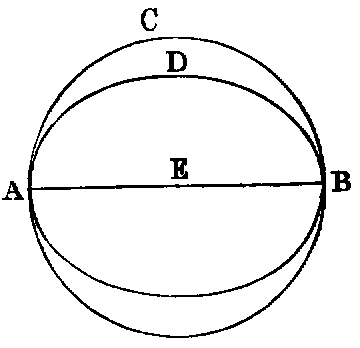
Dem.—1. If possible let two circles touch each other at two points A and B. Now since the two circles touch each other in A, the line joining their centres passes through A [xi.]. In like manner, it passes through B. Hence the centres and the points A, B are in one right line; therefore AB is a diameter of each circle. Hence, if AB be bisected in E, E must be the centre of each circle—that is, the circles are concentric—which [v.] is impossible.
2. If two circles touched each other externally in two distinct points, then [xii.] the line joining the centres should pass through each point, which is impossible.
Or thus: Draw a line bisecting AB at right angles. Then this line [i., Cor. 1] must pass through the centre of each circle, and therefore [xi. xii.] must pass through each point of contact, which is impossible. Hence two circles cannot have double contact.
This Proposition is an immediate inference from the theorem [xii., Cor. 1], that a point of contact counts for two intersections, for then two contacts would be equivalent to four intersections; but there cannot be more than two intersections [x.]. It also follows from Prop. xii., Cor. 2, that if two circles touch each other in a point A, they cannot have any other point common; hence they cannot touch again in B.