Theorem. If two circles (PCF, PDE) have external contact at any point P, the line joining their centres must pass through that point.
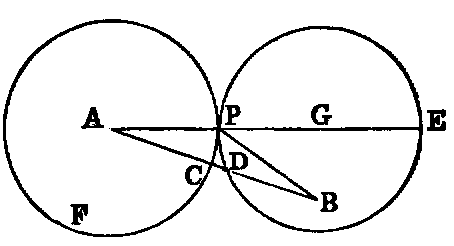
Dem.—Let A be the centre of one of the circles. Join AP, and produce it to meet the second circle again in E. I say the centre of the second circle is in the line PE. If not, let it be elsewhere, as at B. Join AB, intersecting the circles in C and D, and join BP. Now since A is the centre of the circle PCF, AP is equal to AC; and since B is the centre of the circle PDE, BP is equal to BD. Hence the sum of the lines AP, BP is equal to the sum of the lines AC, DB; but AB is greater than the sum of AC and DB; therefore AB is greater than the sum of AP, PB—that is, one side of a triangle greater than the sum of the other two–which [I. xx.] is impossible. Hence the centre of the second circle must be in the line PE. Let it be G, and we see that the line through the centres passes through the point P.
Or thus: Since BP is a line drawn from a point without the circle PCF to its circumference, and when produced does not pass through the centre, the circle whose centre is B and radius BP must cut the circle PCF in P [viii., Cor. 3]; but it touches it (hyp.) also in P, which is impossible. Hence the centre of the second circle must be in the line PE.
Observation.—Propositions xi, xii., may both be included in one enunciation as follows:—“If two circles touch each other at any point, the centres and that point are collinear.” And this latter Proposition is a limiting case of the theorem given in Proposition iii., Cor. 4, that “The line joining the centres of two intersecting circles bisects the common chord perpendicularly.”
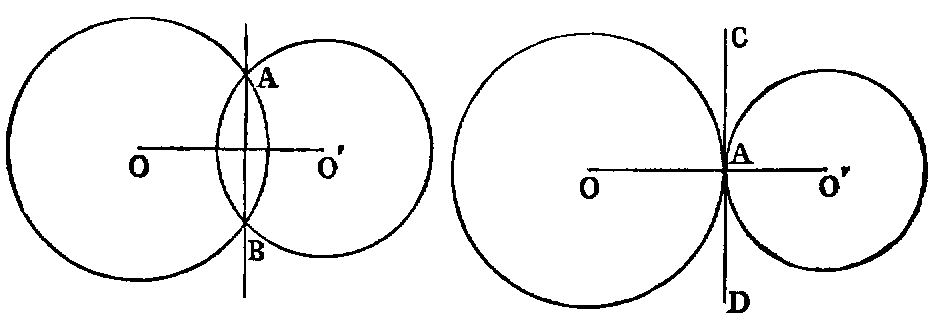
Suppose the circle whose centre is O and one of the points of intersection A to remain fixed, while the second circle turns round that point in such a manner that the second point of intersection B becomes ultimately consecutive to A; then, since the line OO′ always bisects AB, we see that when B ultimately becomes consecutive to A, the line OO′ passes through A. In consequence of the motion, the common chord will become in the limit a tangent to each circle, as in the second diagram.—Comberousse, Géométrie Plane, page 57.
Cor. 1.—If two circles touch each other, their point of contact is the union of two points of intersection. Hence a contact counts for two intersections.
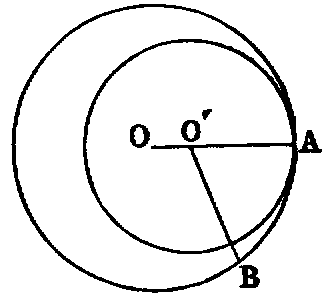
Cor. 2.—If two circles touch each other at any point, they cannot have any other common point. For, since two circles cannot have more than two points common [x.], and that the point of contact is equivalent to two common points, circles that touch cannot have any other point common. The following is a formal proof of this Proposition:—Let O, O′ be the centres of the two circles, A the point of contact, and let O′ lie between O and A; take any other point B in the circumference of O. Join O′B; then [vii.] O′B is greater than O′A; therefore the point C is outside the circumference of the smaller circle. Hence B cannot be common to both circles. In like manner, they cannot have any other common point but A.