Theorem. If one circle (CPD) touch another circle (APB) internally at any point P, the line joining the centres must pass through that point.
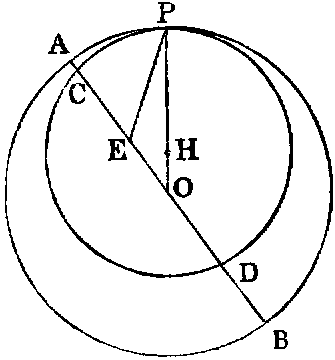
Dem.—Let O be the centre of APB. Join OP. I say the centre of the smaller circle is in the line OP. If not, let it be in any other position such as E. Join OE, EP, and produce OE through E to meet the circles in the points C, A. Now since E is a point in the diameter of the larger circle between the centre and A, EA is less than EP [vii. 2]; but EP is equal to EC (hyp.), being radii of the smaller circle. Hence EA is less than EC; which is impossible; consequently the centre of the smaller circle must be in the line OP. Let it be
H; then we see that the line joining the centres passes through the point P.
Or thus: Since EP is a line drawn from a point within the circle APB to the circumference, but not forming part of the diameter through E, the circle whose centre is E and radius EP cuts [vii., Cor. 2] APB in P, but it touches it (hyp.) also in P, which is impossible. Hence the centre of the smaller circle CPD must be in the line OP.