Theorem. If two circles have more than two points common, they must coincide.
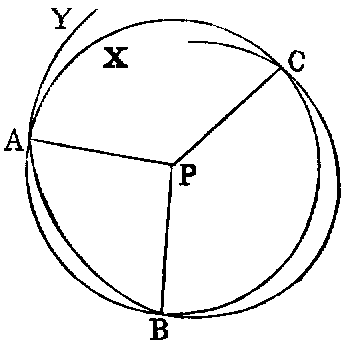
Dem.—Let X be one of the circles; and if possible let another circle Y have three points, A, B, C, in common with X, without coinciding with it. Find P, the centre of X. Join PA, PB, PC. Then since P is the centre of X, the three lines PA, PB, PC are equal to one another.
Again, since Y is a circle and P a point, from which three equal lines PA, PB, PC can be drawn to its circumference, P must be the centre of Y . Hence X and Y are concentric, which [v.] is impossible.
Cor.—Two circles not coinciding cannot have more than two points common. Compare I., Axiom x., that two right lines not coinciding cannot have more than one point common.