Theorem.
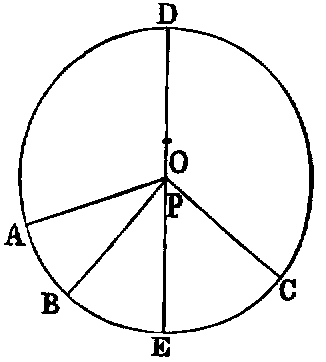
A point (P) within a circle (ABC), from which more than two equal lines (PA, PB, PC, &c.) can be drawn to the circumference, is the centre.
Dem.—If P be not the centre, let O be the centre. Join OP, and produce it to meet the circle in D and E; then DE is the diameter, and P is a point in it which is not the centre: therefore [vii.] only two equal lines can be drawn from P to the circumference; but three equal lines are drawn (hyp.), which is absurd. Hence P must be the centre.
Or thus: Since the lines AP, BP are equal, the line bisecting the angle APB [vii. Cor. 1] must pass through the centre: in like manner the line bisecting the angle BPC must pass through the centre. Hence the point of intersection of these bisectors, that is, the point P, must be the centre.