Problem. From a given point (P) without a given circle (BCD) to draw a tangent to the circle.
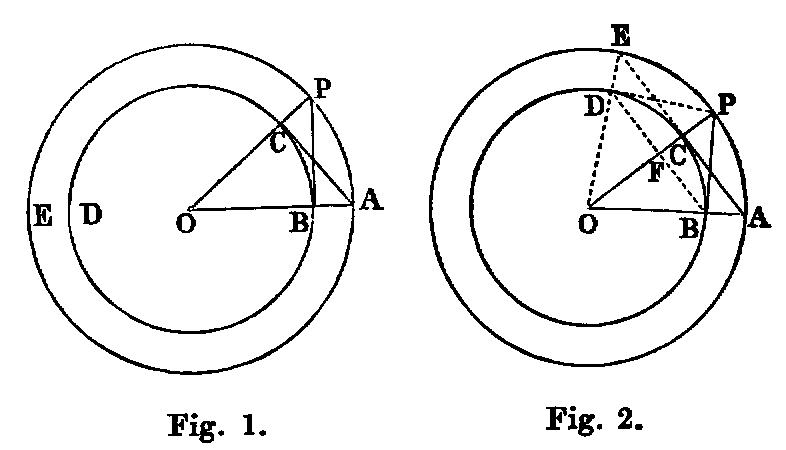
Sol.—Let O (fig. 1) be the centre of the given circle. Join OP, cutting the circumference in C. With O as centre, and OP as radius, describe the circle APE. Erect CA at right angles to OP. Join OA, intersecting the circle BCD in B. Join BP; it will be the tangent required.
Dem.—Since O is the centre of the two circles, we have OA equal to OP, and OC equal to OB. Hence the two triangles AOC, POB have the sides OA, OC in one respectively equal to the sides OP, OB in the other, and the contained angle common to both. Hence [I. iv.] the angle OCA is equal to OBP; but OCA is a right angle (const.); therefore OBP is a right angle, and [xvi.] PB touches the circle at B.
Cor.—If AC (fig. 2) be produced to E, OE joined, cutting the circle BCD in D, and the line DP drawn, DP will be another tangent from P.