Theorem. If a line (AB) be divided into any two parts (at C), the square on the whole line is equal to the sum of the rectangles contained by the whole and each of the segments (AC, CB).
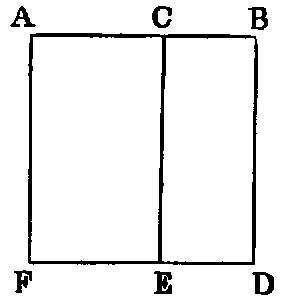
Dem.—On AB describe the square ABDF [I. xlvi.], and through C draw CE parallel to AF [I. xxxi.]. Now, since AB is equal to AF, the rectangle contained by AB and AC is equal to the rectangle contained by AF and AC; but AE is the rectangle contained by AF and AC. Hence the rectangle contained by AB and AC is equal to AE. In like manner the rectangle contained by AB and CB is equal to the figure CD. Therefore the sum of the two rectangles AB.AC, AB.CB is equal to the square on AB.
Or thus: AB = AC + CB, and AB = AB. Hence, multiplying, we get AB2 = AB.AC + AB.CB. This Proposition is the particular case of i. when the divided and undivided lines are equal, hence it does not require a separate Demonstration.