Theorem. If a line (AB) be divided into two segments (at C), the rectangle contained by the whole line and either segment (CB) is equal to the square on that segment together with the rectangle contained by the segments.
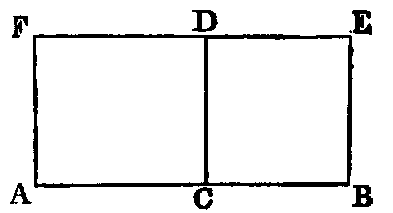
Dem.—On BC describe the square BCDE [I. xlvi.]. Through A draw AF parallel to CD: produce ED to meet AF in F. Now since CB is equal to CD, the rectangle contained by AC, CB is equal to the rectangle contained by AC, CD; but the rectangle contained by AC, CD is the figure AD. Hence the rectangle AC.CB is equal to the figure AD, and the square on CB is the figure CE. Hence the rectangle AC.CB, together with the square on CB, is equal to the figure AE.
Again, since CB is equal to BE, the rectangle AB.CB is equal to the rectangle AB.BE; but the rectangle AB.BE is equal to the figure AE. Hence the rectangle AB.CB is equal to the figure AE. And since things which are equal to the same are equal to one another, the rectangle AC.CB, together with the square on CB, is equal to the rectangle AB.CB.
Or thus: AB = AC + CB,
CB = CB.
Hence AB.CB = AC.CB + CB2.
Prop. iii. is the particular case of Prop. i., when the undivided line is equal to a segment of the divided line.