Theorem. If there be two lines (A, BC), one of which is divided into any number of parts (BD, DE, EC), the rectangle contained by the two lines (A, BC), is equal to the sum of the rectangles contained by the undivided line (A) and the several parts of the divided line.
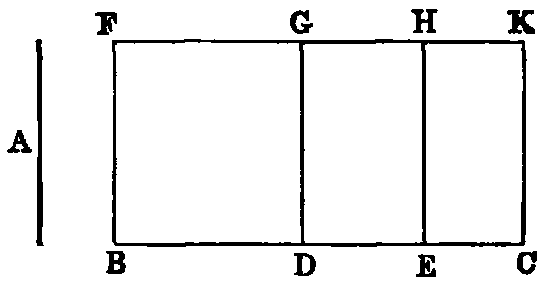
Dem.—Erect BF at right angles to BC [I., xi.] and make it equal to A. Complete the parallelogram BK (Def. v.). Through D, E draw DG, EH parallel to BF. Because the angles at B, D, E are right angles, each of the quadrilaterals BG, DH, EK is a rectangle. Again, since A is equal to BF (const.), the rectangle contained by A and BC is the rectangle contained by BF and BC (Def. v.); but BK is the rectangle contained by BF and BC. Hence the rectangle contained by A and BC is BK. In like manner the rectangle contained by A and BD is BG. Again, since A is equal to BF (const.), and BF is equal to DG [I. xxxiv.], A is equal to DG. Hence the rectangle contained by A and DE is the figure DH (Def. v.). In like manner the rectangle contained by A and EC is the figure EK. Hence we have the following identities:—
Rectangle contained by A and BD ≡ BG. ,, ,, A ,, DE ≡ DH. ,, ,, A ,, EC ≡ EK. ,, ,, A ,, BC ≡ BK.
But BK is equal to the sum of BG, DH, EK (I., Axiom ix.). Therefore the rectangle contained by A and BC is equal to the sum of the rectangles contained by A and BD, A and DE, A and EC.
If we denote the lines BD, DE, EC by a, b, c, the Proposition asserts that the rectangle contained by A, and a + b + c is equal to the sum of the rectangles contained by A and a, A and b, A and c, or, as it may be written, A(a + b + c) = Aa + Ab + Ac. This corresponds to the distributive law in multiplication, and shows that rectangles in Geometry, and products in Arithmetic and Algebra, are subject to the same rules.
Illustration.—Suppose A to be 6 inches; BD, 5 inches; DE, 4 inches; EC, 3 inches; then BC will be 12 inches; and the rectangles will have the following values:—
Rectangle A.BC = 6 × 12 = 72 square inches. ,, A.BD = 6 × 5 = 30 ,, ,, A.DE = 6 × 4 = 24 ,, ,, A.EC = 6 × 3 = 18 ,,
Now the sum of the three last rectangles, viz. 30, 24, 18, is 72. Hence the rectangle A.BC = A.BD + A.DE + A.EC.
The Second Book is occupied with the relations between the segments of a line divided in various ways. All these can be proved in the most simple manner by Algebraic Multiplication. We recommend the student to make himself acquainted with the proofs by this method as well as with those of Euclid. He will thus better understand the meaning of each Proposition.
Cor. 1.—The rectangle contained by a line and the difference of two others is equal to the difference of the rectangles contained by the line and each of the others.
Cor. 2.—The area of a triangle is equal to half the rectangle contained by its base and perpendicular.
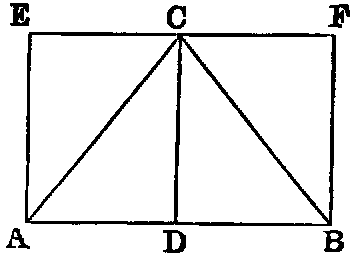
Dem.—From the vertex C let fall the perpendicular CD. Draw EF parallel to AB, and AE, BF each parallel to CD. Then AF is the rectangle contained by AB and BF; but BF is equal to CD. Hence AF = AB.CD; but [I. xli.] the triangle ABC is = half the parallelogram AF. Therefore the triangle ABC is = ½ AB.CD.