Theorem. If a right line (EF) intersecting two right lines (AB, CD) makes the exterior angle (EGB) equal to its corresponding interior angle (GHD), or makes two interior angles (BGH, GHD) on the same side equal to two right angles, the two right lines are parallel.
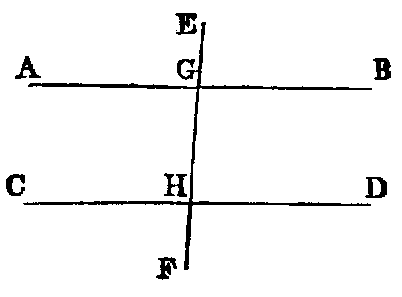
Dem.—1. Since the lines AB, EF intersect, the angle AGH is equal to EGB [xv.]; but EGB is equal to GHD (hyp.); therefore AGH is equal to GHD, and they are alternate angles. Hence [xxvii.] AB is parallel to CD.
2. Since AGH and BGH are adjacent angles, their sum is equal to two right angles [xiii.]; but the sum of BGH and GHD is two right angles (hyp.); therefore rejecting the angle BGH we have AGH equal GHD, and they are alternate angles; therefore AB is parallel to CD [xxvii.].