Theorem. If a right line (EF) intersect two parallel right lines (AB, CD), it makes—1. the alternate angles (AGH,GHD) equal to one another; 2. the exterior angle (EGB) equal to the corresponding interior angle (GHD); 3. the two interior angles (BGH, GHD) on the same side equal to two right angles.
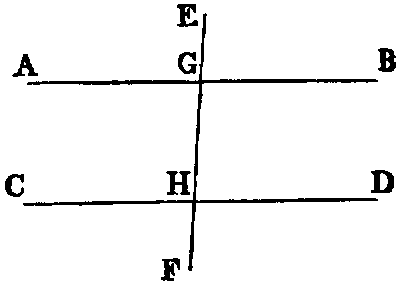
Dem.—If the angle AGH be not equal to GHD, one must be greater than the other. Let AGH be the greater; to each add BGH, and we have the sum of the angles AGH, BGH greater than the sum of the angles BGH, GHD; but the sum of AGH, BGH is two right angles; therefore the sum of BGH, GHD is less than two right angles, and therefore (Axiom xii.) the lines AB, CD, if produced, will meet at some finite distance: but since they are parallel (hyp.) they cannot meet at any finite distance. Hence the angle AGH is not unequal to GHD—that is, it is equal to it.
2. Since the angle EGB is equal to AGH [xv.], and GHD is equal to AGH (1), EGB is equal to GHD (Axiom i.).
3. Since AGH is equal to GHD (1), add HGB to each, and we have the sum of the angles AGH, HGB equal to the sum of the angles GHD, HGB; but the sum of the angles AGH, HGB [xiii.] is two right angles; therefore the sum of the angles BGH, GHD is two right angles.