Theorem. If a right line (EF) intersecting two right lines (AB, CD) makes the alternate angles (AEF, EFD) equal to each other, these lines are parallel.
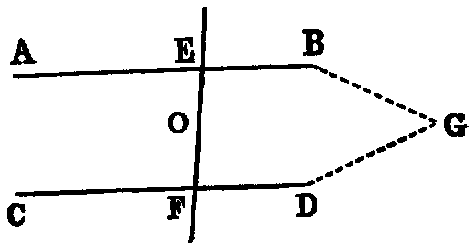
Dem.—If AB and CD are not parallel they must meet, if produced, at some finite distance: if possible let them meet in G; then the figure EGF is a triangle, and the angle AEF is an exterior angle, and EFD a non-adjacent interior angle. Hence [xvi.] AEF is greater than EFD; but it is also equal to it (hyp.), that is, both equal and greater, which is absurd. Hence AB and CD are parallel.
Or thus: Bisect EF in O; turn the whole figure round O as a centre, so that EF shall fall on itself; then because OE = OF, the point E shall fall on F; and because the angle AEF is equal to the angle EFD, the line EA will occupy the place of FD, and the line FD the place of EA; therefore the lines AB, CD interchange places, and the figure is symmetrical with respect to the point O. Hence, if AB, CD meet on one side of O, they must also meet on the other side; but two right lines cannot enclose a space (Axiom x.); therefore they do not meet at either side. Hence they are parallel.