Problem. In a given circle (ABCDEF) to inscribe a regular hexagon.
Sol.—Take any point A in the circumference, and join it to O, the centre of the given circle; then with A as centre, and AO as radius, describe the circle OBF, intersecting the given circle in the points B, F. Join OB, OF, and produce AO, BO, FO to meet the given circle again in the points D, E, C. Join AB, BC, CD, DE, EF, FA; ABCDEF is the required hexagon.
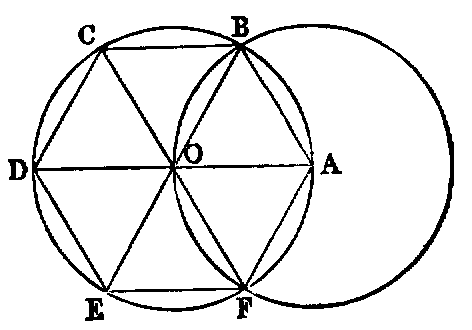
Dem.—Each of the triangles AOB, AOF is equilateral (see Dem., I. i.). Hence the angles AOB, AOF are each one-third of two right angles; therefore EOF is one-third of two right angles. Again, the angles BOC, COD, DOE are [I. xv.] respectively equal to the angles EOF, FOA, AOB. Therefore the six angles at the centre are equal, because each is one-third of two right angles. Therefore the six chords are equal [III. xxix.]. Hence the hexagon is equilateral.
Again, since the arc AF is equal to ED, to each add the arc ABCD; then the whole arc FABCD is equal to ABCDE; therefore the angles DEF, EFA which stand on these arcs are equal [III. xxvii.]. In the same manner it may be shown that the other angles of the hexagon are equal. Hence it is equiangular, and is therefore a regular hexagon inscribed in the circle.
Cor. 1.—The side of a regular hexagon inscribed in a circle is equal to the radius.
Cor. 2.—If three alternate angles of a hexagon be joined, they form an inscribed equilateral triangle.