Problem. To inscribe a regular polygon of fifteen sides in a given circle.
Sol.—Inscribe a regular pentagon ABCDE in the circle [xi.], and also an equilateral triangle AGH [ii.]. Join CG. CG is a side of the required polygon.
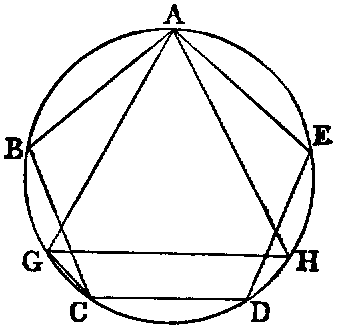
Dem.—Since ABCDE is a regular pentagon, the arc ABC is 2/5 ths of the circumference; and since AGH is an equilateral triangle, the arc ABG is 1/3 rd of the circumference. Hence the arc GC, which is the difference between these two arcs, is equal to 2/5 ths − 1/3 rd, or 1/15 th of the entire circumference; and therefore, if chords equal to GC [i.] be placed round the circle, we shall have a regular polygon of fifteen sides, or quindecagon, inscribed in it.
Scholium.—Until the year 1801 no regular polygon could be described by constructions employing the line and circle only, except those discussed in this Book, and those obtained from them by the continued bisection of the arcs of which their sides are the chords; but in that year the celebrated Gauss proved that if 2n + 1 be a prime number, regular polygons of 2n + 1 sides are inscriptable by elementary geometry. For the case n = 4, which is the only figure of this class except the pentagon for which a construction has been given, see Note at the end of this work.
Questions for Examination on Book IV.
1. What is the subject-matter of Book IV.?
2. When is one rectilineal figure said to be inscribed in another?
3. When circumscribed?
4. When is a circle said to be inscribed in a rectilineal figure?
5. When circumscribed about it?
6. What is meant by reciprocal propositions? Ans. In reciprocal propositions, to every line in one there corresponds a point in the other; and, conversely, to every point in one there corresponds a line in the other.
7. Give instances of reciprocal propositions in Book IV.
8. What is a regular polygon?
9. What figures can be inscribed in, and circumscribed about, a circle by means of Book IV.?
10. What regular polygons has Gauss proved to be inscriptable by the line and circle?
11. What is meant by escribed circles?
12. How many circles can be described to touch three lines forming a triangle?
13. What is the centroid of a triangle?
14. What is the orthocentre?
15. What is the circumcentre?
16. What is the polar circle?
17. When is the polar circle imaginary?
18. What is the “nine-points circle”?
19. Why is it so called?
20. Name the special nine points through which it passes.
21. What three regular figures can be used in filling up the space round a point? Ans. Equilateral triangles, squares, and hexagons.
22. If the sides of a triangle be 13, 14, 15, what are the values of the radii of its inscribed and escribed circles?
23. What is the radius of the circumscribed circle?
24. What is the radius of its nine-points circle?
25. What is the distance between the centres of its inscribed and circumscribed circles?
26. If r be the radius of a circle, what is the area of its inscribed equilateral triangle?—of its inscribed square?—its inscribed pentagon?—its inscribed hexagon?—its inscribed octagon?—its inscribed decagon?
27. With the same hypothesis, find the sides of the same regular figures.
Exercises on Book IV.
1. If a circumscribed polygon be regular, the corresponding inscribed polygon is also regular, and conversely.
2. If a circumscribed triangle be isosceles, the corresponding inscribed triangle is isosceles, and conversely.
3. If the two isosceles triangles in Ex. 2 have equal vertical angles, they are both equilateral.
4. Divide an angle of an equilateral triangle into five equal parts.
5. Inscribe a circle in a sector of a given circle.
6. The line DE is parallel to the base BC of the triangle ABC: prove that the circles described about the triangles ABC, ADE touch at A.
7. The diagonals of a cyclic quadrilateral intersect in E: prove that the tangent at E to the circle about the triangle ABE is parallel to CD.
8. Inscribe a regular octagon in a given square.
9. A line of given length slides between two given lines: find the locus of the intersection of perpendiculars from its extremities to the given lines.
10. If the perpendicular to any side of a triangle at its middle point meet the internal and external bisectors of the opposite angle in the points D and E; prove that D, E are points on the circumscribed circle.
11. Through a given point P draw a chord of a circle so that the intercept EF may subtend a given angle X.
12. In a given circle inscribe a triangle having two sides passing through two given points, and the third parallel to a given line.
13. Given four points, no three of which are collinear; describe a circle which shall be equidistant from them.
14. In a given circle inscribe a triangle whose three sides shall pass through three given points.
15. Construct a triangle, being given—
The radius of the inscribed circle, the vertical angle, and the perpendicular from the vertical angle on the base.
The base, the sum or difference of the other sides, and the radius of the inscribed circle, or of one of the escribed circles.
The centres of the escribed circles. 16. If F be the middle point of the base of a triangle, DE the diameter of the circumscribed circle which passes through F, and L the point where a parallel to the base through the vertex meets DE: prove DL.FE is equal to the square of half the sum, and DF.LE equal to the square of half the difference of the two remaining sides.
17. If from any point within a regular polygon of n sides perpendiculars be let fall on the sides, their sum is equal to n times the radius of the inscribed circle.
18. The sum of the perpendiculars let fall from the angular points of a regular polygon of n sides on any line is equal to n times the perpendicular from the centre of the polygon on the same line.
19. If R denotes the radius of the circle circumscribed about a triangle ABC, r, r′, r′′, r′′′ the radii of its inscribed and escribed circles, δ, δ′, δ′′ the perpendiculars from its circumcentre on the sides; μ, μ′, μ′′ the segments of these perpendiculars between the sides and circumference of the circumscribed circle, we have the relations—
r′ + r′′ + r′′′ = 4R + r, (1) μ + μ′ + μ′′ = 2R − r, (2) δ + δ′ + δ′′ = R + r. (3) The relation (3) supposes that the circumcentre is inside the triangle.
20. Through a point D, taken on the side BC of a triangle ABC, is drawn a transversal EDF, and circles described about the triangles DBF, ECD. The locus of their second point of intersection is a circle.
21. In every quadrilateral circumscribed about a circle, the middle points of its diagonals and the centre of the circle are collinear.
22. Find on a given line a point P, the sum or difference of whose distances from two given points may be given.
23. Find a point such that, if perpendiculars be let fall from it on four given lines, their feet may be collinear.
24. The line joining the orthocentre of a triangle to any point P, in the circumference of its circumscribed circle, is bisected by the line of collinearity of perpendiculars from P on the sides of the triangle.
25. The orthocentres of the four triangles formed by any four lines are collinear.
26. If a semicircle and its diameter be touched by any circle, either internally or externally, twice the rectangle contained by the radius of the semicircle, and the radius of the tangential circle, is equal to the rectangle contained by the segments of any secant to the semicircle, through the point of contact of the diameter and touching circle.
27. If ρ, ρ′ be the radii of two circles, touching each other at the centre of the inscribed circle of a triangle, and each touching the circumscribed circle, prove
1/ρ + 1/ρ′ = 2/r
and state and prove corresponding theorems for the escribed circles.
28. If from any point in the circumference of the circle, circumscribed about a regular polygon of n sides, lines be drawn to its angular points, the sum of their squares is equal to 2n times the square of the radius.
29. In the same case, if the lines be drawn from any point in the circumference of the inscribed circle, prove that the sum of their squares is equal to n times the sum of the squares of the radii of the inscribed and the circumscribed circles.
30. State the corresponding theorem for the sum of the squares of the lines drawn from any point in the circumference of any concentric circle.
31. If from any point in the circumference of any concentric circle perpendiculars be let fall on all the sides of any regular polygon, the sum of their squares is constant.
32. For the inscribed circle, the constant is equal to 3n/2 times the square of the radius.
33. For the circumscribed circle, the constant is equal to n times the square of the radius of the inscribed circle, together with ½ n times the square of the radius of the circumscribed circle.
34. If the circumference of a circle whose radius is R be divided into seventeen equal parts, and AO be the diameter drawn from one of the points of division (A), and if ρ1, ρ2……ρ8 denote the chords from O to the points of division, A1, A2……A8 on one side of AO, then
ρ₁ρ₂ρ₃ρ₈ = R⁴; and ρ₃ρ₅ρ₆ρ₇ = R⁴. —Catalan.
Dem.—Let the supplemental chords corresponding to ρ1, ρ2, &c., be denoted by r1, r2, &c.; then [III. xxxv. Ex. 2], we have
ρ1r1 = Rr2, ρ2r2 = Rr4, ρ4r4 = Rr8, ρ8r8 = Rr1, Hence ρ1ρ2ρ4ρ8 = R4. And it may be proved in the same manner that
ρ1ρ2ρ3ρ4ρ5ρ6ρ7ρ8 = R8. Therefore ρ3ρ5ρ6ρ7 = R4. 35. If from the middle point of the line joining any two of four concyclic points a perpendicular be let fall on the line joining the remaining two, the six perpendiculars thus obtained are concurrent.
36. The greater the number of sides of a regular polygon circumscribed about a given circle, the less will be its perimeter.
37. The area of any regular polygon of more than four sides circumscribed about a circle is less than the square of the diameter.
38. Four concyclic points taken three by three determine four triangles, the centres of whose nine-points circles are concyclic.
39. If two sides of a triangle be given in position, and if their included angle be equal to an angle of an equilateral triangle, the locus of the centre of its nine-points circle is a right line.
40. If, in the hypothesis and notation of Ex. 34, α, β denote any two suffixes whose sum is less than 8, and of which α is the greater,
ρα·ρβ = R(ρ(α−β) + ρ(α+β))
For instance, ρ1ρ4 = R(ρ3 + ρ5) [III. xxxv., Ex. 7].
In the same case, if the suffixes be greater than 8,
ρα·ρβ = R(ρ(α−β) − ρ(17−α−β))
For instance, ρ8ρ2 = R(ρ6 − ρ7) [III. xxxv., Ex. 6].
41. Two lines are given in position: draw a transversal through a given point, forming with the given lines a triangle of given perimeter.
42. Given the vertical angle and perimeter of a triangle, construct it with either of the following data: 1. The bisector of the vertical angle; 2. the perpendicular from the vertical angle on the base; 3. the radius of the inscribed circle.
43. In a given circle inscribe a triangle so that two sides may pass through two given points, and that the third side may be a maximum or a minimum.
44. If s be the semiperimeter of a triangle, r′, r′′, r′′′, the radii of its escribed circles,
r′r″ + r″r‴ + r‴r′ = s²
45. The feet of the perpendiculars from the extremities of the base on either bisector of the vertical angle, the middle point of the base, and the foot of the perpendicular from the vertical angle on the base, are concyclic.
46. Given the base of a triangle and the vertical angle; find the locus of the centre of the circle passing through the centres of the escribed circles.
47. The perpendiculars from the centres of the escribed circles of a triangle on the corresponding sides are concurrent.
48. If AB be the diameter of a circle, and PQ any chord cutting AB in O, and if the lines AP, AQ intersect the perpendicular to AB at O, in D and E respectively, the points A, B, D, E are concyclic.
49. If the sides of a triangle be in arithmetical progression, and if R, r be the radii of the circumscribed and inscribed circles; then 6Rr is equal to the rectangle contained by the greatest and least sides.
50. Inscribe in a given circle a triangle having its three sides parallel to three given lines.
51. If the sides AB, BC, &c., of a regular pentagon be bisected in the points A′, B′, C′, D′, E′, and if the two pairs of alternate sides, BC, AE; AB, DE, meet in the points A′′, E′′, respectively, prove
△A″AE″ − △A′AE′ = pentagon A′B′C′D′E′
52. In a circle, prove that an equilateral inscribed polygon is regular, and also an equilateral circumscribed polygon, if the number of sides be odd.
53. Prove also that an equiangular circumscribed polygon is regular, and an equiangular inscribed polygon, if the number of sides be odd.
54. The sum of the perpendiculars drawn to the sides of an equiangular polygon from any point inside the figure is constant.
55. Express the sides of a triangle in terms of the radii of its escribed circles.