Problem. To describe a circle about a regular pentagon (ABCDE).
Sol.—Bisect two adjacent angles A, B by the lines AO, BO. Then O, the point of intersection of the bisectors, is the centre of the required circle.
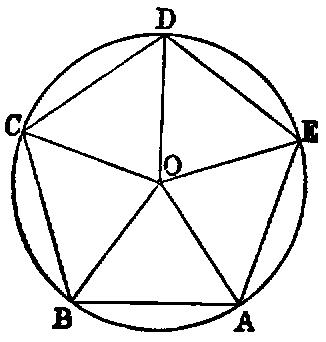
Dem.—Join OC, OD, OE. Then the triangles ABO, CBO have the side AB equal to BC (hyp.), BO common, and the angle ABO equal to CBO (const.). Hence the angle BAO is equal to BCO [I. iv.]; but the angle BAE is equal to BCD (hyp.); and since BAO is half BAE (const.), BCO is half BCD. Hence CO bisects the angle BCD. In like manner it may be proved that DO bisects CDE, and EO the angle DEA. Again, because the angle EAB is equal to ABC, their halves are equal. Hence OAB is equal to OBA; therefore [I. vi.] OA is equal to OB. In like manner the lines OC, OD, OE are equal to one another and to OA. Therefore the circle described with O as centre, and OA as radius, will pass through the points B, C, D, E, and be described about the pentagon.
In the same manner a circle may be described about any regular polygon.
Propositions xiii., xiv. are particular cases of the following theorem:—
“A regular polygon of any number of sides has one circle inscribed in it, and another described about it, and both circles are concentric.”